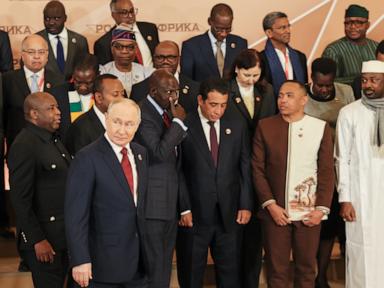
Vladimir Putin’s latest summit with African leaders in Moscow is not a nostalgic revival of Soviet-era solidarity. It is a calculated, transactional survival strategy designed to secure raw materials, bypass Western sanctions, and build a diplomatic firewall at the United Nations. While state media broadcasts images of handshakes and grand declarations of multipolar cooperation, the actual mechanics of Russia-Africa ties rely on regime security, discounted grain, nuclear energy contracts, and mineral extraction rights. For African heads of state, Moscow offers an alternative to Western lectures on governance, even if the promised Russian investment capital rarely materializes at scale.
The pageantry in Moscow masks a stark economic asymmetry. Russia’s total trade volume with the entire African continent hovers around $20 billion to $25 billion annually. Compare that to China, which routinely clears over $250 billion, or the European Union, which remains Africa’s largest trading partner by a wide margin. Moscow cannot outspend Beijing, nor can it match the developmental grants of Brussels and Washington. Instead, the Kremlin has learned to punch far above its economic weight by targeting specific, high-impact sectors where Western competitors are either hesitant to tread or bogged down by regulatory oversight.
The Security-for-Resources Pipeline
To understand why African leaders fly to Moscow, look at the regimes facing active insurgencies. In the Sahel—specifically Mali, Burkina Faso, and Niger—military juntas have systematically expelled French troops and United Nations peacekeepers, replacing them with Russian mercenaries. Following the death of Yevgeny Prigozhin, the Kremlin folded the remnants of the Wagner Group directly into the Russian Ministry of Defense under a rebranded entity known as the Africa Corps.
This structural shift matters. Wagner operated with plausible deniability, allowing Moscow to distance itself from human rights abuses while reaping the financial rewards. The Africa Corps removes the mask. It is an official instrument of the Russian state, offering regime survival packages to vulnerable governments.
The transaction is straightforward. Moscow provides praetorian guards, air defense systems, drone operators, and disinformation campaigns aimed at neutralizing domestic opposition. In exchange, Russian state-affiliated companies secure preferential access to gold mines, uranium deposits, and diamond concessions. For a junta leader worried about surviving the next six months, a Russian security guarantee is infinitely more valuable than a ten-year Western infrastructure loan tied to democratic reforms.
Consider a hypothetical example of how this plays out on the ground. A transitional government in a landlocked West African nation faces a worsening militant threat in its northern provinces. Western partners freeze military aid following a coup, citing constitutional violations. Moscow steps in within weeks. It deploys two hundred specialized contractors and a handful of helicopter gunships. The immediate cost to the host nation is paid not in hard currency, which its central bank lacks, but through an exclusive extraction license for a medium-sized gold mine. The contractors secure the capital, the junta stays in power, and the extracted bullion flows out through opaque supply chains in the Middle East to help Russia offset the freeze on its own central bank reserves.
Weaponizing Food and Fertilizer
Security is only half the equation. The second pillar of Moscow’s strategy rests on basic commodities that African nations cannot survive without—specifically wheat and fertilizer.
Before the full-scale invasion of Ukraine, Russia and Ukraine together supplied roughly forty percent of Africa’s wheat imports. When the conflict disrupted Black Sea shipping lanes, global food prices spiked, triggering severe economic distress across North and East Africa. Moscow quickly realized that food security was a potent diplomatic tool.
By offering free or heavily discounted grain shipments to select, compliant nations, the Kremlin casts itself as a savior against global inflation—conveniently omitting the fact that its own military actions triggered the crisis in the first place. When Russia withdrew from the Black Sea Grain Initiative, Putin immediately promised tens of thousands of tons of free grain to six specific African countries, all of which had either supported Moscow at the United Nations or hosted Russian military contractors.
Fertilizer plays an equally critical role. Russia is the world's largest exporter of fertilizers, a vital input for African agriculture. Despite Western sanctions carving out exemptions for agricultural products, secondary sanctions on Russian shipping, insurance, and banking initially slowed exports. Moscow used these logistical bottlenecks to argue that Western sanctions were starving the Global South. By smoothing out direct state-to-state supply routes for potash and nitrogen fertilizers, Russian diplomats buy immense goodwill among African agriculture ministries, translating directly into diplomatic neutrality when Ukraine-related resolutions hit the floor of the UN General Assembly.
Nuclear Diplomacy and Debt Traps
While Western nations focus on green energy transitions and solar micro-grids, Russia’s state nuclear corporation, Rosatom, is aggressively pitching full-scale nuclear power plants across Africa. Energy poverty remains the single biggest bottleneck to African industrialization, with hundreds of millions of people lacking reliable access to electricity.
Rosatom offers a turnkey solution that no Western company can currently match. It does not just sell the reactor. It provides the financing, builds the facility, trains the local workforce, supplies the uranium fuel, and manages the nuclear waste.
The Long-Term Lock-In
The catch lies in the financing. These projects, often valued in the tens of billions of dollars, are backed by Russian state loans. Once a country breaks ground on a Rosatom facility—such as Egypt’s massive El Dabaa nuclear power plant—it enters a sixty-to-eighty-year technological and financial marriage with Moscow.
- Fuel Dependency: The reactors are engineered specifically for Russian-fabricated fuel assemblies, making it nearly impossible to switch suppliers later.
- Sovereign Debt: The repayment schedules stretch across decades, giving Moscow permanent financial weight over the host nation’s treasury.
- Geopolitical Alignment: A government reliant on Russian engineers to keep its national power grid running is unlikely to vote against the Kremlin in international forums.
Even for countries that cannot afford a full-scale power plant, Rosatom signs memoranda of understanding for smaller research reactors and nuclear medicine centers. These agreements serve as diplomatic foot-in-the-door mechanisms, establishing permanent Russian bureaucratic presence inside African science and energy ministries.
The Information War and Anti-Colonial Rhetoric
Walk through the streets of Bamako, Ouagadougou, or Bangui, and you will see Russian flags alongside local banners. This sentiment did not happen organically. It is the product of a sustained, low-cost information campaign executed through local radio networks, Telegram channels, and state-backed media outlets like RT and Sputnik.
Moscow’s messaging is tailored specifically to exploit the lingering resentments of European colonialism. Western nations—particularly France, the former colonial power in much of West and Central Africa—make easy targets. Russian information operatives amplify every Western diplomatic misstep, framing European and American foreign policy as an ongoing attempt to subjugate African sovereignty.
Russia, by contrast, markets itself as the only major power that never held African colonies. Kremlin diplomats constantly remind their counterparts of the Soviet Union’s historical support for African liberation movements against apartheid and European rule. It is a selective reading of history that ignores Moscow’s current extractive practices, yet it resonates deeply with younger demographics frustrated by stagnant economies and perceived Western hypocrisy.
When Western officials lecture African leaders on human rights, press freedom, or LGBTQ+ rights, they inadvertently strengthen Moscow’s hand. Putin presents Russia as a defender of traditional values and absolute state sovereignty. To an authoritarian leader facing domestic unrest, the Kremlin’s promise of non-interference in internal affairs sounds like music.
The Reality Gap in Moscow's Promises
Despite the high-profile summits and aggressive rhetoric, the Russia-Africa relationship suffers from a massive execution problem. Moscow is skilled at disruption, security guarantees, and symbolic diplomacy, but it is terrible at broad-based economic development.
Take a hard look at the numbers from previous summits. In 2019, Putin hosted the inaugural Russia-Africa Summit in Sochi, promising to double trade volume within five years. Instead, trade stagnated, distorted heavily by Russian exports and minimal African imports. African nations buy weapons, wheat, and refined petroleum from Russia, while selling very little back. This massive trade imbalance drains African foreign currency reserves without creating local manufacturing jobs or transferring industrial technology.
Furthermore, Russia’s own economy is currently locked in a wartime footing. Its industrial base is consumed by the demands of the conflict in Ukraine. Factories that once produced tanks and air defense systems for export to Algeria, Egypt, and Angola are now working three shifts just to replace equipment lost on the Ukrainian front lines. As a result, Russia’s share of the global arms market—historically its strongest export sector in Africa—has plummeted. African militaries that rely on Soviet-era hardware are suddenly facing severe shortages of spare parts and ammunition, forcing them to look toward China, Turkey, or India to fill the void.
How African Leaders Play the Great Power Game
It is a mistake to view African leaders attending the Moscow summit as passive pawns being manipulated by the Kremlin. Most are seasoned political operators executing a deliberate strategy of multi-alignment.
By showing up in Moscow, shaking Putin’s hand, and signing non-binding memoranda of understanding, African presidents send an unmistakable signal to Washington, Brussels, and Beijing: they have options. In an era of renewed great power competition, the threat of pivoting toward Russia is an effective way to extract better terms, faster loan approvals, and fewer political conditions from Western institutions.
Leaders like South Africa’s Cyril Ramaphosa or Egypt’s Abdel Fattah el-Sisi navigate these waters with cold precision. They maintain deep intelligence and trade ties with the United States and Europe while simultaneously participating in BRICS summits and hosting Russian naval vessels. They refuse to choose a side because neutrality maximizes their diplomatic value.
For the smaller, isolated juntas of the Sahel, the calculus is narrower, driven by immediate survival rather than grand strategy. Yet even there, cracks are beginning to show. In northern Mali, the combination of Malian troops and Russia’s Africa Corps recently suffered devastating ambushes at the hands of Tuareg separatists and jihadist factions. The myth of Russian military invincibility, carefully cultivated by Kremlin propagandists, is colliding with the harsh operational realities of counterinsurgency warfare in the Sahara.
The Limits of Transactional Diplomacy
Moscow’s current push in Africa is built on opportunism. It thrives in governance vacuums, exploits post-colonial grievances, and trades weapons for rocks. In the short term, this model works. It breaks Russia’s diplomatic isolation, secures vital UN abstentions, and generates off-the-books revenue to sustain the Russian state apparatus.
However, transactional diplomacy has a hard ceiling. You cannot build a sustainable, century-long geopolitical alliance solely on mercenaries, free grain, and anti-Western grievances. Eventually, African populations demand tangible economic growth, functioning infrastructure, and genuine security—areas where Moscow simply lacks the financial capital and industrial capacity to deliver. Until the Kremlin can offer more than survival tools for beleaguered elites, its influence across the continent will remain loud, disruptive, and fundamentally fragile.