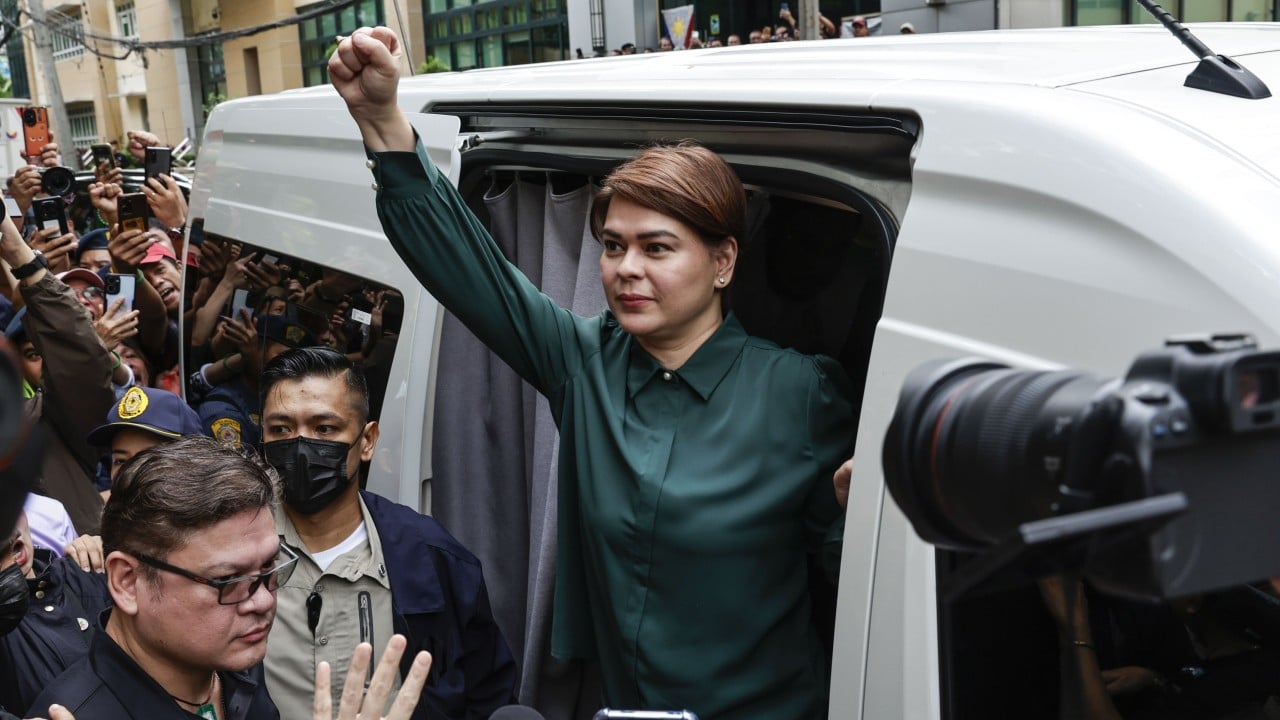
The marriage of convenience that birthed the UniTeam coalition in Manila was never built on shared ideology. It was a transactional marriage of two political heavyweights designed solely to sweep the 2022 elections. Now, the wreckage of that union litters the halls of Malacañang Palace. President Ferdinand Marcos Jr. and Vice President Sara Duterte are locked in an escalating, existential war for control over the future of the Philippine republic. This fallout has shattered the illusion of elite consensus and paralyzed governance across the archipelago.
To understand how a landslide victory dissolved into bitter institutional warfare, one must look past the daily theatrical outbursts and examine the fundamental divergence in statecraft. When Rodrigo Duterte handed over the presidency, his political machine expected continuity on hardline security enforcement and a cozy, accommodating posture toward Beijing. Instead, Marcos Jr. pivoted sharply. He re-anchored Philippine foreign policy toward Washington and its regional security partners, systematically dismantling the diplomatic framework his predecessor spent six years constructing.
This pivot created an intolerable friction point. Vice President Sara Duterte, retaining the mantle of the Duterte family dynasty based in Davao, found herself increasingly alienated within the administration. Her exit from the cabinet was not merely a personal falling out; it was the formal opening of hostilities. Public insults soon graduated to institutional blockades. Congressional allies of the president began stripping away confidential funds allocated to the vice president's office, while Duterte loyalists launched blistering counter-attacks questioning the administration's competence and stability.
The fissure deepened dramatically as international legal pressures closed in on the former president. The specter of International Criminal Court proceedings regarding the bloody war on drugs waged under Rodrigo Duterte hung over the family like a guillotine. Rather than offering protection, the Marcos administration displayed a calculated coldness, allowing legislative inquiries and political pressures to mount. In response, the Duterte camp ratcheted up its rhetoric, culminating in impeachment threats, open challenges to presidential authority, and an ideological polarization that divided the country's military and security bureaucracy.
Beneath the domestic political theater lies a critical foreign policy battleground. The South China Sea has become the crucible where this domestic feud manifests dangerously. While Marcos Jr. doubles down on transparency initiatives and joint patrols with Western allies to counter Beijing's maritime aggression, the vice president has maintained a studied, conspicuous neutrality. She has publicly questioned the utility of American security guarantees, echoing Beijing's talking points that external partnerships only provoke escalation. This internal contradiction hobbles the nation's deterrent posture. Foreign capitals watch Manila anxiously, uncertain whether a government at war with itself can maintain a coherent geopolitical stance.
The upcoming electoral cycles loom over this conflict as a zero-sum judgment day. Both political dynasties view legislative control not as a tool for legislative output, but as a protective shield against future prosecution and a springboard for the next presidential succession. Constitutional reform initiatives pushed by allies of the president have stalled as the two factions deploy every mechanism of state power to neutralize each other.
Ordinary citizens bear the direct cost of this distraction. Inflation bites, infrastructure projects stall amid administrative paralysis, and vital bureaucratic reforms take a backseat to survival politics. The political dynasties are too consumed by their high-stakes poker game to notice the structural vulnerabilities compounding beneath them.
Marcos Jr. may have successfully marginalized his rival's institutional footprint for the moment, but the Duterte brand remains deeply entrenched in the national consciousness. The battle lines are drawn across regional loyalties, institutional boundaries, and differing visions of national sovereignty. There is no middle ground left in Manila, and the winner of this protracted struggle will dictate not just the fate of two political families, but the trajectory of Philippine democracy for a generation.


