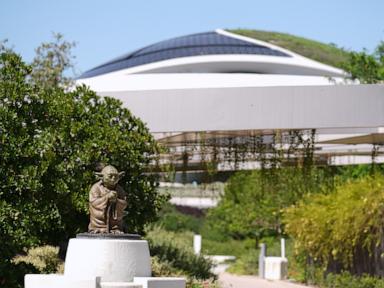
George Lucas spent decades funding his cinematic universes from his own pocket, retaining creative control while traditional studio executives tried to clip his wings. Now, he is doing the exact same thing with physical architecture. The Lucas Museum of Narrative Art in Los Angeles represents a billion-dollar monument to storytelling that blurs the lines between commercial illustration, fine art, and cinematic history. When the museum finally opens its doors at Exposition Park, visitors will not walk into a quiet, sterile white-cube gallery meant only for high-society connoisseurs. They will enter a futuristic, flowing structure designed by Ma Yansong that houses everything from Norman Rockwell oil paintings to original storyboards for Star Wars. But behind the striking facade lies a complex battle over what society values as cultural heritage.
The Battle Over High Culture and Commercial Illustration
Traditional museum directors have spent years quietly rolling their eyes at the enterprise. They view it as a glorified fan shrine, an expensive ego project funded by box-office billions generated from a galaxy far, far away. That criticism misses the deeper structural shift happening within the cultural sector. For centuries, fine art academies drew a rigid line between elite canvas work and popular illustration, dismissing comic books, pulp magazine covers, and digital concept art as lesser commercial trades. Lucas refused to acknowledge that boundary. His collection treats a J.C. Leyendecker Saturday Evening Post cover with the same curatorial reverence usually reserved for Renaissance portraiture.
This ideological friction exposes a deep insecurity within traditional institutions. For generations, gatekeepers decided what belonged on museum walls based on scarcity, patronage, and elite taste. Narrative art operates under an entirely different logic. It was created for mass consumption, reproduced on cheap paper or projected on silver screens to move millions of ordinary people. By forcing these two worlds into the same building, the new institution challenges the very definition of artistic worth. It asks why a painting commissioned to sell an automobile or a soft drink deserves any less respect than one commissioned by a church or a monarch.
Political Warfare and the Long Road to Los Angeles
Getting to this point required enduring political warfare that spanned multiple cities. Chicago originally seemed like the natural landing spot, a midwestern anchor for a collection that celebrates populist American imagery. Neighborhood activists and lakefront protection groups blocked the lakefront site through relentless legal challenges, treating the proposed museum as an unwarranted encroachment on public green space. San Francisco faced similar bureaucratic paralysis, bogged down by local zoning debates and historic preservation fights.
Los Angeles finally stepped in, offering land at Exposition Park next to the Los Angeles Memorial Coliseum and the Natural History Museum. The relocation saved the project from permanent limbo, but the decade-long delay inflated costs and turned public anticipation into a mixture of cynicism and awe. The entire ordeal serves as a cautionary tale for any billionaire attempting to gift a major civic amenity to an urban center. Public land is precious, and communities are no longer willing to rubber-stamp vanity projects without ironclad guarantees regarding public access and architectural harmony.
Architecture as an Organic Spacecraft
The architecture itself commands immediate attention before a single ticket is scanned. MAD Architects conceived a building that looks less like a traditional museum and more like an organic, metallic spacecraft hovering over South Los Angeles. Its sweeping curves and undulating rooflines contrast sharply with the neoclassical columns of the neighboring institutions. This visual rebellion is intentional. Lucas wanted a structure that mirrors the fluidity of imagination rather than the rigid boxes where history is usually stored.
Inside, the sweeping public plazas and elevated gardens are designed to invite the surrounding neighborhood in, attempting to heal the historic disconnect between massive cultural institutions and the local communities that host them. The engineering required to achieve these dynamic curves pushed construction firms to their limits, involving complex steel framing and custom composite panels. Whether this futuristic shell ages gracefully against the smog and sun of Southern California remains to be seen, but it immediately establishes the campus as a bold architectural landmark.
Curation Without Historical Silos
Curating a collection of narrative art creates unique ideological hurdles. How do you exhibit a piece created for the inside of a cheap sci-fi paperback alongside a priceless oil painting commissioned for a luxury magazine? The institution solves this by focusing on the mechanics of visual storytelling rather than medium superiority. Visitors tracing the evolution of visual narrative will see how nineteenth-century history painters solved compositional problems in ways that directly influenced twentieth-century concept artists working on blockbuster films.
The galleries do not separate art into neat historical silos. Instead, they present a continuous lineage where an anonymous pulp illustrator from 1930 shares DNA with a digital matte painter working on modern computer-generated environments. The cornerstone of the public fascination remains the massive archive of cinematic memorabilia. Original costumes, hand-drawn production designs, and conceptual maquettes from Industrial Light and Magic fill dedicated wings. Critics often point to these artifacts as proof that the institution is little more than a corporate marketing extension for Lucasfilm. Yet, dismissing these items ignores how filmmaking became the dominant narrative medium of the twentieth century.
The Economics of a Personal Monument
Financial sustainability remains the ultimate test for any private museum of this scale, especially one built without major government subsidies. George Lucas and his wife, Mellody Hobson, have personally underwritten the vast majority of the construction costs and initial endowment, creating a war chest that shields the institution from immediate revenue pressures. However, operating a facility of this magnitude requires a massive, ongoing cash flow. Ticket sales, specialized exhibitions, and merchandising will have to pull their weight.
The surrounding community will judge whether the enterprise acts as an economic engine for local businesses or an isolated fortress that charges exorbitant admission fees. Education and community outreach programs form the backbone of the institution's public relations strategy, and for good reason. South Los Angeles has historically been underserved by major cultural investments that cater to local youth rather than elite tourists. The museum has promised extensive educational spaces, free programs for local schools, and pathways for young artists to learn digital and traditional media.
Legacy in the Shadow of the Freeway
The internal culture of the museum workforce also reflects the tension between corporate entertainment legacy and traditional fine arts administration. Curators hired from elite university programs and traditional art museums now find themselves working alongside archivists who spent their careers preserving movie props and digital asset libraries. This cross-pollination of disciplines creates friction. Traditionalists worry about dilution of standards, while entertainment veterans argue that academic institutions are too out of touch with popular culture to remain relevant.
As the crowds pour through the turnstiles and the initial media hype settles into daily operational reality, the true test of the institution will emerge. Will it become a living center for the study of how humanity tells stories visually, or will it settle into a comfortable tourist attraction for aging cinephiles seeking nostalgia? The raw materials inside the building are world-class. The financial backing is bulletproof. The architectural statement is unmistakable. The doors are open, and the massive metallic curves of the building now reflect the harsh Southern California sun, drawing the gaze of millions passing by on the freeway.