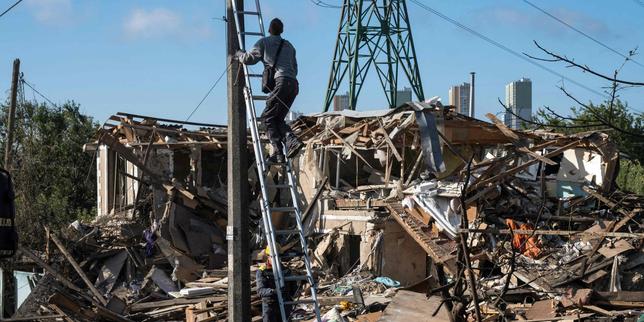
The turbine halls do not bleed; they simply grow cold. In a nondescript, classified district hidden somewhere across the Ukrainian landscape, the skeleton of a thermal power station stands open to the grey November sky. Where a reinforced roof once protected banks of high-pressure steam turbines, twisted sheets of corrugated steel now hang like tattered ribbons. Stray dogs pick their way across mounds of pulverized concrete and soot-stained copper wiring.
This is the grim frontline of a quieter, far more methodical campaign. While geopolitical headlines obsess over territorial gains and muddy trenches along the eastern contact line, a devastating war of attrition is playing out hundreds of feet above the ground and deep within the electronic veins of the national energy grid. Moscow has shifted its operational weight from scattered opportunistic shellings to a synchronized, high-volume blitz targeting the absolute prerequisites of modern human survival. Recently making headlines in related news: Why Permanent Military Occupations Guarantee Endless Chaos.
Kiev officials point to a staggering escalation in volume. Private energy operators like DTEK have logged dozens of heavy, multi-vector strikes packed into consecutive 72-hour windows—a density of ordnance that dwarfs the scattered attacks of previous years. This is not military infrastructure in the traditional sense of barracks or ammunition dumps. This is the plumbing, the high-voltage transformers, the district heating boilers, and the massive sub-station switching yards that transform high-tension current into domestic light and warmth.
The Mathematics of Substation Destruction
To understand why these strikes are so uniquely punishing, one must look past the fiery flashes captured on social media and examine the underlying engineering vulnerabilities. Ukraine inherited a centralized Soviet-era power grid. It was built with a fatal architectural logic: massive generation nodes—huge thermal plants, hydroelectric giants, and nuclear facilities—pumping electricity across vast distances through high-voltage transmission lines into centralized urban distribution rings. Additional insights on this are detailed by NPR.
By targeting the intermediate substations rather than just the generation plants themselves, planners in Moscow discovered an efficient shortcut. A single heavy ballistic missile or a swarm of precision drones targeting an open-air switchyard can instantly sever entire regional links, isolating power even when the distant generators are technically capable of producing it.
Energy executives note a grim shift toward saturation tactics. Instead of spreading strikes across weeks, current operations concentrate dozens of cruise missiles, ballistic assets, and jet-powered drones onto single facilities until defenses are saturated and physical structures are pulverized beyond patch-work repair. When a 750-kilovolt transformer bank built over decades takes a direct hit from multiple high-explosive warheads, it cannot be fixed with spare parts from a hardware store. It requires specialized, custom-built heavy engineering components that take months or years to manufacture globally.
The Human Cost Behind the Load Shedding
Statistics about gigawatts lost and transformers destroyed obscure the raw human reality on the ground. In the neighborhoods surrounding these battered industrial monuments, life has degraded into a grueling logistical endurance test.
Lioudmyla, a pensioner living in a damp apartment block near one of the central thermal hubs, describes the rhythm of her days with flat exhaustion. When the power drops, the water pumps fail shortly thereafter, cutting off municipal heating and sanitation. The routine involves dressing in heavy winter coats indoors, boiling water on small gas camping stoves if cylinders are available, and waiting out rolling blackouts that stretch for days.
This is the psychological vector of the strategy. The objective is not merely tactical disruption of military logistics; it is an effort to fracture the societal glue that holds the rear echelon together. By making urban life functionally untenable through freezing temperatures and sanitation collapses, the campaign aims to induce a fresh wave of displacement, driving more civilians westward across Europe and straining the internal stability of the state.
Yet, the behavioral response on the ground defies simple defeatism. At the ruined turbine station, machinists whose families have worked the same industrial site for three generations continue to report for duty. Armed with shovels, torches, and improvised welding rigs, they clear away the rubble before the concrete even cools. It is an act of stubborn industrial defiance. They know the repairs are vulnerable, and they know another salvo could wipe out their morning's labor by nightfall. They rebuild anyway, driven by the knowledge that stopping means an absolute, permanent freeze.
The Interceptor Deficit and Air Defense Realities
The efficacy of these strikes points directly to a glaring strategic bottleneck: the supply and availability of advanced air defense interceptors. Ukraine's mobile gun teams and legacy Soviet-era anti-aircraft batteries manage to swat down large percentages of conventional loitering munitions, but high-speed ballistic and hypersonic threats require sophisticated Western systems like Patriot or IRIS-T batteries, along with an uninterrupted stream of high-cost interceptor missiles.
International partners have pledged support, but delivery pipelines lag behind the consumption rate of an active, high-intensity conflict. When air defense networks are forced to choose between shielding frontline troop concentrations or protecting civilian power grids three hundred kilometers in the rear, agonizing compromises must be made. Moscow’s tactical analysts understand this arithmetic intimately. They calculate the cost-per-drone versus the cost-per-interceptor, gambling that the industrial capacity to produce offensive ordnance will outlast the Western political will to continuously replenish defensive stockpiles.
The Broader European Ripple Effects
The implications of this localized grid destruction extend far past Ukraine's borders. As domestic generation and transmission capacities are systematically eroded, the country becomes increasingly reliant on emergency power imports from neighboring European Union member states through interconnected cross-border lines.
This creates a dual pressure system. On one hand, European grid operators must manage the delicate technical feat of stabilizing a bleeding neighboring network without destabilizing their own regional markets. On the other hand, it forces a radical re-evaluation of continental energy security. Decentralization has become the only viable long-term counter-strategy. Across cities like Lviv and Kiev, municipal planners are desperately trying to pivot away from massive, easily targetable centralized heating plants toward hundreds of smaller, modular, highly distributed green energy sources—biomass boilers, localized solar arrays, and micro-cogeneration units that are inherently harder to wipe out with a handful of ballistic missiles.
The snow continues to fall over the jagged metal frames of Eastern Europe's fractured industrial heartland. In the control rooms, technicians watch flickering monitors tracking grid frequency drops while listening for the familiar, terrifying whine of incoming propulsion systems overhead. The struggle for the winter is no longer about winning territory on a map. It is about whether copper, concrete, and human resilience can hold together long enough for the spring to thaw the dark.