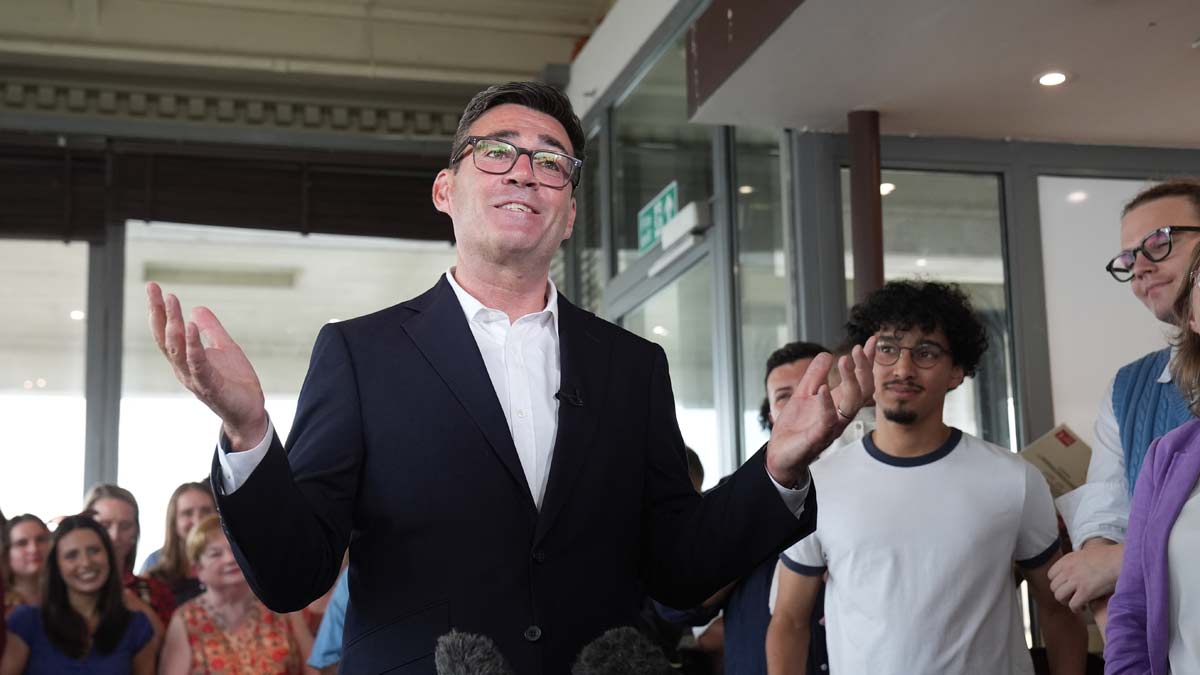
Andy Burnham’s radical blueprint to decentralise Britain through a Manchester-based operational hub known as No. 10 North is a high-stakes gamble against an entrenched Whitehall system designed to centralise power. While the front-runner for the national leadership promises a post-Thatcherite era of regional equity, the hard reality is that shifting structural power away from London requires breaking the Treasury’s absolute veto over public spending. Historical precedent suggests that without rewriting the state’s fiscal rules, regional devolution remains a management exercise rather than a true transfer of power.
For nearly a decade as the Mayor of Greater Manchester, Burnham built a political brand by positioning himself as the outsider fighting the insular logic of the capital. Now, as he positions himself for the highest office in the country, his strategy relies on exporting this local model to the rest of the United Kingdom. It is an approach he calls Manchesterism, a philosophy that prioritises place over political party and favors public intervention over unchecked market forces. Yet the mechanisms of British governance are remarkably resistant to outside interference, and the institutional walls of London are already preparing to absorb and neutralise his agenda.
The Mirage of No 10 North
Setting up a secondary seat of power in the northwest makes for excellent political theatre. It sends a message to an exhausted electorate that the geographic monopoly of the south-east is ending. But a building is not an institution. The proposed nerve centre is intended to force national civil servants to work alongside local leaders to align economic strategies, yet it lacks the statutory authority to override departmental budgets.
The British civil service operates on strict vertical hierarchies. A senior civil servant in Manchester remains bound by the directives of their permanent secretary in London, who in turn answers to a secretary of state focused on national parliamentary survival. When resources become scarce, departments inevitably protect their core budgets, starving regional experiments first.
Consider a hypothetical scenario where the Department for Transport and a regional authority disagree on the funding priority for a new trans-Pennine rail link. Under the current framework, the final decision does not rest with a regional coordinator in Manchester. It defaults back to a desk officer in London applying standard value-for-money metrics that structurally favour high-density, high-value areas like the south-east.
The Treasury Iron Cage
The true obstacle to Burnham’s vision is not departmental inertia, but the institutional doctrine of the Treasury. Britain remains one of the most fiscally centralised countries in the G7. Local authorities and combined regions control a tiny fraction of their tax base, relying instead on central government handouts masquerading as devolved funding pots.
The recent implementation of integrated financial settlements was supposed to end the ritual of councils begging for small pots of regeneration money. It did not give them fiscal autonomy. The Treasury still sets the overall expenditure limits, dictates borrowing caps, and retains the final say on tax-raising powers.
To understand why this system persists, one must look at how the Treasury evaluates risk. Its primary mandate is to maintain macroeconomic stability and enforce fiscal rules. To the institutional mind of Whitehall, granting genuine tax-raising powers to a dozen regional mayors introduces unacceptable volatility into national accounting.
A decade of English devolution has done little to alter this core philosophy. The Treasury views greater financial flexibility as a privilege to be earned through compliance, not as an inherent right of local governance. Burnham’s economic advisers know this challenge well, yet the political commitments to strict national fiscal rules leave very little room to alter the financial architecture of the state.
The German Illusion
A central pillar of the new blueprint is the ambition to introduce a statutory right to equivalent living conditions across the country, explicitly drawing inspiration from the German Basic Law. In Germany, the federal government is constitutionally mandated to ensure that public services, infrastructure, and economic opportunities are broadly equal across all states. This is backed by a legal mechanism that automatically redistributes value-added tax and income tax revenues from wealthier regions to poorer ones.
Replicating this model in a unitary state like the United Kingdom is a structural impossibility without a complete written constitution. The German system works because it is built on a foundation of powerful state governments that possess independent legislative rights and direct representation in the upper house of parliament.
In contrast, English devolution is an uneven patchwork of deals created by administrative decree. One region holds powers over bus franchising and adult education, while a neighbouring county operates with no devolved authority at all. Implementing a legal requirement for equal living conditions in a system this fragmented would lead to immediate paralysis, triggering endless litigation as underfunded councils sue the central government for structural negligence.
Why Manchesterism Cannot Scale
The success of the Greater Manchester model cannot simply be copied and pasted across the rest of England. The region benefited from decades of unique political stability, where local leaders across different boroughs worked in relative lockstep to build a coherent economic identity long before the first metro mayor was elected.
Most parts of the country do not possess this institutional cohesion. Attempting to force rural shires, fractured coastal towns, and competing midland cities into the same administrative mold ignores the reality of English economic geography.
Furthermore, a national policy focused heavily on regional autonomy faces severe political friction from the devolved administrations in Scotland, Wales, and Northern Ireland. These nations already possess distinct legislative powers and are led by political movements with their own territorial demands.
An English prime minister attempting to bypass national assemblies by pushing power down to local councils within those nations will be met with immediate resistance. Rather than creating unity, a top-down drive for place-based governance risks exacerbating the constitutional fractures that threaten the union.
The coming months will demonstrate whether a political philosophy forged in the town halls of the north can survive the institutional friction of the British state. If Burnham refuses to confront the Treasury's monopoly on fiscal power directly, No. 10 North will become nothing more than an expensive press office, leaving the real engine of British power exactly where it has always been.