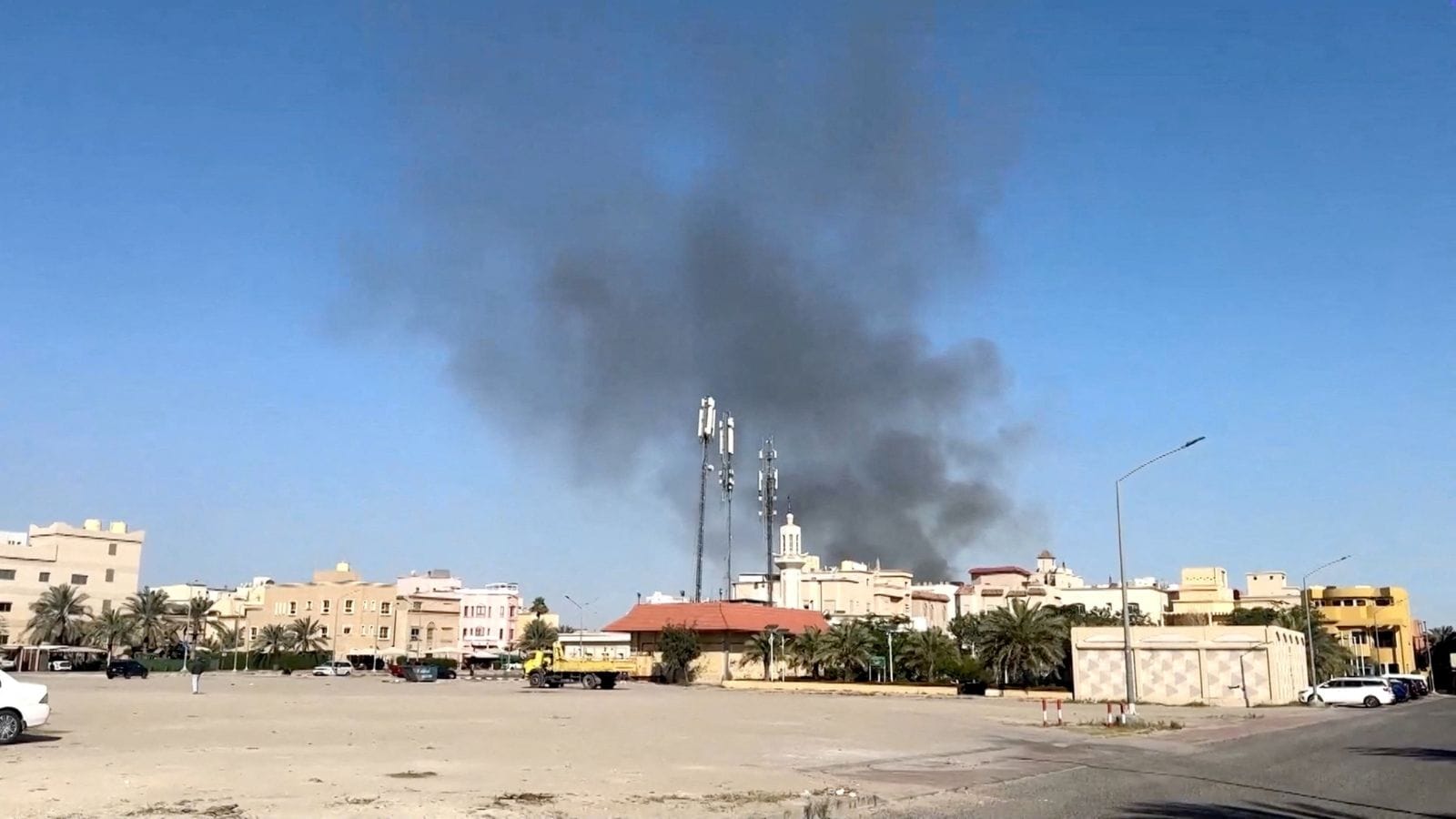
The ballistic trajectory of modern state conflict rarely respects diplomatic boundaries or carefully drawn lines of non-alignment. When an Iranian missile slammed into a facility operated by a Chinese contractor in northern Kuwait, killing a migrant worker, the illusion that peripheral actors could sit out a direct Washington-Tehran confrontation evaporated. This kinetic spillover marks a dangerous new phase in the regional war, transforming neighboring countries hosting foreign economic infrastructure into accidental front lines.
Understanding how a routine retaliatory cycle between the United States and the Islamic Revolutionary Guard Corps (IRGC) metastasized into northern Kuwait requires examining the strategic calculus governing modern precision munitions. Tehran's targeting parameters have expanded beyond explicit American military installations to encompass the broader logistical ecosystem supporting Western security architecture in the Gulf. Kuwaiti defense officials confirmed that the strike caused severe structural damage alongside the fatal casualty, exposing the vulnerability of civilian and corporate spaces embedded within critical geopolitical nodes.
For Beijing, the incident presents a profound diplomatic dilemma. China maintains a delicate balancing act in the Middle East, cultivating deep economic ties with Iran while relying on the stability of the broader Gulf Cooperation Council states for energy imports. The death of a contractor employee at a Chinese-linked site forces Beijing to recalculate the safety of its Belt and Road infrastructure personnel stationed across volatile theaters. Official statements from the Chinese embassy in Kuwait quickly noted that no Chinese nationals were among the casualties, a measured linguistic choice designed to avoid backing Beijing into a corner that would demand a muscular retaliatory response against Iran.
Yet the kinetic reality on the ground mocks diplomatic semantics. Gulf states that spent years constructing sophisticated insulation policies find their air defense networks and sovereign airspace tested to their absolute limits. Interceptions over neighboring Jordan and explosive impacts in Kuwait demonstrate that modern missile warfare features high error margins and chaotic terminal phases. When saturation attacks are launched in response to American strikes on IRGC infrastructure, debris, guidance failures, and miscalculations guarantee that non-combatants bear the brunt of the kinetic burden.
The structural vulnerability of foreign corporate sites in the Gulf stems from an era of globalization that treated economic enterprise as entirely distinct from geopolitical friction. Contractors building civilian infrastructure, transport hubs, or energy grids operate under the assumption that commercial immunity still holds value in the twenty-first century. That assumption is now obsolete. As long as regional supply chains remain intertwined with Western military logistics and hosting agreements, every concrete warehouse and worker accommodation camp remains a soft target in an escalating war of attrition.
Military analysts tracking the escalation observe that Tehran is consciously shifting toward a more aggressive deterrence posture. By signaling that nations cooperating with or passively accommodating American military posture will face secondary costs, the IRGC aims to fracture regional coalitions from within. Kuwaiti authorities have responded with immediate security clampdowns and elevated force readiness, acutely aware that their economic model relies entirely on perceived regional safety. Once that safety is punctured by stray ballistic payloads, foreign capital and labor force mobility face immediate contraction.
The geopolitical architecture of the Middle East is splintering along lines that no amount of diplomatic ambiguity can mend. Every interceptor fired and every civilian facility reduced to rubble narrows the margin for error between localized containment and regional conflagration. As Washington weighs subsequent phases of military action against Iranian positions and the IRGC doubles down on asymmetric retaliation across the Gulf waterways and landmasses, the collateral cost shifts from abstract strategic projections to human casualties on factory floors in the northern desert. The illusion of distance has vanished, leaving regional governments to manage a war that refuses to stay contained within designated battlefields.

/GettyImages-157526585-93425538070d4422ad42d22af28c0758.jpg)