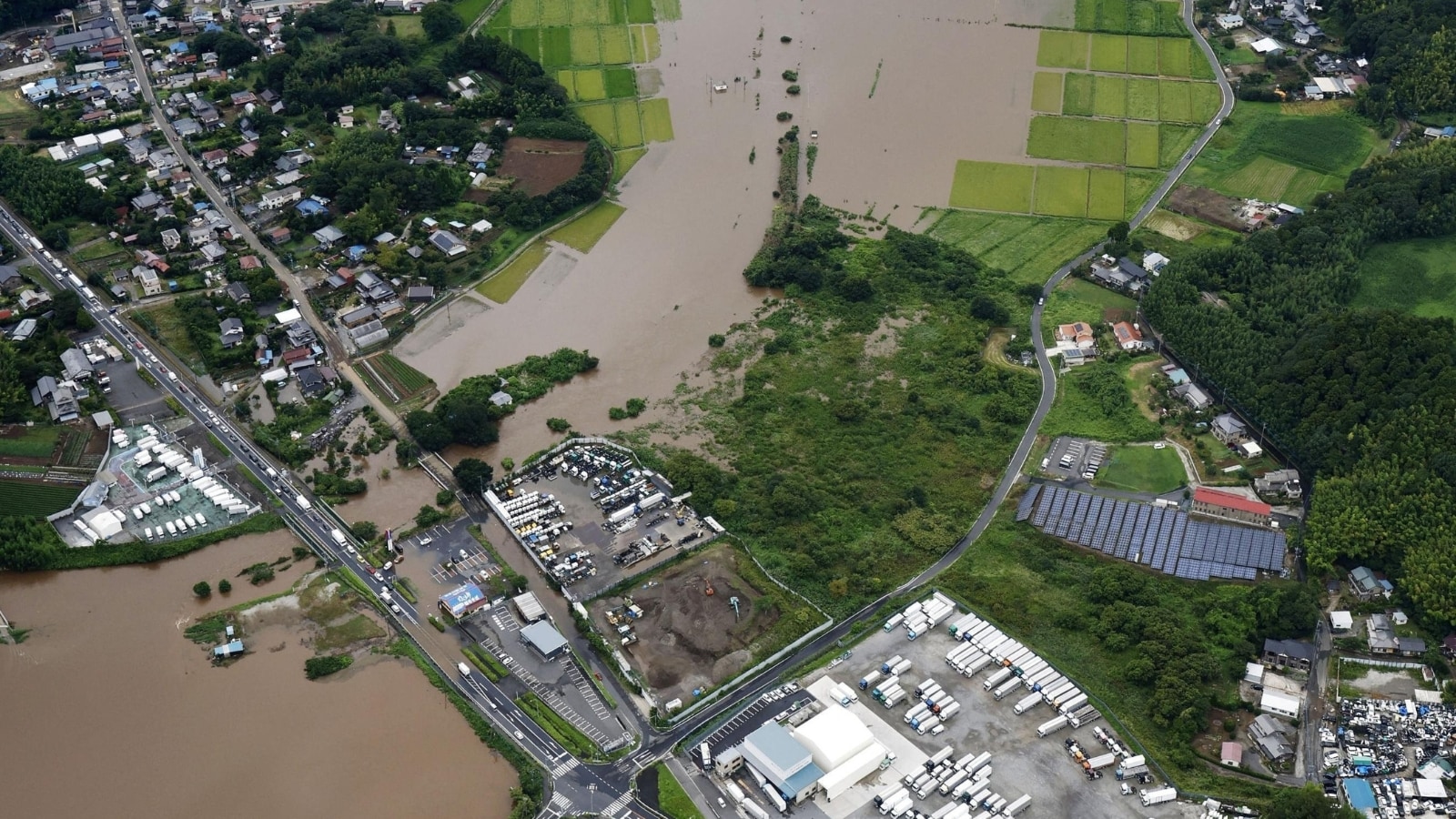
Record-breaking rainfall slammed Chiba Prefecture and parts of eastern Japan, claiming at least four lives, leaving tens of thousands of households without power, and stranding approximately 7,000 travelers overnight inside Narita International Airport. The storm dropped more than 360 millimeters of rain within a 24-hour window, overwhelming local drainage systems and triggering the Japan Meteorological Agency to issue its highest-level emergency warnings. While local media quickly pivoted to human-interest stories of passengers sleeping under foil emergency blankets on terminal floors, the disaster highlights a far more structural vulnerability in how regional infrastructure interacts with extreme meteorological shifts.
The Anatomy of a Meteorological Blind Spot
The deluge was fueled by humid air riding along a high-pressure system colliding with cold air aloft, exacerbated by the remnants of a tropical system. Weather monitoring stations recorded hourly rainfall rates exceeding 100 millimeters in specific pockets of Chiba, matching what those regions typically expect for an entire month.
Municipal planners built the regional drainage networks to handle historical precipitation baselines. Those baselines are now obsolete. When a volume equivalent to a month's worth of water falls in a single afternoon, gravity-fed urban canals and coastal spillways cannot process the inflow fast enough.
The consequences turned fatal on submerged roadways. Victims became trapped inside vehicles as floodwaters rose faster than doors could be manually opened. In flash flood scenarios, water pressure against a car door creates a seal that human strength cannot overcome once the water level rises past the mid-door threshold. Emergency responders across Chiba noted that several motorists attempted to drive through low-lying underpasses unaware that water depth had already compromised their engine blocks and electrical systems.
The Narita Bottleneck
Narita International Airport sits on a plateau, yet its operational viability depends entirely on ground-level arteries. When the torrential downpour knocked out rail links operated by JR East and Keisei Electric Railway, alongside major expressway sections managed by NEXCO East, the facility transformed into an isolated island.
Air traffic controllers kept flights moving on schedule, creating a dangerous disconnect between the airspace and the ground. Planes landed safely, but passengers had nowhere to go. Approximately 7,000 people found themselves trapped inside the terminals as buses and trains ground to a complete halt.
Airport management distributed emergency rations, drinking water, and sleeping bags, preventing a humanitarian crisis inside the concourses. Yet, the incident exposes a glaring design flaw in major transit hubs. International aviation facilities are engineered for passenger flow, not extended residential sheltering. When regional lifelines collapse, terminals lack the permanent infrastructure required to house thousands of stranded individuals for multiple days safely and hygienically.
Power Grids Under Siege
Tokyo Electric Power Company reported that over 22,000 households lost electricity at the peak of the storm. Transformer substations located in flood-prone lowlands suffered water intrusion, automatically tripping circuit protection systems to prevent catastrophic electrical fires.
Repair crews faced impossible logistics. Flooded access roads prevented utility trucks from reaching damaged substations for hours. In urban planning terms, burying electrical grids without adequate waterproof vaulting leaves communities entirely vulnerable to localized inundation.
Governors deployed military personnel to assist with emergency relief, yet deployment delays underscored the friction inherent in bureaucratic disaster response protocols. Troops cannot clear debris or assist stranded citizens until formal emergency requests clear prefectural and national chains of command.
Infrastructure Realities Moving Forward
The events in Chiba serve as a harsh indicator for metropolitan regions worldwide. Engineers can no longer rely on century-old hydrological data. Retrofitting drainage channels requires massive capital expenditure, but the alternative involves recurring grid failures, transportation paralyzation, and preventable fatalities.
As transit hubs like Narita continue to handle high-density international traffic, regional authorities must decouple airport accessibility from single-point rail and highway corridors. Until secondary transit routes and subterranean infrastructure are completely overhauled to handle hyper-localized cloudbursts, major storm systems will continue to expose the fragile margins of modern regional planning.