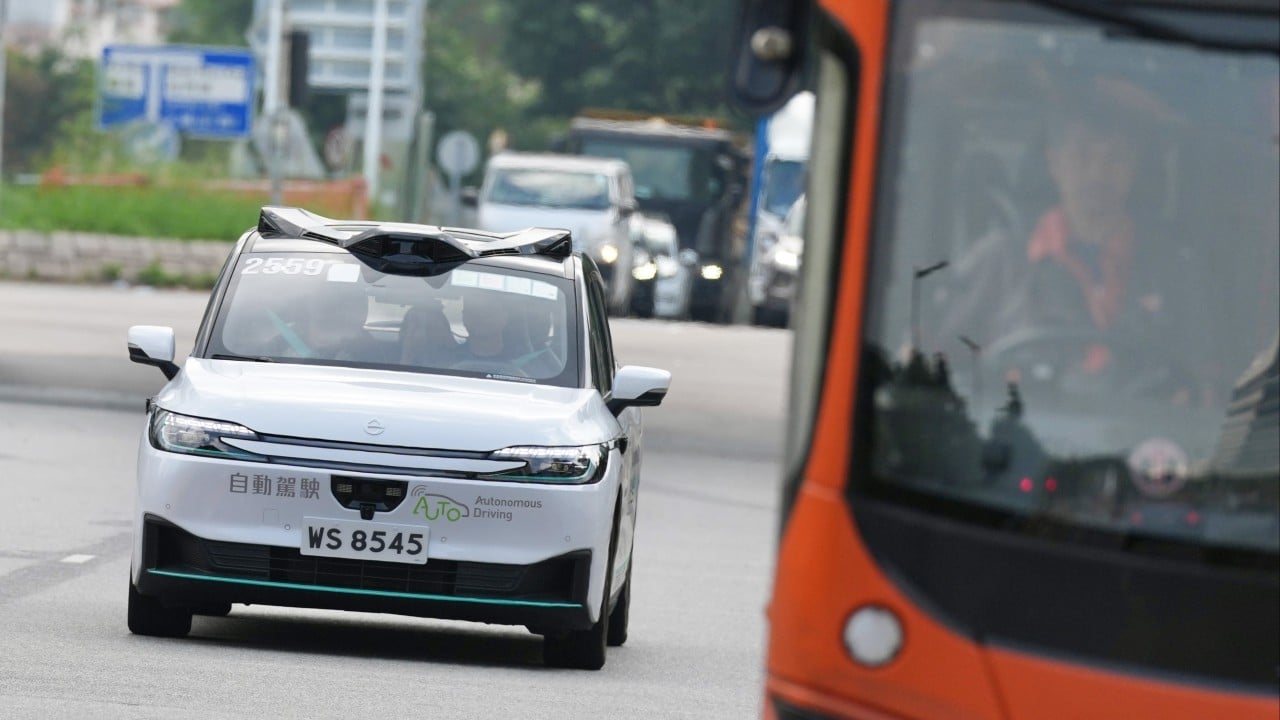
More than 1,000 residents are slated to test Baidu’s autonomous vehicles in Hong Kong’s first large-scale public robotaxi trial through its Apollo Go platform. At first glance, putting hundreds of locals into self-driving cars looks like a straightforward victory lap for autonomous mobility. Look closer at the licensing fine print, the geography of the test zones, and the legal architecture governing Hong Kong’s roads, and a very different story emerges.
I have spent two decades covering urban transit, vehicle homologation, and the quiet battles between tech companies and municipal regulators. I have seen dozens of "historic" pilot launches turn out to be tightly choreographed theater, where a press release promises a revolution and a two-mile geofenced loop delivers a slow golf-cart ride. Hong Kong is no ordinary proving ground, and Baidu is not stepping onto a blank slate. It is stepping into a dense, hyper-efficient transit ecosystem with left-hand traffic, tight tolerances, and a regulatory framework built on incremental caution rather than Silicon Valley bravado.
Why Tung Chung and Airport Island Come First
Anyone who knows Hong Kong’s street map understands why Baidu’s early expansion centers on North Lantau, including Airport Island and Tung Chung, rather than dropping a fleet straight into Causeway Bay or Mong Kok at rush hour.
Central Hong Kong is a stress test that breaks human drivers. Minibuses weave across lanes with millimeter precision, delivery vans double-park in blind spots, pedestrians step off crowded curbs without looking up from their phones, and rain turns asphalt into a mirror. North Lantau offers wider carriageways, more predictable traffic flows, and direct connectivity around the airport precinct. That does not make the engineering trivial. Roundabouts, mixed commercial and residential traffic, coastal weather, and strict local traffic ordinances still punish sloppy perception or hesitant decision-making. Yet it gives engineers room to validate edge cases before confronting the city’s most unforgiving corridors.
A public trial with over 1,000 riders is a meaningful operational milestone, yet a controlled public trial is not the same thing as an open, citywide, on-demand taxi replacement.
The distinction matters. In autonomous vehicle development, moving from closed-course testing to invited or registered public riders tests something far harder than lane-keeping or obstacle braking. It tests human-machine trust under real social pressure. Riders hesitate when a car yields unexpectedly to a pedestrian. They reach for door handles or question route choices when a vehicle takes a conservative detour. They talk to friends, post videos, and form durable impressions based on a single ten-minute trip.
Even the word "robotaxi" carries baggage that engineers dread and marketers adore. In everyday speech, a robotaxi implies hailing a car anywhere at any hour and paying a metered fare to go door-to-door. Pilot programs operating under strict Transport Department permits rarely work that way. Routes, operating windows, passenger eligibility, and safety oversight remain tightly bounded. Confusing a structured public trial with full commercial deployment is how expectations get inflated—and how sensible regulations get blamed when timelines stretch.
Right-Hand Drive and Left-Hand Traffic
Most commentary on Baidu’s expansion treats right-hand-drive vehicles operating on left-hand-traffic roads as a minor localization tweak, roughly equivalent to translating an app menu or swapping metric units for imperial ones. That is a mistake.
Changing the side of the road alters the geometry of every single maneuver. Sightlines at uncontrolled junctions flip. Right turns across oncoming traffic (in a left-hand system) or left turns across lanes behave differently in terms of occlusion, gap acceptance, and oncoming vehicle speeds. Lane markings, priority signage, bus lane rules, and emergency vehicle yielding norms all carry distinct spatial assumptions. A perception stack trained overwhelmingly on right-hand-traffic environments does not merely mirror coordinates; it must verify that every behavioral rule, edge-case heuristic, and map attribute holds true under the local code.
Hardware Adaptation vs Software Discipline
Putting the steering wheel on the right side is the easy part. Automakers and Tier-1 suppliers have built right-hand-drive platforms for decades for markets such as the United Kingdom, Japan, Australia, and Hong Kong itself.
Software discipline is the real moat—or the real trap. An autonomous driving stack relies on high-definition maps, sensor calibration, prediction models, and fallback maneuvers. If a vehicle encounters an unmapped roadwork zone or a broken traffic signal in a new jurisdiction, the fallback behavior defines safety. Does the car pull over cleanly without blocking a bus lane? Does it hand off smoothly to remote assistance without stalling in an intersection? Those details rarely make headlines, yet they determine whether a trial earns long-term public confidence or triggers a local backlash.
Hong Kong also serves as a strategic bridge beyond its own borders. Mastering operations here builds credibility for other left-hand-traffic markets across Asia and the Commonwealth, where local regulators watch how neighboring jurisdictions handle incidents, data governance, and safety reporting.
The Regulatory Ladder Beneath the Headlines
To understand how Baidu reached a public trial involving more than 1,000 residents, you have to look at Hong Kong’s multi-year legal groundwork rather than treating the launch as a sudden bolt from the blue.
Hong Kong updated its road traffic legislation to create a dedicated statutory regime for autonomous vehicles, backed by a Code of Practice administered by the Transport Department. Under this framework, operators do not simply show up and start carrying paying strangers. Vehicles require formal approval, specific pilot licensing, stakeholder engagement, and staged testing milestones—moving from closed or restricted trials with safety operators toward broader use and driverless clearances as risk criteria are met.
Why Caution Shapes Every Stage
Consider a hypothetical scenario to see how this staged architecture works in practice. Suppose an operator wants to expand a pilot route past a school gate and a busy bus terminus during morning peak hours. Even if the software performed well on quieter roads, regulators and district stakeholders will scrutinize peak-hour congestion, pedestrian surges, and emergency vehicle access before signing off.
That approach frustrates tech purists who believe rapid, broad exposure is the fastest path to solving edge cases. Yet in dense cities, a single high-profile collision involving a member of the public can freeze an entire sector for years. Hong Kong’s model trades breakneck speed for institutional durability. If an operator clears each hurdle, the permission rests on documented compliance rather than political goodwill.
Commercialization Is a Separate Mountain
Pilot permits and public trials answer technical and operational questions. Commercialization answers economic ones.
Hong Kong already possesses one of the world’s highest-performing public transit networks. The MTR rail system, franchised buses, minibuses, ferries, and conventional taxis move millions of people every day at high frequency and competitive cost. An autonomous vehicle service in Hong Kong cannot survive merely by being a novelty. To matter at scale, it has to fit into existing commuter habits—solving first- and last-mile connections, serving off-peak hours, or operating corridors where traditional labor costs bite hardest—without creating worse congestion or frustrating riders with slow, overly cautious driving.
What Over 1,000 Riders Actually Prove
Bringing over 1,000 Hongkongers into Baidu’s vehicles is a real step forward for autonomous mobility in the city. It moves the conversation from closed-door engineering demos to lived urban experience.
Still, numbers like "1,000 riders" are easy to misread. One thousand rides spread across a defined trial window in specific zones tells you how the system behaves with everyday passengers, how boarding and support workflows hold up, and how locals react to riding without a traditional cabbie at the wheel. It does not yet prove unit economics at full city scale, nor does it erase the hardest questions around winter holidays, typhoons, complex multi-lane merges, or long-term fleet maintenance.
Watch what happens after the trial rides end. The true test of Baidu’s Hong Kong push will not be the applause around a large rider count, but whether the company can expand its operational footprint steadily, earn repeat trust from skeptical commuters, and navigate the slow, unglamorous grind from licensed trial to sustainable service.