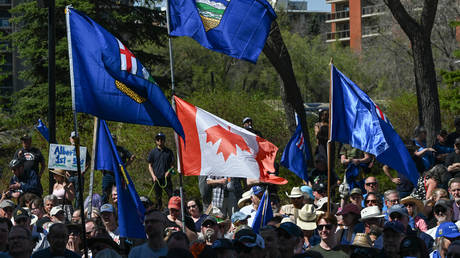
Alberta is on the brink of a political reckoning that could fundamentally alter the geographic and economic map of North America. On October 19, 2026, residents of Canada’s richest, oil-producing province will head to the ballot box to vote on whether the provincial government should initiate the legal process to hold a binding referendum on seceding from Canada.
This is not a sudden, erratic impulse. It is the culmination of decades of economic friction, a recent federal election that left the province feeling politically isolated, and a highly organized grassroots petition that forced the government’s hand.
While the international press often treats western Canadian alienation as a minor regional grievance, the reality is far more dangerous. The upcoming vote is a symptom of a deep structural flaw in the Canadian federation.
The Mechanics of the Ballot
To understand the gravity of the October vote, one must look closely at how it arrived on the provincial calendar.
Earlier this year, a separatist advocacy group named Stay Free Alberta submitted over 300,000 signatures to Elections Alberta. This easily cleared the legislative threshold required under the province's citizen-initiative laws to force a public vote.
Premier Danielle Smith, who leads the ruling United Conservative Party, found herself in a delicate position. Personally, Smith has maintained that she wants to fight for a stronger Alberta within a united Canada rather than pursue outright independence. However, her political base includes a fierce separatist faction that cannot be ignored.
Her response was a tactical maneuver. On May 21, 2026, Smith announced that the provincial referendum would feature a multi-layered ballot. Instead of asking voters to leave Canada immediately, the headline question asks whether the provincial government should commence the legal framework under the Canadian Constitution to hold a subsequent, binding referendum on separation.
It is a vote to have a vote.
Critics from both sides of the aisle have attacked the phrasing. Hardline separatists view it as an attempt to stall momentum. Federalists argue that merely putting the question on a ballot introduces catastrophic economic instability. Both are right.
The Economic Engine and the Equalization Grievance
At the heart of Alberta’s anger is a single, inescapable reality. The province sits on the third-largest oil reserves in the world, yet its political leverage in Ottawa is virtually nonexistent.
For decades, the Canadian economy has relied heavily on Alberta's natural resource revenues. Under Canada's federal equalization program, tax revenues collected by the federal government are redistributed to provinces with lower fiscal capacities to ensure relatively equal public services across the country.
Alberta has historically been a "have" province, contributing billions more to the federal treasury than it receives back in provincial transfers.
Local resentment boiled over after the 2025 federal election, which saw the Liberal Party, now led by Prime Minister Mark Carney, retain power. The Liberal platform focused heavily on aggressive carbon reduction targets, oil sands emissions caps, and regulatory hurdles that have effectively blocked new major pipeline projects.
To the average high-earning Albertan facing rising costs and regulatory gridlock, the deal looks entirely transactional. Ottawa happily collects resource taxes while simultaneously enacting policies designed to phase out the very industry generating those taxes.
It is an economic paradox that has driven even moderate business leaders to question the value of the federation.
The Legal and Indigenous Roadblocks
Even if a majority of Albertans vote "Yes" this fall, breaking up a G7 nation is not as simple as packing up and leaving.
The Canadian Constitution does not contain a straightforward exit clause. According to the Supreme Court of Canada’s landmark 1998 Secession Reference regarding Quebec, a province cannot unilaterally secede under international or domestic law. A clear majority vote on a clear question would merely obligate the rest of Canada to enter into constitutional negotiations.
Those negotiations would be an administrative nightmare. Alberta would have to negotiate its share of the Canadian national debt, the creation of a new currency or adoption of the U.S. dollar, and trade agreements with a newly hostile Canadian rump state. Furthermore, Alberta is landlocked. An independent Alberta would still rely entirely on Canadian or American territory to get its crude oil to tidewater ports.
The most formidable barrier, however, lies within the province itself.
On May 13, 2026, Alberta Justice Shaina Leonard ruled in favor of several First Nations who brought a legal challenge against the referendum process. The court affirmed that the provincial government failed to consult Indigenous communities before moving forward with a process that could alter treaty relationships.
Nearly all of Alberta’s land is governed by historic numbered treaties signed between First Nations and the British Crown, which were later inherited by the federal government of Canada. Chief after chief has made it clear: their treaties are with Canada, not the Government of Alberta. If Alberta leaves Canada, the legal status of the land itself comes into question. Indigenous leaders have stated they will block secession through the courts and, if necessary, on the ground.
The Shadow of Foreign Influence
There is another, quieter factor amplifying the chaos.
A joint report published in May 2026 by DisinfoWatch and the Media Ecosystem Observatory revealed that Alberta's internal political divisions are being actively exploited from abroad. State-aligned media networks from hostile foreign nations, alongside conservative populist influencers in the United States, have been using algorithmic targeting to supercharge separatist sentiment on social media.
The goal of these foreign operations is not necessarily a sovereign Alberta. The goal is a fractured, distracted Canada that is too consumed by internal constitutional warfare to act effectively on the world stage. By turning local economic frustrations into an existential battle over identity and sovereignty, these digital campaigns have succeeded in making compromise nearly impossible.
A Legacy of Flat Polls and Volatile Futures
Despite the noise, the banners, and the 300,000 signatures on the petition, the actual appetite for separation among the broader public remains remarkably rigid.
Polling data released by Janet Brown Opinion Research in late April 2026 shows that public sentiment has barely budged over the last twelve months. Only 27 percent of Albertans surveyed said they would vote for separation, while 67 percent remain firmly opposed. The separatist movement is loud, well-funded, and highly motivated, but it remains a minority.
The danger is that public sentiment during a referendum campaign is highly volatile. Five months of intense political campaigning, combined with potential economic shocks or heavy-handed rhetoric from Ottawa, could easily shift those numbers.
The federal government in Ottawa has a long history of ignoring western alienation until it threatens to tear the country apart. If Prime Minister Mark Carney’s government dismisses the October ballot as a meaningless stunt, they risk miscalculating the depth of the anger. Alberta may not leave Canada this year, but the foundational cracks in the nation have never been wider.