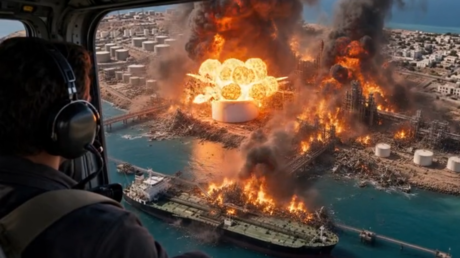
Iranian state television broadcast a claim that shook Gulf security architectures to their core. Tehran asserted that its military launched a swarm of explosive drones against the Al Minhad Air Base in the United Arab Emirates, specifically targeting zones housing American personnel and aircraft.
The announcement followed a direct escalation arc involving United States Central Command strikes against Islamic Revolutionary Guard Corps rocket launchers near the Strait of Hormuz. Those American strikes, intended to preempt sea-mine deployments, left casualties on Larak Island. Tehran's purported drone operation against Emirati territory represents a retaliatory vector explicitly designed to pull neutral Gulf capitals into the furnace of an expanding regional conflict. Yet, the immediate denial by the United Arab Emirates Defense Ministry—insisting that the reported attack on Al Minhad was entirely false and that a single intercepted drone was neutralized over territorial waters—highlights a profound information warfare dimension running parallel to the kinetic exchange.
Understanding why this specific facility sits at the crosshairs requires looking past routine military bulletins. Al Minhad Air Base is not just another landing strip in the desert. It serves as a vital logistics and operational hub for foreign military elements, including United States forces operating in the theater. For Tehran, striking or claiming to strike Al Minhad sends a deliberate diplomatic and strategic message to regional host nations. The message is stark. Hosting foreign powers that project force against Iranian assets carries an immediate, high-stakes security cost.
The Anatomy of Retaliatory Posturing
Military analysts watching the telemetry out of Tehran note a distinct shift in operational doctrine. For decades, Iran relied heavily on proxy networks scattered across Iraq, Syria, and Yemen to calibrate its response to Western or allied pressure. Direct attribution attacks originating from Iranian soil or claimed explicitly by the regular military rather than proxy groups signal an evolution in risk tolerance.
When American warplanes target rocket systems preparing to seed the Strait of Hormuz with anti-ship mines, the calculus changes for Tehran's command structure. The strait remains the jugular vein of global energy transport. Disrupting traffic there invites immediate kinetic countermeasures.
[US Central Command Strike on Larak Island]
                      │
                      ▼
[Iranian Retaliation Claim vs. Al Minhad Air Base]
                      │
                      ▼
[UAE Defense Ministry Denial & Territorial Interception]
The sequence reveals a dangerous feedback loop. Action invites reaction, and the speed of escalation leaves precious little room for diplomatic off-ramps.
The Gulf Dilemma Between Neutrality and Alliance
Capitals across the Gulf Cooperation Council face an unenviable reality. For years, nations like the United Arab Emirates pursued a delicate foreign policy balancing act. They maintained robust security partnerships with Washington while simultaneously attempting to normalize and stabilize diplomatic channels with Tehran.
That architecture strains under the weight of active hostilities. When Iranian state media broadcasts successful drone saturation attacks against facilities on Emirati soil—even while local defense ministries deny structural hits—the illusion of regional insulation shatters.
Foreign investors read these reports with immediate anxiety. Insurance premiums for maritime shipping through the Gulf spike with every projectile launched. Commercial aviation routes adjust to avoid potential airspace hazards. The psychological impact of a drone campaign far exceeds the physical damage of any single intercepted unmanned aerial vehicle.
Separating Kinetic Reality from State Broadcasts
We must separate verified battlefield events from domestic political theater. Iranian state television operates as an instrument of psychological operations and regime stabilization. Broadcasting massive retaliatory strikes serves an internal audience just as much as it threatens external adversaries.
Conversely, host nations downplaying strikes face their own institutional pressures. Admitting vulnerability invites domestic panic and economic flight. The official Emirati stance—reporting an interception over territorial waters rather than a successful base penetration—underscores the desire to project operational control.
The truth likely rests in the friction of modern air defense. Intercepting dozens of loitering munitions requires split-second coordination, advanced radar tracking, and expensive interceptor missiles. Even when air defense architectures perform flawlessly, the economic asymmetry remains staggering. Launching cheap, commercially derived propulsion drones forces defenders to expend multi-million-dollar missile inventory.
The Broader Horizon of Regional Instability
As this conflict grinds through its current phase, the danger lies in miscalculation. A single errant drone penetrating a hardened hangar or missing a designated target by a hundred meters could result in mass casualties among allied service members. That threshold crosses from a war of words and limited strikes into an all-out regional conflagration.
Diplomatic channels remain dangerously thin. Traditional intermediaries find themselves sidelined as military commands take operational precedence. The Strait of Hormuz continues to choke under reduced traffic volume, and secondary actors across the region weigh their own alignment choices.
The smoke over Al Minhad—whether from burning debris of an intercepted drone or the friction of competing official narratives—signals that the Gulf is no longer a sanctuary. The friction between Washington's containment strategy and Tehran's asymmetric survival doctrine has transformed regional hubs into frontline targets. The margin for error has officially evaporated.