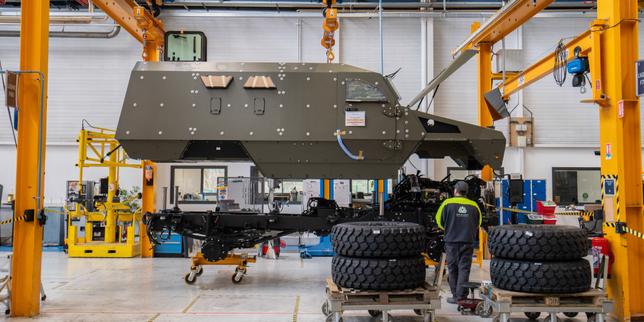
The prevailing narrative surrounding the French defense industry is one of "acceleration." Politicians visit Arquus plants, point at armored hulls, and talk about a "war economy" as if it’s a dial you can simply turn from three to ten. They are wrong. What we are seeing in Limoges and Saint-Nazaire isn't a transition to a war economy. It is a frantic, expensive attempt to scale a boutique craft shop into a factory.
The media loves the "two-speed" trope—complaining that while assembly lines move faster, the supply chain drags behind. This ignores the structural rot. The problem isn't speed; it’s the fundamental architecture of how we build weapons. We are trying to win a 21st-century high-intensity conflict using a 1990s luxury car business model.
The Myth of the Agile Assembly Line
Walking through an armored vehicle plant today, you’ll see impressive machines. You’ll see the Griffon and the Serval taking shape. The "lazy consensus" suggests that if we just hire more welders and order more steel, we can meet the needs of a modern battlefield.
I’ve spent years watching procurement cycles eat themselves alive. Here is the reality: a "war economy" is defined by attrition, not perfection.
The French defense apparatus is obsessed with "over-specing." We build Swiss watches that weigh twenty tons. Every vehicle is a masterpiece of integration, packed with proprietary electronics and specific ergonomic requirements that make mass production an impossibility. When you build a masterpiece, you can’t build ten thousand of them. In a real war, the side that can replace a lost vehicle in forty-eight hours wins. The side that needs eighteen months to calibrate a specialized sensor suite loses.
Arquus and its peers are trapped in a cycle of "gold-plating." By demanding that every vehicle be a survivable, air-conditioned, networked command center, the French state has ensured that the "economy of scale" remains a fantasy.
The Supply Chain Is Not the Bottleneck—The Design Is
Critics point at the shortage of semiconductors or specialized alloys as the reason for delays. They claim the "two-speed" economy is a logistical failure. That is a surface-level diagnosis.
The bottleneck is complexity.
If your vehicle requires a specific grade of hardened steel that only one foundry in Europe produces, you don't have a supply chain problem; you have a design failure. True war economies—think the U.S. in 1942 or even modern drone production in Eastern Europe—rely on substitution.
- Standardization over Specialization: We should be using off-the-shelf industrial components wherever possible.
- Modular Attrition: We need vehicles designed to be destroyed and replaced, not preserved in museums.
- Decoupled Electronics: The hull should outlive the computer. By hard-wiring bespoke tech into the frame, we ensure the entire vehicle is obsolete before it even leaves the lot.
The current "war economy" rhetoric ignores that we are still buying "exquisite" platforms. You cannot scale exquisite. You can only scale "good enough."
The Human Capital Lie
There is a lot of talk about "mobilizing" the workforce. The industry complains about a lack of skilled technicians.
The harsh truth? The industry has made itself too difficult to work for. By clinging to archaic, high-touch manufacturing processes, they require artisans rather than assembly line workers. If it takes six months to train a worker to weld a specific joint on a Jaguar EBRC, your process is broken.
A real war economy simplifies the task so the workforce can be expanded overnight. We are doing the opposite. We are deepening the "artisan trap," making our defense sovereignty dependent on a shrinking pool of highly specialized labor that cannot be surged in a crisis.
Stop Fixing the Supply Chain, Start Breaking the Requirements
When people ask, "How do we speed up production?" they are asking the wrong question. The right question is: "What can we strip away to make this buildable in a week?"
The French military-industrial complex is allergic to this question. There is a "prestige tax" on every vehicle. We want the best optics, the best armor, and the best ergonomics. But in a high-intensity conflict, the "best" is the enemy of the "available."
Imagine a scenario where we stop viewing a vehicle as a twenty-year asset. Imagine we view it as a six-month consumable. Suddenly, the "two-speed" problem vanishes. You don't need the three-year lead time on that specific thermal camera if you design the vehicle to use a commercial-grade alternative that costs 10% as much and is available at 100x the volume.
Yes, the capability drops by 15%. But the volume increases by 500%. That is the math of winning.
The Sovereignty Paradox
We talk about "Strategic Autonomy," yet our production lines are paralyzed the moment a single Tier-3 supplier in a different time zone has a hiccup.
True sovereignty isn't owning the factory; it's owning the simplicity of the design. If you can’t build your main battle taxi using parts found in a standard tractor supply chain, you aren't sovereign—you’re a hostage to your own complexity.
The "war economy" as currently described by the French Ministry of Armed Forces is a PR campaign designed to justify increased spending without demanding fundamental reform. We are pouring more money into a system designed for "policing actions" in Africa and expecting it to produce the mass required for a continental war.
The Brutal Reality of Cost
Let's talk about the money. The "two-speed" argument suggests that if we just harmonize the speeds, everything will be fine. It won't.
The cost per unit of French hardware is skyrocketing because we refuse to commit to true mass. We order in "tranches." We tweak the design mid-production. We allow "requirement creep" to turn a simple troop transport into a multi-role platform that does everything poorly and costs a fortune.
If we want a war economy, we need to embrace brutalist manufacturing:
- Freeze the design: No changes for five years. Period.
- Eliminate proprietary interfaces: Use standard mounts and cables.
- Accept 80% solutions: A vehicle in the field today is worth ten "perfect" vehicles on a drawing board for 2029.
The downside to this approach is obvious: the vehicles will be less "impressive." They will have fewer gadgets. Soldiers might complain about the lack of integrated coffee warmers. But they will have vehicles to drive, which is a significant upgrade over the alternative.
The Illusion of Readiness
The current "acceleration" at Arquus is a stress test that the system is already failing. Increasing output by 20% or 30% isn't a war economy; it’s just a busy month. A war economy is an increase of 1,000%.
Our current industrial base cannot do that. Not because it lacks the will, but because the products themselves are too "smart" for their own good. We have engineered our way into a corner where our sophistication is our greatest vulnerability.
We are building Ferraris for a demolition derby. It’s time to start building tractors with guns.
If we don't move toward radical simplification and mass-producibility, all the "war economy" speeches in the world won't save us when the shells start landing. The clock isn't ticking on our assembly lines; it's ticking on our relevance.
Get comfortable with "good enough," or get used to losing.