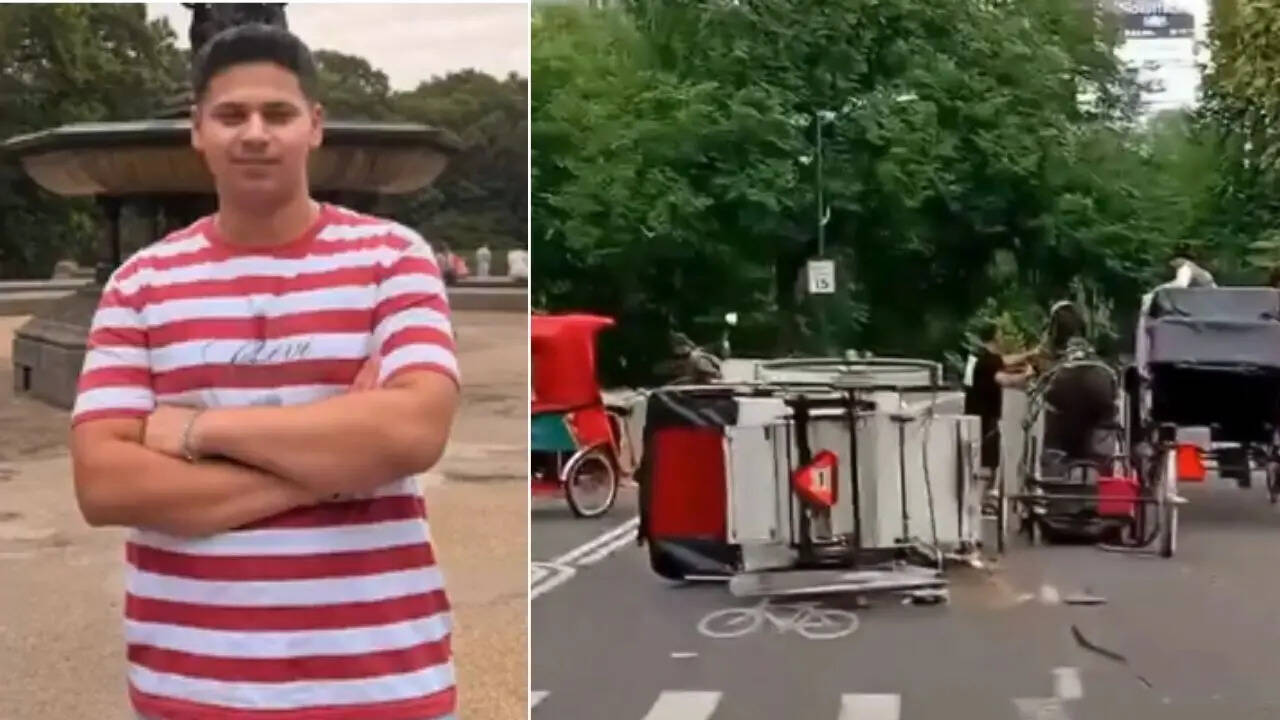
An eighteen-year-old tourist from India, Romanch Mahajan, died on Wednesday after a runaway carriage horse bolted through Central Park, revealing severe cracks in the oversight of one of New York City's oldest tourist traditions. The tragedy occurred during a family vacation meant to celebrate the teenager's high school graduation and upcoming university enrollment. Instead, it became the first recorded passenger fatality in the history of the park's horse-drawn carriage trade.
The catastrophic sequence unfolded near Cherry Hill just before 3:00 p.m., a peak hour for pedestrians, cyclists, and families. Seeking to capture a memory of their first visit to New York, the Mahajan family asked their driver to take a photograph. The driver complied, stepping down from the red-and-white cab and releasing his physical hold on the reins.
In that fraction of a second, the seven-year-old horse, named Sampson, bolted.
Left unattended, the horse surged onto the sidewalk and careened onto the grass, pulling the carriage at high speed while the driver chased fruitlessly behind. Inside the cab, panic took over. As the vehicle lurched violently on two wheels, Romanch's mother, Priya Mahajan, was thrown from the carriage. In a desperate attempt to save her, Romanch jumped from the moving structure. He struck his head on the hard pavement, suffering a catastrophic head injury while shouting for his mother.
The driverless carriage continued its erratic flight down the park's heavily trafficked loop, eventually clipping another carriage before overturning and shattering into splinters. Romanch was rushed to New York-Presbyterian Weill Cornell Medical Center, where he was pronounced dead later that evening. The rest of his family escaped with minor physical injuries but immense psychological trauma.
The Operational Failure Behind the Photo
The immediate cause of the crash points to a direct violation of baseline safety protocols by the driver. According to industry regulations and statements from Transport Workers Union Local 100, which represents the city's carriage drivers, an operator must never leave a horse unattended or step away to handle cameras.
Horses are prey animals. Their biological default when startled is flight, and without a driver holding the reins to provide physical resistance and verbal reassurance, an unexpected noise, a speeding electric bicycle, or a sudden movement can trigger a blind panic.
Alexander Kemp, administrative vice president of TWU Local 100, called the driver's decision to step away to frame a photograph completely unacceptable. The driver has been suspended indefinitely by the carriage owner, and Sampson, the horse involved, will be permanently retired from city streets.
But pinning the blame entirely on a single driver ignores systemic vulnerabilities that have built up over years of minimal regulatory adaptation. Sampson had been working in the chaotic environment of Manhattan for only six weeks. Introducing a large, sensitive animal to a hyper-stimulating landscape filled with construction noise, flashing lights, siren blasts, and fast-moving delivery vehicles requires intense acclimatization. The six-week tenure of the animal raises sharp questions about the adequacy of current training and screening pipelines before a horse is permitted to haul passengers through a crowded urban park.
A Compounding Pattern of Friction
For decades, the horse carriage industry has defended itself against animal rights groups by framing its mishaps as isolated incidents. The data suggests otherwise. The Central Park Conservancy reported that there have been eight major horse-related incidents in or near the park since May 2025.
Just one week prior to this fatal accident, a sixteen-year-old carriage horse named Deniz collapsed and died near 72nd Street and West Drive in front of dozens of onlookers. Initial findings from the union suggested the animal ingested Japanese yew, a common but highly toxic ornamental plant used in area landscaping.
Four months earlier, an escaped carriage horse named Destiny ran headlong into oncoming traffic at Sixth Avenue and West 59th Street, colliding with four vehicles and tearing the bumper off a taxi before being contained.
The frequency of these events points to an environment that has outgrown the industry operating within it. Central Park today is vastly different from the pastoral retreat designed by Frederick Law Olmsted in the nineteenth century. It is a high-density transit corridor where horses must share narrow loops with electric scooters, commercial delivery bikes, pedicabs, and large crowds of distracted tourists. When a horse panics in a modern city, it does not run into an empty meadow. It runs into concrete, steel, and people.
The Legislative Battleground
The political response to the fatality has been immediate and fierce, breathing new life into a long-stalled legislative push to eliminate the horse-drawn trade completely.
The focal point of the political fight is Ryder's Law, a bill introduced by City Council Member Christopher Marte and supported by a growing coalition of lawmakers, including State Senator Erik Bottcher and Council Member Shahana Hanif. The proposed legislation would halt the issuance of new carriage licenses and completely phase out the operations within two years. Crucially, the bill outlines a transition framework aimed at moving current drivers into stable municipal or tourism-related employment, attempting to defuse the economic argument that has long protected the trade.
Following the accident, New York City Council Speaker Julie Menin and Health Committee Chair Lynn Schulman fast-tracked a formal hearing on Ryder's Law, scheduling it for July 2026.
The Central Park Conservancy, which manages the daily operations of the park under a contract with the city, broke its traditional neutrality last year by endorsing a complete ban on the carriages. In a statement issued after Romanch Mahajan's death, the organization argued that a young man losing his life is not an acceptable cost for maintaining an antiquated industry in the middle of one of the most heavily used public spaces in America.
The Economic and Cultural Counterweight
Despite the escalating pressure, the carriage industry retains significant political leverage and deep-rooted support among traditional tourism groups. Proponents argue that the carriage trade provides stable livelihoods for hundreds of workers, many of whom are immigrants or multi-generational stable hands.
The industry positions itself as a vital economic driver for midtown hotels and restaurants, offering an iconic New York experience that cannot be replicated by mechanical alternatives. Representatives from the industry argue that rather than enacting a wholesale ban that destroys small businesses, the city should focus on stricter enforcement of existing rules, better traffic management on the park loops, and dedicated lanes separated from aggressive electric bike riders.
There is also an ongoing debate regarding animal welfare standards. Industry advocates claim that carriage horses receive regular veterinary checks, mandated rest periods, and seasonal turnouts at pasture farms. They argue that a ban would result in many of these horses being sold to auctions or slaughterhouses, as private owners would have little financial incentive to maintain them without the revenue generated by the park rides.
The Reality of Urban Shared Spaces
The tragedy highlights a fundamental truth about modern city planning: mixed-use spaces require strict compatibility between the users. When the speed differential and mass disparity between entities sharing a path become too wide, safety breaks down. A panicked thousand-pound animal pulling a heavy wooden vehicle on iron-shod wheels cannot safely coexist with silent, fast-moving electric micro-mobility devices and dense pedestrian traffic.
For years, city officials managed the carriage industry through minor compromises, adjusting operating hours during extreme heat or restricting pickup zones to specific perimeter locations. The death of Romanch Mahajan has effectively ended the era of incremental regulation.
The upcoming City Council hearings will force New York to decide whether the nostalgic appeal of a nineteenth-century aesthetic is worth the inherent, unpredictable risks it imposes on the modern public. As the Mahajan family prepares to return home without their eldest son, the city is left to confront the harsh reality that some traditions carry a human cost too high to justify.


