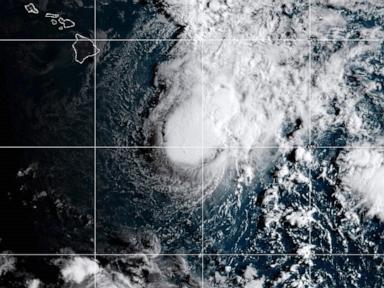
Standard meteorological reporting evaluates tropical cyclones through peak wind speeds and direct landfall trajectories, failing to capture systemic risk when a secondary system impacts compromised infrastructure. Tropical Storm Moke passed south of the Hawaiian Islands, tracking westward while driving heavy precipitation into the windward and southeast slopes of the Big Island. While the system lacked the kinetic wind energy of a major hurricane, treating Moke as an isolated weather event miscalculates the cumulative math of disaster response. The operational reality on the ground was defined entirely by antecedent conditions: ground saturation and structural fatigue left in the immediate wake of Hurricane Lala.
The Mechanics of Cumulative Hydrological Loading
The primary hazard profile of Moke was governed by volumetric water absorption limits rather than wind shear or barometric pressure drops. When soil reaches field capacity, its infiltration rate drops to near zero. Every additional inch of rainfall immediately converts into surface runoff, accelerating flash flood dynamics in steep terrain.
The meteorological parameters of Moke interacted with the Big Island's topography through specific physical vectors:
- Precipitation Volume Thresholds: Forecasters projected baseline accumulations of 5 to 10 inches across the Big Island, with isolated maximum amounts reaching 15 inches along windward and southeast slopes.
- Topographic Orographic Lift: Moist air carried by the storm's circulation was forced upward by the high volcanic elevations of Mauna Loa and Mauna Kea, cooling the air mass and wringing out moisture at an accelerated rate compared to flat island geography.
- Runoff Coefficient Spikes: Because Hurricane Lala had already dumped extreme rainfall totals—exceeding 40 inches in localized northeast sectors—the hydrological baseline was maxed out. The coefficient of runoff for the watershed was effectively unity, meaning nearly 100% of Moke's rainfall became immediate surface discharge.
This dynamic explains why even moderate storm intensity triggers catastrophic civil disruption. The energy required to destabilize a hillside drops exponentially when the soil matrix is already liquefied by prior precipitation events.
The Infrastructure Cost Function
Civil resilience is a function of recovery time between shock events. When a secondary hazard strikes before infrastructure repair curves intersect degradation curves, systemic failure cascades.
The structural damage from Hurricane Lala included compromised bridges, washed-out foundations, and extensive electrical grid failures. Over 8,000 customers remained without power on the Big Island when Moke's outer bands arrived. The arrival of Moke imposed several distinct operational penalties on local systems:
- Logistical Paralysis: Emergency management teams split bandwidth between active debris clearance from Lala and preemptive evacuations for Moke. Supply chains for critical inputs—fuel, potable water, medical provisions—faced restricted transit routes due to compromised state highways like Route 11 near active hazard zones.
- Grid Vulnerability Multipliers: Saturated soils weaken root structures and utility pole anchors. Sustained winds of 45 to 50 mph, which might normally cause isolated outages in dry soil, generated widespread secondary grid failures when combined with softened earth.
- Asset Depletion: Municipal emergency funds and physical stockpiles were drawn down below safe operating reserves before the second system cleared the archipelago. State officials faced compressed timelines to secure federal emergency declarations, amplifying financial exposure for local government entities.
Macroclimatic Drivers and Frequency Shifts
The clustering of tropical systems in the Central Pacific basin during this period is not random variance; it reflects thermodynamic efficiencies governed by basin-wide ocean temperatures. Positive sea surface temperature anomalies associated with active El Niño phases reduce vertical wind shear across the region.
Vertical wind shear acts as a structural deterrent for tropical cyclones by tilting the vortex and venting heat away from the core. When shear is suppressed, nascent disturbances like Moke maintain structural integrity over longer durations while traversing warm oceanic corridors. Furthermore, elevated sea surface temperatures increase the enthalpy of the boundary layer, raising the upper bound of potential precipitation efficiency for passing storms.
Consequently, emergency planners must discard historical return-period models. The conditional probability of experiencing back-to-back tropical systems increases when basin-scale thermal energy remains high, shifting operational planning from single-event recovery to continuous-threat management.
Strategic Operational Allocation
Governments facing compounded hydro-meteorological threats must transition from reactive hazard response to continuous asset staging. Resource allocation should no longer be calculated based on the forecasted category of an incoming storm alone, but rather on the vulnerability index of the receiving terrain.
Pre-positioning heavy earth-moving equipment outside of anticipated flood zones, establishing redundant microgrid power supplies for critical water treatment facilities, and enforcing strict clearing intervals for compromised vegetation are mandatory operational baselines. When the interval between systemic shocks approaches zero, defensive engineering and decentralized supply chains represent the only viable hedge against total infrastructure collapse.