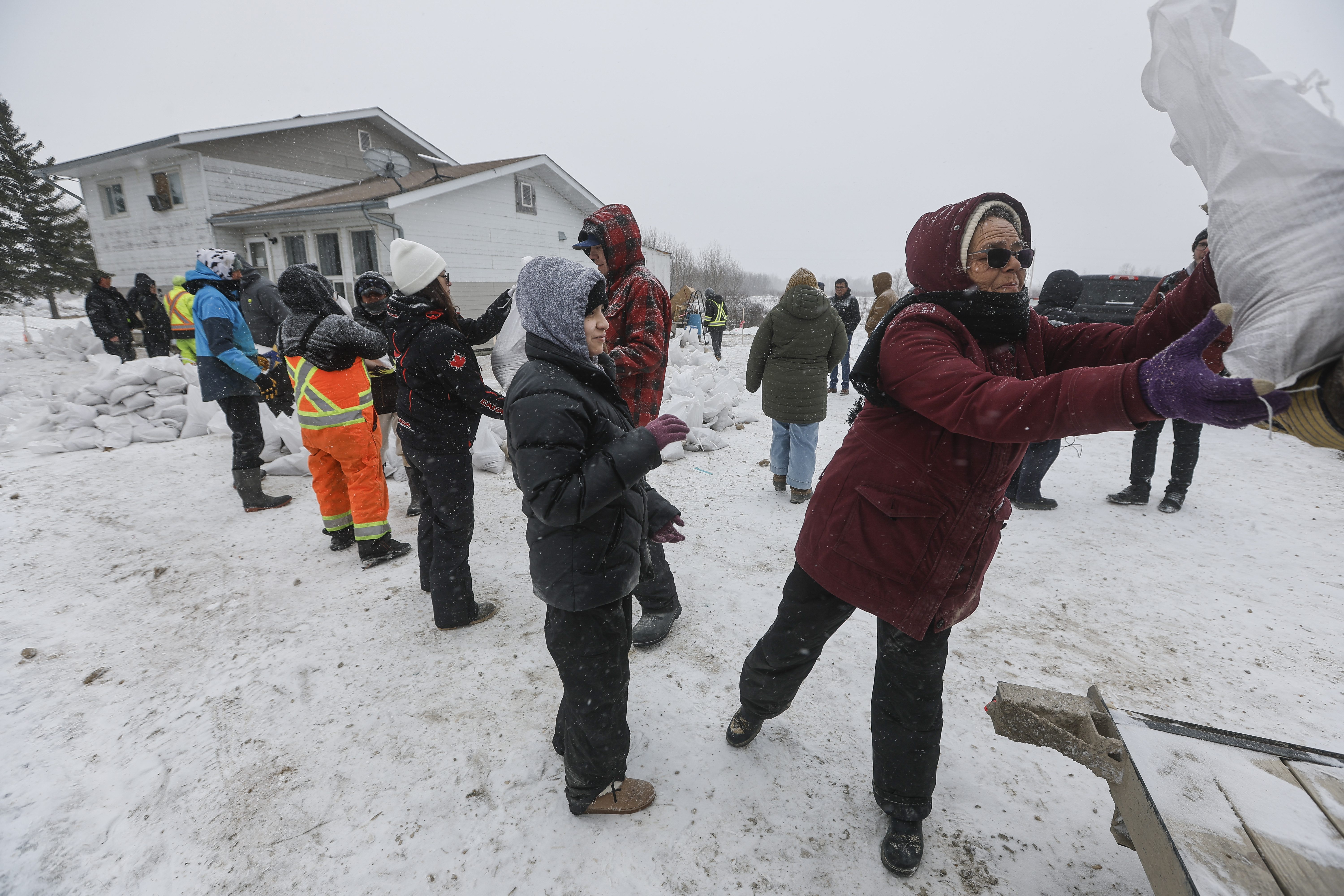
The declaration of a state of emergency in the Peguis First Nation and Fisher River Cree Nation is not a mere administrative formality; it is a calculated response to a recurring failure in hydraulic infrastructure and regional water management. In the Interlake region of Manitoba, flooding is a structural certainty rather than an anomaly. The mechanism of disaster here is driven by the convergence of rapid snowmelt (freshet), high soil moisture saturation, and the physical constraints of the Fisher River’s drainage capacity. When the rate of inflow from spring melt exceeds the volumetric flow rate capacity of the river channel, the surplus water follows the path of least resistance—inland toward residential and critical infrastructure.
The Tri-Factor Risk Matrix of the Fisher River Basin
To evaluate the severity of the current threat, one must analyze the interaction between three independent variables that dictate flood magnitude. For an alternative look, read: this related article.
- Antecedent Moisture Conditions: The baseline for any spring flood is established during the previous autumn. High precipitation levels before the winter freeze-out saturate the soil, effectively turning it into an impermeable surface. This removes the ground’s ability to act as a buffer for spring runoff.
- Snow Water Equivalent (SWE): The total volume of liquid water contained within the snowpack is the primary fuel for the event. The risk profile shifts from manageable to critical when a significant SWE is combined with a rapid thermal spike, causing the entire volume to enter the system simultaneously.
- Hydrographic Bottlenecks: The Fisher River is characterized by a low gradient and high sinuosity. These geomorphological features naturally slow water velocity. When ice jams occur at narrow junctions or bridge crossings, they create "backwater effects" where the water level rises upstream independent of actual volume increases.
The Mechanics of a State of Emergency Declaration
A state of emergency (SOE) serves as a legal trigger to bypass standard procurement and operational bottlenecks. It grants the leadership of Peguis and Fisher River the authority to mobilize resources that are otherwise restricted under normal governance. The decision-making process follows a specific hierarchy of necessity:
- Jurisdictional Mobilization: Under the Emergency Measures Act, the declaration allows for the formal request of provincial and federal assistance, including the deployment of the Canadian Armed Forces if the internal capacity for sandbagging and tiger dam installation is exceeded.
- Preventative Evacuation Logistics: High-risk individuals—specifically those with limited mobility or chronic medical needs—must be relocated before road access is compromised. In many Interlake communities, a rise of 0.5 meters in water level can isolate entire subdivisions, turning a flood response into a search-and-rescue operation.
- Critical Infrastructure Hardening: The focus shifts from individual property protection to the preservation of lift stations, power grids, and water treatment plants. If the wastewater system is inundated, the community remains uninhabitable long after the floodwaters recede due to biohazard contamination.
Structural Vulnerabilities and the Historical Failure of Mitigation
The recurrent nature of flooding in Peguis First Nation highlights a discrepancy between emergency response and long-term engineering. The Fisher River basin has seen major flood events in 2009, 2011, 2014, and most severely in 2022. The 2022 event resulted in the displacement of nearly 2,000 residents, a scale of demographic upheaval that suggests the existing levee systems are insufficient for modern hydrological extremes. Further insight on the subject has been published by NBC News.
The primary limitation in the current mitigation strategy is the reliance on reactive measures. Sandbagging and temporary dams are high-cost, labor-intensive solutions that offer no permanent protection. The "Cost of Inaction" (CoI) in these communities is rising. Every major flood event incurs tens of millions of dollars in recovery costs, yet the capital expenditure (CAPEX) for permanent channel diversion or large-scale dredging remains stalled in the feasibility study phase.
This creates a cycle of "reconstruction fatigue." Infrastructure is repaired to its pre-flood state rather than being upgraded to withstand higher return-period floods (e.g., moving from a 1:50 year protection level to 1:100). Consequently, the community remains in a perpetual state of vulnerability, where the only variable that determines survival is the speed of the spring thaw.
The Logistics of Displacement and Social Cost
When the Fisher River breaches its banks, the displacement is not just a logistical hurdle; it is a breakdown of the social fabric. The internal logic of evacuation follows a tiered protocol:
- The Medically Fragile: Dialysis patients and those requiring continuous oxygen are moved to urban centers (primarily Winnipeg) weeks before the predicted peak.
- Primary Displacees: Residents whose homes fall within the projected inundation map.
- Voluntary Departures: Individuals who leave due to the loss of essential services, even if their homes are dry.
The second limitation of this process is the "Hotel Refugee" phenomenon. Displaced residents are often housed in commercial hotels for months. This leads to a degradation of community cohesion and significant mental health stressors. From a strategy perspective, the lack of local temporary housing solutions—such as elevated modular units within the community—forces a total brain drain during every flood season.
Hydraulic Modeling and Predictive Accuracy
The accuracy of flood forecasting in the Interlake depends on the density of hydrometric stations. Real-time data on river flow (measured in cubic meters per second) and stage height (meters above sea level) allow for the generation of inundation maps. However, these models often struggle with "ice-affected" flow.
Traditional hydraulic equations, such as Manning’s Equation:
$$v = \frac{1}{n} R_h^{2/3} S^{1/2}$$
where $v$ is velocity, $n$ is the roughness coefficient, $R_h$ is the hydraulic radius, and $S$ is the slope, are disrupted by ice. Ice increases the "roughness" ($n$), which drastically reduces velocity ($v$), causing the water level to rise to maintain the same discharge volume. This is why a community can flood even when the total snowmelt volume is relatively low.
Strategic Infrastructure Realignment
To move beyond the cycle of emergency declarations, the strategic focus must shift toward three specific engineering interventions:
- Upstream Storage and Retention: Constructing artificial wetlands or reservoirs upstream of Peguis and Fisher River to "meter" the flow. By holding back the peak discharge for 48–72 hours, the river channel downstream can handle the volume without breaching.
- Permanent Diking Systems: Replacing temporary Tiger Dams with permanent, clay-core levees integrated into the natural landscape. These must be engineered with internal drainage systems to prevent "seepage flooding" behind the walls.
- Channel Enhancement: Selective dredging and the removal of hydraulic bottlenecks at bridge crossings. This increases the cross-sectional area of the river, allowing for a higher discharge capacity ($Q = A \cdot v$).
The current emergency declaration serves as a necessary tactical move to save lives and property in the immediate 14-day window. However, the data indicates that without a fundamental shift in the regional water management strategy—one that treats the Fisher River as a unified system rather than a series of isolated community threats—the Interlake will continue to face annual existential risks. The financial and social feasibility of remaining in high-risk zones is diminishing. The only viable path forward involves the aggressive implementation of permanent hydraulic bypasses or a strategic, large-scale managed retreat of residences from the 1:100 year floodplain.
The immediate operational priority must be the reinforcement of the highway 214 and 224 corridors. If these arterial routes are cut by overland flooding, the evacuation becomes a helicopter-only operation, increasing the cost and complexity by an order of magnitude. Engineering teams must prioritize culvert clearing and the deployment of high-capacity pumps at these specific topographical low points to maintain ground-based logistics for as long as the hydrograph allows.