Hollywood ruined how we talk about planetary defense. When most people hear about using a nuclear blast to stop a killer asteroid, they immediately picture Bruce Willis drilling into a space rock to split it in half like a cheap log.
That's not just bad cinema. It's terrible physics. You might also find this connected coverage interesting: Executive Accountability in Federal Infrastructure and the Mechanics of Systemic Outages.
Blowing an asteroid into pieces doesn't solve the problem—it turns one giant bullet into a shotgun blast of radioactive rubble still hurtling straight toward Earth. Real astrophysicists and nuclear engineers at places like Lawrence Livermore National Laboratory and Sandia National Laboratories don't want to shatter an incoming rock. They want to give it a gentle, terrifyingly precise shove.
If a massive asteroid is discovered on a collision course with Earth and we only have a few months—or even a few years—to react, a nuclear standoff explosion isn't just a backup plan. It's likely our only viable option. As extensively documented in detailed articles by CNET, the results are significant.
Why Kinetic Impactors Aren't Always Enough
In September 2022, NASA proved we can move a space rock without nukes. The Double Asteroid Redirection Test (DART) slammed a vending-machine-sized spacecraft into Dimorphos, a 160-meter-wide moonlet orbiting a larger asteroid named Didymos. It worked brilliantly, shortening Dimorphos's orbit by 33 minutes.
Case closed, right? Not quite.
Kinetic impactors rely on brute mechanical momentum. You hit a rock really hard, and the transferred energy changes its velocity by a tiny fraction of a millimeter per second. Over ten or twenty years, that microscopic nudge adds up to thousands of miles, causing the asteroid to miss Earth entirely.
Here's the catch. Kinetic impactors require two things we might not have: massive lead time and a relatively small target.
If we spot a 500-meter or 1-kilometer asteroid—big enough to trigger continental devastation or a global winter—with only two years' notice, slamming a spacecraft into it is like trying to stop a freight train by throwing a pebble at the windshield. You'd need dozens of heavy-lift rockets launching simultaneously, and even then, the math probably wouldn't work out.
That's where nuclear deflection enters the conversation. A single nuclear warhead packs millions of times more energy per kilogram than a kinetic impactor.
How a Nuclear Standoff Deflection Actually Works
Forget drilling. Forget burying a bomb inside a crater.
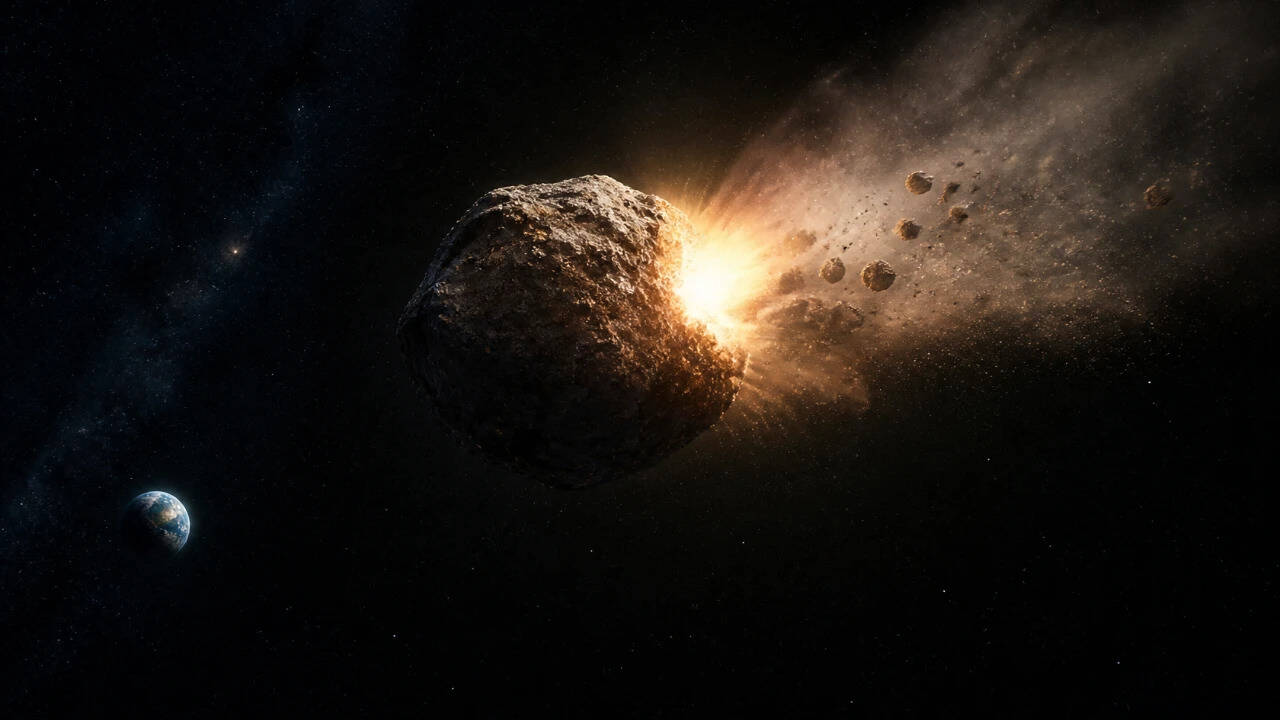
The actual strategy studied by planetary defense experts is called a standoff detonation. Instead of hitting the asteroid, a spacecraft carries a nuclear device to a carefully calculated distance—usually a few hundred meters away from the asteroid's surface—and detonates it in the vacuum of space.
Without an atmosphere, there's no fireball and no shockwave like you see in tests on Earth. Instead, the detonation unleashes an intense burst of X-rays, gamma rays, and high-energy neutrons.
When that radiation slams into the side of the asteroid facing the blast, something wild happens. The surface layer of rock and ice instantly absorbs the energy and vaporizes. It superheats into plasma and blasts outward into space at tremendous speed.
By Newton's third law of motion—every action has an equal and opposite reaction—that violent ejection of vaporized rock acts like a massive, temporary rocket thruster. It pushes the remaining body of the asteroid in the opposite direction.
It's clean. It's controlled. And most importantly, it keeps the asteroid intact so we can track its new trajectory.
What the Sandia Lab X-Ray Experiments Proved
For decades, scientists relied on complex supercomputer simulations to model how asteroid rock reacts to nuclear radiation. You can't exactly test a nuclear weapon in orbit without violating international treaties and triggering a geopolitical crisis.
Then, researchers at Sandia National Laboratories found a clever workaround using the Z Pulsed Power Facility—the world's most powerful laboratory X-ray source.
In a landmark study published in Nature Physics in 2024, physicist Nathan Moore and his team used the Z machine to zap tiny, 12-millimeter mock asteroids made of quartz and fused silica with intense X-ray pulses. They suspended the samples in a vacuum chamber using ultra-thin foil that vaporized instantly, leaving the rock targets briefly floating in zero gravity just like a real asteroid.
The X-rays heated the surfaces, creating the exact vaporization plume predicted by theory. The mock asteroids accelerated up to speeds of about 70 meters per second in a fraction of a second.
Moore's team scaled those measurements up to real-world dimensions. Their calculations showed that a standoff nuclear blast could successfully deflect an asteroid up to roughly 4 kilometers (2.5 miles) wide, provided we catch it with enough lead time. For context, the asteroid that wiped out the dinosaurs was around 10 kilometers wide.
The Rubble Pile Problem
Asteroids aren't solid chunks of iron or granite floating neatly through the void. Most of them are what astronomers call rubble piles.
When NASA's OSIRIS-REx spacecraft touched down on the asteroid Bennu in 2020, the sampling arm didn't bounce off a hard crust. It sank straight into the surface like a fist plunging into a ball pit. Bennu is basically a loose collection of boulders, gravel, and dust held together by weak gravity.
Try hitting a rubble pile with a massive kinetic impactor, and you risk punching straight through it or breaking it into unpredictable fragments.
A nuclear standoff blast handles rubble piles much better. Because X-rays irradiate a wide swath of the asteroid's hemisphere all at once, the push is distributed across a massive surface area. Instead of delivering a sharp, localized punch that shatters the rock, it delivers a broad, gentle shove across the entire face of the rubble pile.
Still, there's a fine line between a nudge and a catastrophe. Detonate the device too close, and the shockwave coupling into the interior could disrupt the rubble pile anyway. Detonate it too far away, and the X-rays spread out too thinly to vaporize enough surface material.
Getting that standoff distance right requires knowing what the asteroid is actually made of before we pull the trigger.
Why Reconnaissance Missions Matter More Than Bombs
You can't deflect what you don't understand.
If astronomers spot a dangerous asteroid heading our way, launching a nuclear interceptor blindly is a massive gamble. Silicate-rich asteroids, carbonaceous chondrites, and metallic asteroids absorb X-rays differently. Their densities vary wildly. Their rotation rates and shapes—some look like bowling pins, others like spinning tops—dictate how much energy actually translates into a linear push versus simply making the rock spin faster.
If we have a few years of warning, the smartest first step isn't launching a weapon. It's launching a fast reconnaissance probe.
A small, high-speed flyby spacecraft equipped with radar, spectrometers, and high-resolution cameras could reach the target months ahead of the deflection mission. It would map the asteroid's mass, surface composition, and internal structure, feeding hard data back to mission planners on Earth.
With those numbers in hand, engineers could dial in the exact yield of the warhead and the precise detonation distance needed to nudge the rock safely off course without breaking it apart.
The Legal and Political Minefield
Physics is only half the battle. International law is the other half.
Under the Outer Space Treaty of 1967, placing nuclear weapons in orbit or stationing them on celestial bodies is strictly illegal. The Partial Test Ban Treaty of 1963 also prohibits nuclear explosions in outer space.
Right now, no nation keeps a nuclear asteroid interceptor sitting on a launchpad. Building one, testing its delivery systems, or launching a nuclear warhead toward deep space—even on a peaceful planetary defense mission—would set off alarm bells in every intelligence agency on the planet.
How do you verify that a rocket carrying a megaton-class warhead is actually headed for an asteroid and not an orbital trajectory over a rival superpower? Who gets to hold the launch keys? What happens if the rocket explodes on the launchpad during liftoff, scattering plutonium across the coastline?
These aren't sci-fi plot holes. They're real policy bottlenecks that NASA, the UN's Space Mission Planning Advisory Group, and defense departments actively debate. Any real nuclear deflection mission would require unprecedented international transparency, independent verification protocols, and rapid diplomatic waivers before the rocket ever leaves the hangar.
Where Planetary Defense Stands Right Now
We're getting much better at finding the rocks before they find us.
NASA's NEO Surveyor—an infrared space telescope specifically designed to hunt down dark, hard-to-see near-Earth asteroids—is built to find over 90 percent of hazardous asteroids larger than 140 meters. Ground-based observatories like the Vera C. Rubin Observatory in Chile are scanning the southern sky every few nights, catching faint moving objects we used to miss completely.
Early detection buys us time, and time is the ultimate currency in planetary defense. With twenty years of warning, we can use slow, non-nuclear methods like gravity tractors or multiple kinetic impactors. We never have to touch the nuclear option.
If you want to keep track of real asteroid threats instead of sensationalist headlines, check NASA's Center for Near-Earth Object Studies (CNEOS) Sentry table online. It lists every known asteroid with even a tiny chance of hitting Earth over the next century, complete with impact probabilities and Torino Scale ratings. You'll quickly see that while space is full of flying rocks, astronomers are watching them closer than ever—and they already know the exact math required to push one out of the way if the clock ever runs down.