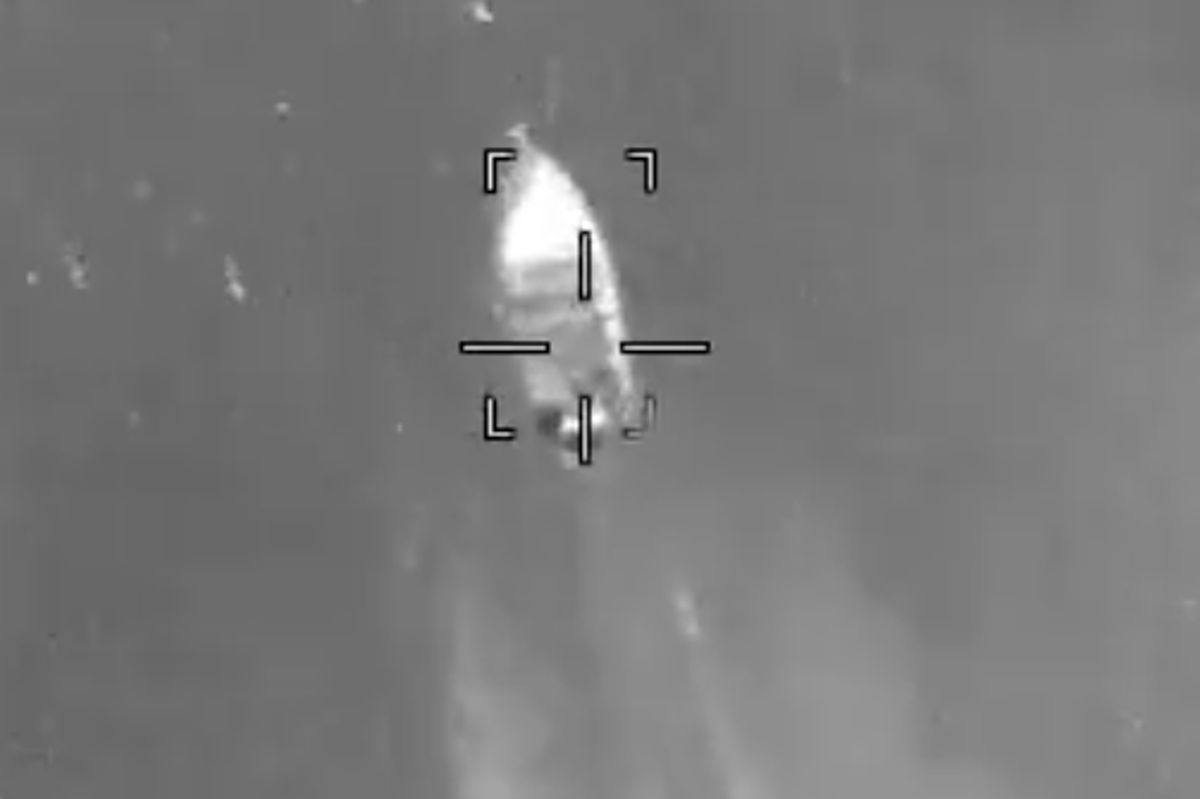
The hand-wringing over the latest Pacific drug boat strike is predictable, tiresome, and fundamentally ignores how global security actually functions. Critics are currently obsessed with the legality of a kinetic strike against a low-profile vessel (LPV) in international waters. They want to talk about due process for narco-traffickers at 3:00 AM in the middle of the ocean. They are asking the wrong questions because they don’t understand the stakes of modern maritime interdiction.
The Pacific is not a courtroom. It is a vast, unpoliced gray zone where the speed of a decision determines the safety of a hemisphere. When the U.S. military or Coast Guard assets engage a "narco-sub," they aren't just stopping a shipment of powder. They are dismantling a logistics network that mirrors the supply chains of state-sponsored insurgencies.
The Myth of the Innocent Fishermen
The most common "lazy consensus" pushed by human rights observers is that these crews are often coerced, low-level poverty-stricken locals. This narrative suggests that blowing a hole in a fiberglass hull is a disproportionate response to a crime driven by desperation.
Let’s be real. These "poverty-stricken" crews are operating sophisticated, custom-built semi-submersibles that cost upwards of $2 million to manufacture. These vessels are engineered with specialized exhaust cooling systems to evade infrared detection. They carry encrypted satellite comms. To suggest that the military should treat these as simple "boats in distress" or civilian craft is a dangerous fantasy.
When a vessel refuses to heave to, ignores international maritime signals, and begins scuttling—sinking the evidence along with the crew—they have already opted out of the protections of civil law. At that point, the vessel is an unidentified tactical threat.
The Sovereignty Fallacy
Lawyers love to argue that the U.S. lacks jurisdiction in these "lethal" encounters. This ignores the bilateral "shiprider" agreements that have been the bedrock of Pacific security for decades.
If you think the U.S. is acting as a lone wolf, you haven't been paying attention to the Department of Defense’s collaborative framework. Nations across Central and South America are begging for these interdictions. Why? Because these drug boats are the same vessels used to test vulnerabilities in coastal defense. Today it’s six tons of cocaine; tomorrow it’s a dirty bomb or human trafficking.
The legal "mounting questions" mentioned in mainstream headlines are a distraction. Under the Maritime Drug Law Enforcement Act (MDLEA), a vessel without nationality is subject to the jurisdiction of the United States. If you strip your boat of flags and registration to hide your identity, you lose your right to complain about international protocol. You have effectively declared yourself hostis humani generis—an enemy of all mankind.
Kinetic Energy is a Communication Tool
Critics argue that "three dead" is a failure of policy. I argue it is a brutal, necessary signal.
In the world of high-stakes smuggling, the only currency that matters is risk. If the deterrent is a decade-long trial in a federal court with a high chance of a plea bargain, the cartel’s ROI remains positive. When the deterrent is a kinetic strike that sends your cargo and your crew to the bottom of the Mariana Trench, the math changes.
We have spent twenty years trying to "police" the ocean. It doesn't work. The ocean is too big, and the traffickers are too well-funded. Moving from a policing mindset to a high-intensity interdiction mindset is the only way to disrupt the flow.
The Real Cost of Scuttling
Let's break down the mechanics of these "deadly" strikes. Often, the deaths occur because the crew chooses to scuttle the boat to destroy evidence. They open the sea valves, the boat fills with water, and they jump into the dark.
The media frames this as "U.S. Military Kills Three." The reality is often "Three Die After Intentionally Sinking Unseaworthy Vessel to Avoid Prison."
The military isn't out there hunting for sport. They are operating under strict Rules of Engagement (ROE). If a strike is authorized, it’s because the threat profile reached a threshold where the potential for violence against the boarding party or the escape of a high-value shipment outweighed the risk of lethal outcomes.
Precision Over Proportionality
The argument for "proportionality" is a trap. In a fight against non-state actors using "dark" vessels, proportionality is a recipe for getting your own sailors killed.
I’ve seen the aftermath of "soft" boardings where crews hidden in the hull opened fire with automatic weapons the moment a Coast Guard officer stepped on deck. When you are dealing with a craft that has no manifest, no flag, and a crew that answers to a cartel boss rather than a government, you lead with overwhelming force.
The use of precision-guided munitions or sniper fire to disable engines is a technical marvel that saves lives by preventing high-speed chases that lead to catastrophic collisions. When it fails and people die, it’s a tragedy, but it’s a tragedy born of the smugglers’ choices, not the military’s intent.
The Tech Gap is Closing
We are entering an era where the cartels are using autonomous underwater vehicles (AUVs). These are not clunky DIY projects. They are silent, unmanned, and capable of carrying massive payloads across thousands of miles.
If we don't establish a hard-line precedent of kinetic interdiction now, we will be completely helpless when the Pacific is swarming with narco-drones. The "legality" debate is a 20th-century luxury we can no longer afford. We need to stop treating the ocean like a suburban neighborhood and start treating it like the tactical frontier it is.
Addressing the "Humanitarian" Critique
"Why couldn't they just use non-lethal means?"
This is the favorite question of the armchair strategist. Non-lethal means, like fouling a propeller or using LRADs (Long Range Acoustic Devices), require proximity. Proximity equals vulnerability. In the open ocean, with 15-foot swells and a target that might be rigged with explosives, "non-lethal" is often a synonym for "suicidal."
The military's job is to neutralize the threat with the lowest possible risk to American assets. If that requires a kinetic strike from a distance, that is the correct tactical choice. To suggest otherwise is to value the life of a drug runner over the life of a sailor.
The Strategy of Forced Friction
The goal of these strikes isn't to stop every gram of drugs. That’s impossible. The goal is to create friction.
Every time an LPV is sent to the bottom, the cartel loses millions in hardware and months of shipbuilding time. Most importantly, they lose the "security" of the route. By making the Pacific a high-mortality zone for smugglers, you force them into longer, more expensive, and more detectable routes.
This isn't about the "War on Drugs" in the 1980s sense. This is about theater denial. It’s about telling every non-state actor that if you enter this water without a flag, you are a target.
The Hard Truth
We like to pretend that the world is governed by ink on paper. It isn't. It is governed by the ability to project power and the will to use it.
The critics pearl-clutching over "three dead" are the same people who will complain when fentanyl deaths spike in their zip code next quarter. You cannot have it both ways. You cannot demand "safe" streets and "humane" high-seas interdiction against a ruthless, multi-billion dollar shadow army.
The Pacific strikes are a message. They are a demonstration of technical superiority and a refusal to allow the commons to be dominated by criminal enterprises.
The legality isn't mounting; the effectiveness is. If you find yourself in a drug sub in the middle of the Pacific, and the gray hull of a destroyer appears on the horizon, you have reached the end of your legal options. You are now in the realm of physics, and physics doesn't care about your "mounting questions."
Stop apologizing for the military doing exactly what it was designed to do: dominate the space and eliminate the threat. Every strike is a reminder that the ocean still belongs to those who can defend it. If the price of a secure hemisphere is a few sunken LPVs and the crews who chose to man them, that is a price we should be more than willing to pay.
The only mistake we’re making is not doing it more often.