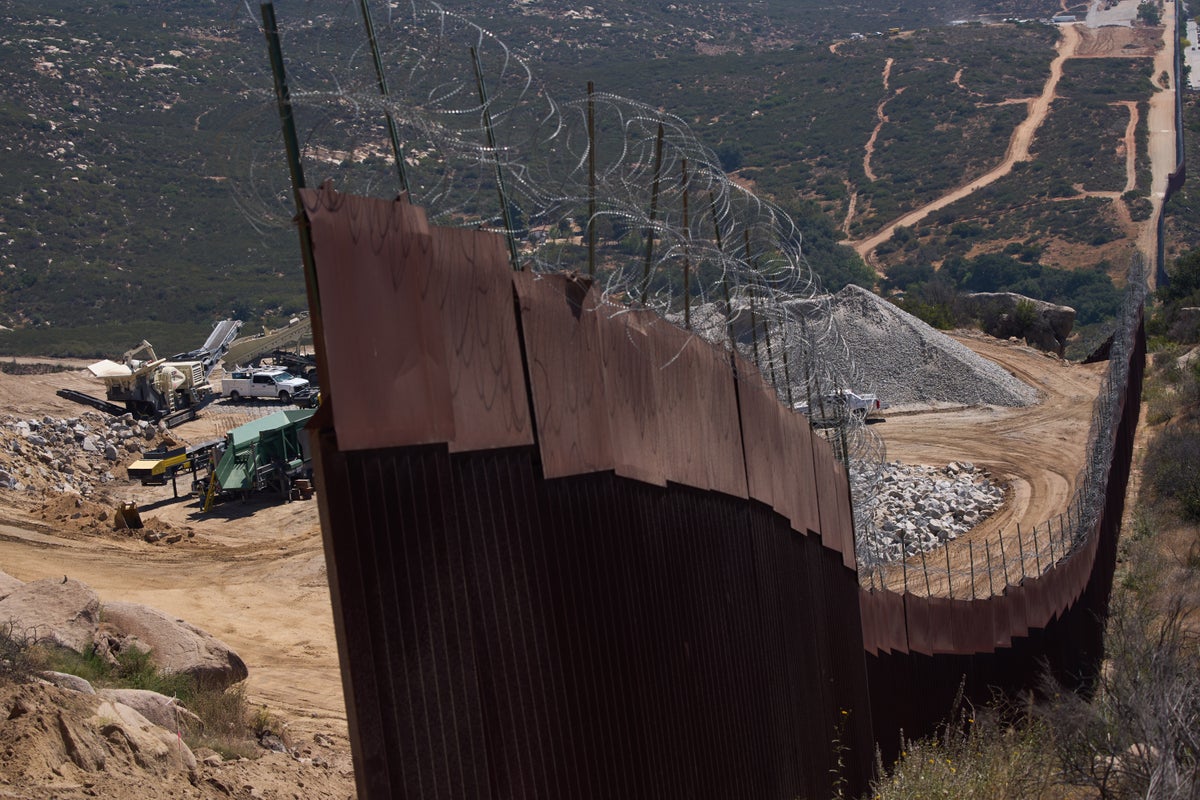
A thousands-year-old spring dried up in the Arizona desert, choked by tons of concrete poured into the earth. Explosive charges shattered the ridges of Monument Hill, a final resting place for Apache and O'odham warriors. Across the United States-Mexico border, the physical barrier erected under the guise of national security has achieved something far more permanent than stopping migration. It is systematically dismantling the archaeological and spiritual heritage of Native American tribes. While public debate focuses on immigration statistics and partisan posturing, the real mechanism driving this destruction is a sweeping, decades-old legal exemption that strips Indigenous nations of their statutory rights.
This is not a story about political theater. It is a story about the deliberate suspension of federal law.
The Real Power Weaponizing the Border Wall
To understand how ancient burial grounds and sacred water sources can be legally bulldozed, one must look past the border patrol trucks and focus on a single piece of legislation passed in 2005.
Under Section 102 of the REAL ID Act, the Secretary of Homeland Security possesses the extraordinary authority to waive any and all federal laws that might delay the construction of border barriers. This is not a standard administrative shortcut. It is an absolute legal bypass.
When the Department of Homeland Security invokes this waiver, it effectively erases the protections of the National Environmental Policy Act (NEPA), the Endangered Species Act, and, most crucially for tribal nations, the National Historic Preservation Act (NHPA) and the Native American Graves Protection and Repatriation Act (NAGPRA).
Laws Formally Waived Along the Border
- National Historic Preservation Act (NHPA): Eliminates the requirement to consult with tribes before disturbing historic or sacred properties.
- Native American Graves Protection and Repatriation Act (NAGPRA): Removes the legal obligation to protect, identify, and return excavated Native American human remains and cultural items.
- American Indian Religious Freedom Act: Strips away the guaranteed access to sacred sites and the freedom to worship through traditional rites at these locations.
Without these laws, tribes lose their seat at the table. The federal government is no longer legally mandated to consult with tribal leaders, conduct archaeological surveys, or halt bulldozers when human remains are uncovered. The barrier becomes an unstoppable bureaucratic force, moving through ancestral lands with total legal immunity.
The Tragedy of Quitobaquito Springs
The physical fallout of this legal vacuum is painfully evident at Quitobaquito Springs, a rare desert oasis located within Organ Pipe Cactus National Monument. For millennia, this water source sustained the Hia-C'ed O'odham people. It is a sacred site, a crucial ecological haven, and a historical resting point on ancient trade routes.
During the construction of the 30-foot steel bollard wall, contractors pumped millions of gallons of groundwater from local aquifers to mix the concrete needed for the wall's foundation.
The math is simple and devastating.
$$Groundwater\ Extraction > Natural\ Aquifer\ Recharge = Ecosystem\ Collapse$$
As the water table dropped, the flow rate of Quitobaquito Springs plummeted to historic lows. The mud cracked. The wildlife suffered. For the O'odham, the drying of the spring was not just an environmental issue; it was the severing of a living connection to their ancestors.
Further east, at Monument Hill, the destruction was even more visceral. Contractors utilized controlled detonations to clear ground for the wall and its accompanying patrol roads. This hill was a documented burial site, containing the remains of Apache ancestors who died in clashes with the Spanish and other tribes. Because the REAL ID Act waiver was active, there was no requirement to carefully excavate the site or repatriate the disturbed remains. The bones of ancestors were treated as mere displaced topsoil.
The Myth of the Fixed Border
The federal government often treats the border as a static line on a map. For the Tohono O'odham Nation, whose traditional lands stretch deep into Sonora, Mexico, the border is an artificial imposition that cuts directly through their living community.
Before the reinforcement of the barrier, tribal members moved back and forth across the border using traditional checkpoints to attend religious ceremonies, visit family members, and receive medical care. The modern wall has effectively bisected the tribe.
The Split Reality of the Tohono O'odham
- Ancestral Territory: Roughly 2.8 million acres in Arizona, historically extending far into Mexico.
- The Barrier Impact: High-intensity lighting, surveillance towers, and steel walls now block migratory routes and pilgrimage paths.
- The Security Paradox: The tribe spends millions of dollars of its own budget annually on tribal law enforcement to secure their reservation, yet their sovereign rights are routinely overridden by federal border mandates.
Tribal leaders are quick to point out that they do not advocate for lawlessness. They live on the border; they understand the complexities of cross-border crime better than most politicians in Washington. However, they argue that security does not require the eradication of their history. Modern surveillance technology, such as underground sensors and radar towers, could secure the perimeter without carving a scar of steel and concrete through sacred geography. The insistence on a physical wall is a political choice, not a technological necessity.
The Permanent Cost of Temporary Politics
When a historic building in a major city is threatened with demolition, preservation societies rally, lawsuits are filed, and injunctions are granted. The law protects the structure until a consensus is reached.
On the border, that legal recourse does not exist. The courts have repeatedly upheld the validity of the REAL ID Act waivers, ruling that Congress gave the executive branch absolute discretion over these lands. This leaves tribal nations with few options outside of public protest and international human rights appeals.
The damage inflicted by these construction projects is irreversible. A mountain blasted apart cannot be glued back together. An ancient aquifer drained and compressed cannot easily be refilled. When a bulldozer grinds through an unmapped pre-Columbian village site, the context of those artifacts is lost forever to science and history.
The political rhetoric surrounding the border wall will inevitably shift with changing administrations. Construction may halt under one president and resume under the next. But for the Indigenous peoples of the Southwest, the wall is not a temporary political talking point. It is a monument to their ongoing displacement, built with concrete mixed from their own sacred water.