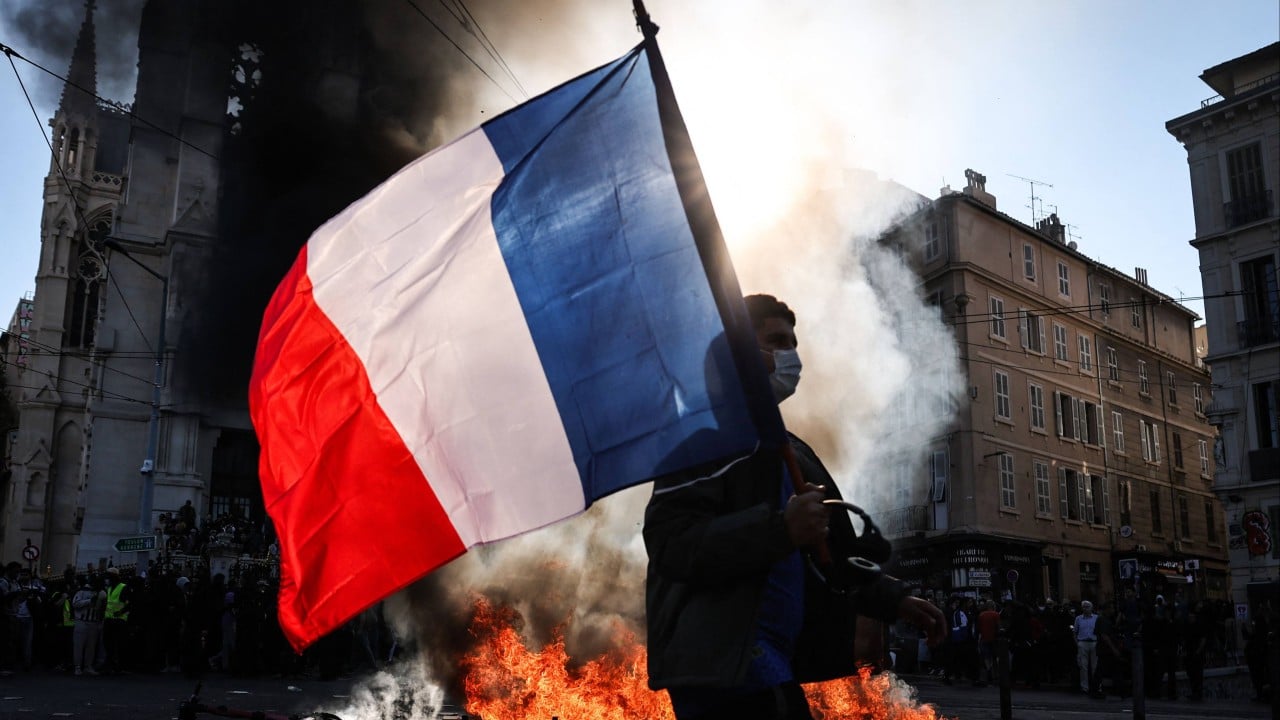
The café chair was still warm when the first siren wailed three blocks away.
Not a distant murmur. Not the polite, musical chime of a Parisian ambulance weaving through Sunday traffic near Luxembourg Gardens. This was low, metallic, urgent—the kind of sound that makes a porcelain espresso cup vibrate against a saucer. Across the zinc counter, a waiter whose apron had already survived twelve hours of lunch service didn't look up from his rag. He simply wiped a little slower, eyes flicking toward the tall glass panes facing the boulevard, gauging the angle of the afternoon light and the weight of the air.
Travelers often arrive in France carrying a postcard in their heads. Lavender fields in Provence. Croissants flaking onto linen napkins in Lyon. The Eiffel Tower catching late-day copper along the Seine. Nobody packs a sense of civic tension in their carry-on, yet there it sits—unannounced, unscheduled, woven into the very architecture of a country that treats public square protest not as an interruption of daily life, but as one of its oldest dialects.
I have stood on a wet cobblestone street in Bordeaux while tear gas drifted like morning fog between stone facades that had watched revolutions come and go for centuries. My eyes burned. My throat scratched. And right beside me, an elderly couple in sensible walking shoes argued calmly about whether the tram line two avenues over would still run before dinner. That contrast—ordinary domestic rhythm colliding with sudden civic friction—is what disorients visitors most. You expect either a war zone or a museum. France is almost never either.
To be clear, the scenes and people you are about to meet in these pages are hypothetical composites built to illustrate real patterns travelers encounter during periods of French unrest, rather than accounts of a single real-world incident. When I compare civic tension to weather moving across a valley, that is a metaphor meant to help you read the terrain, not a literal forecast.
The Misreading of a Siren
Panic is expensive. So is indifference.
Most travel advisories flatten complex social movements into a single word: unrest. To a reader sitting at a kitchen table thousands of miles away, unrest sounds like a fuse burning toward a blast. It triggers an all-or-nothing reflex. Cancel the flights. Eat the non-refundable hotel deposit. Pretend the trip never existed.
That reflex is understandable. Nobody wants to spend their savings watching barricades go up outside a booked boutique hotel or getting trapped between police cordons while trying to catch a train to Nice. Admitting that safety and disruption feel blurry during political protests isn't a sign of weakness; it's basic human self-preservation. I have felt that knot in my stomach myself—staring at a push notification on my phone in a Marseille train station, wondering whether the delay ahead was a routine signal fault or the start of a blockade.
Yet reading every demonstration in France as a personal threat to a visitor misses how the country actually functions. Strikes over pensions, labor rules, agricultural policy, or government budgets are recurring features of French public life. Demonstrations are often planned in advance, routed along known boulevards, and heavily policed around specific ministries or symbolic squares. Most of the time, the friction is localized, noisy, and disruptive to transit rather than aimed at tourists.
Still, "mostly localized" does not mean "never messy." Protests can shift routes quickly. Clashes can erupt at the edges of peaceful marches when fringe groups break away. Smoke and crowds can spill into side streets a few hundred meters from where you planned to buy baguette and cheese. Dismissing the risk entirely is just as careless as canceling everything at the first headline.
Consider what happens next: a traveler lands at Charles de Gaulle with a tight schedule, a non-flexible rail pass, and no idea how a national strike ripples through the SNCF network or the Paris Métro. Suddenly, a minor civic dispute becomes a major logistical crisis—not because anyone targeted the traveler, but because their itinerary left zero slack.
When the Rails Go Quiet
Imagine a hypothetical traveler named Nadia, flying into Paris for a five-day autumn break with a single non-negotiable goal: taking the TGV south to Avignon on day three to meet old friends.
On paper, her plan is tidy. High-speed trains are fast. Connections are frequent. Nothing could go wrong except the weather.
Then a nationwide day of action hits transport workers. Suddenly, Nadia isn't fighting flames or tear gas. She is fighting a screen that reads Trafic perturbé—disrupted traffic. A strike in France rarely looks like Hollywood chaos. More often, it looks like a quiet platform, a glowing departure board with half the lines grayed out, and a line of patient, mildly exhausted commuters waiting outside a ticket office.
France's strength is also its vulnerability during strikes. Because public transit, rail, aviation control, and municipal services are deeply interconnected and heavily unionized, a walkout in one sector can ripple outward fast. Regional trains might run on skeleton schedules. Métro lines might close specific stations near protest zones for crowd control. Flights might face delays or cancellations when air traffic controllers join coordinated actions.
For someone on vacation, the emotional toll is subtle. You lose hours. You stand in drizzle with a rolling suitcase. You watch a carefully mapped day dissolve into improvising lunch at a corner bakery because your museum reservation is two miles away and the bus isn't coming.
If Nadia had built a buffer into her trip—say, arriving a day earlier in the south or keeping refundable bookings—the disruption would have been an annoyance rather than a disaster. Without slack, every delay feels personal.
A Country That Argues in Public
Why does this keep happening?
To understand what you are walking into when traveling to France during periods of unrest, it helps to look past the day's headlines and notice a deeper cultural habit. Since 1789, the street in France has carried a moral weight that many other democracies reserve for the ballot box or the courtroom. Marching, chanting, blocking traffic, gathering in Place de la République—these aren't treated merely as tantrums. To millions of French citizens, visible collective pressure is a legitimate civic tool when negotiations stall.
That history doesn't make disruption pleasant when you're trying to reach Gare du Nord. It does explain why a crowd chanting slogans outside a town hall can coexist ten minutes later with families strolling past a carousel. Life splits into lanes. One lane marches; another shops; another argues over wine prices at a bistro table.
Over years of traveling through cities like Lyon, Nantes, and Paris during tense moments, I've noticed a pattern in how locals respond. French residents rarely panic at the sight of riot police vans parked near a major square. They check transport apps first, news alerts second, and adjust their walking routes with practiced efficiency. Visitors, by contrast, often read the presence of armored vehicles as proof that danger is everywhere.
Both readings are incomplete. Armored vehicles mean authorities are preparing for friction, often around predictable flashpoints. They do not automatically mean the entire city is unsafe. At the same time, local nonchalance shouldn't lull you into strolling straight toward a crowd pushing against barriers just to get a dramatic photo. Curiosity can pull you into a bottleneck before you realize the exits are tightening.
Reading the Room Like a Local
So how do you move through France with clear eyes when unrest is in the news?
Start by ditching the idea of a rigid, minute-by-minute clock. Treat your itinerary like a sailboat rather than a train on tracks: you still have a destination, but you adjust tack when the wind shifts. Book flexible or refundable reservations where possible, especially for intercity trains and flights during announced strike windows. Keep an eye on official operator updates rather than relying solely on breathless social media clips that strip ten seconds of footage out of its street context.
Pay attention to geography, too. Protests tend to cluster around symbolic squares, government buildings, major transit hubs, and certain commercial boulevards. If demonstrations are scheduled for a given afternoon, moving your sightseeing to another neighborhood—or shifting your schedule earlier in the day—often lets you sidestep the worst bottlenecks altogether.
Listen to the people who live there. Not to treat them as oracles, and certainly not to pester busy staff during a rush, but to read the temperature of the block. A hotel receptionist, a bakery owner, or a neighbor in your apartment building usually knows within an hour if a station has shut down or if a march is heading toward your street.
Most of all, give yourself permission to feel two things at once. You can respect the seriousness of social grievances in a country you love while still feeling frustrated that your cross-country train just got canceled. You can stay careful around crowds without turning your trip into a hostage situation of fear.
The Quiet After the Noise
Hours after that first siren faded near Luxembourg Gardens, the boulevard settled again.
The demonstrators had moved on or dispersed. A street sweeper hummed softly along the curb, washing away the last traces of paper flyers and grit. Along the sidewalk, a young man sat on a low stone wall reading a paperback, while a couple walked past holding hands, their reflections stretching long and thin across the damp pavement as dusk crept in.
Nothing had been erased. The tensions that brought people into the streets didn't vanish because the evening grew quiet. Yet the city breathed on—imperfect, loud, stubbornly alive, demanding only that you pay attention rather than look away.
When you step off the plane into France during turbulent weeks, you aren't stepping into a postcard frozen in amber. You're stepping into a living argument with a deep soul. Bring patience. Bring curiosity. Leave room for detours. And watch how much more of the real country you see when you stop expecting the streets to stay silent.