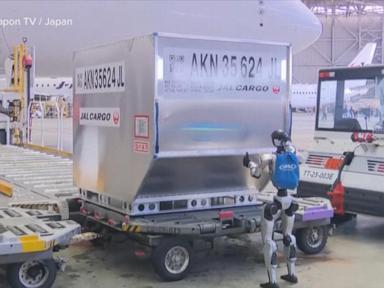
Tokyo’s Haneda Airport is currently the playground for a very expensive, very shiny delusion. The headlines are screaming about a "revolution" in ground handling because a few bipedal robots are lifting suitcases. It looks like the future. It feels like The Jetsons.
It is actually a massive step backward in engineering logic. Meanwhile, you can read other developments here: The Myth of the Stolen Nonprofit and Why OpenAI Was Never Meant to Be Free.
The tech press is swooning over the "human-like" dexterity of these machines. They see a robot with two arms and two legs and think, "Finally, the labor shortage is solved." They are wrong. Designing a robot to look like a human to do a job humans hate is the most inefficient way to automate a workspace. We are witnessing the "Uncanny Valley of Productivity," where form is being prioritized over function to satisfy a marketing department's desire for a viral video.
The Biomechanical Fallacy
Human beings are versatile, but we are mechanically inefficient for heavy lifting. We have high centers of gravity, prone-to-failure lower backs, and a power-to-weight ratio that would make an industrial arm laugh. To explore the complete picture, check out the excellent article by Engadget.
When you build a humanoid robot to move luggage, you are intentionally inheriting all those biological flaws. You are spending millions of dollars to replicate a spine that can slip a disk.
True automation doesn't mimic the worker; it replaces the need for the worker's shape.
- The Sucker’s Bet: Building a $200,000 humanoid to lift a 50lb bag.
- The Engineer’s Solution: A specialized gantry system or a modular conveyor belt that costs a fraction of the price and never needs to balance on two legs.
I have watched logistics firms burn through venture capital trying to make "Androids" happen in warehouses. Every single time, the company that installs a "dumb" autonomous forklift or a ceiling-mounted sorting grid wins on throughput. Why? Because a forklift doesn't have to waste 40% of its processing power just staying upright.
The Latency of "Cool"
The biggest lie in the Haneda "pilot programs" is the speed. Watch the footage closely. These robots move with the agonizing hesitation of a toddler walking on ice. They calculate every centimeter of movement.
In the high-pressure ecosystem of an international hub, speed is the only metric that matters. A flight turnaround is a brutal race against the clock. Ground crews are judged by seconds.
If a humanoid takes 30 seconds to identify, grip, and pivot a single suitcase, the system has already failed. A traditional automated baggage handling system (BHS)—the kind that lives under the floor and uses scanners and high-speed diverters—processes thousands of bags an hour.
Replacing a BHS with a humanoid is like replacing a fire hose with a person carrying a silver bucket. It looks more "human," but the building is still going to burn down.
The Maintenance Nightmare Nobody Mentions
Let’s talk about the "Joint Complexity Tax."
A standard industrial robotic arm has six degrees of freedom. It is a proven, hardened piece of hardware. A humanoid robot trying to navigate a tarmac or a loading bay requires upwards of 20 to 30 actuators.
Each one of those is a point of failure.
- Hydraulic/Electric Stress: Constant stabilization wears out motors faster than repetitive lifting.
- Environmental Variables: Haneda deals with jet blast, humidity, and temperature swings. Sophisticated sensors on a humanoid are notoriously finicky compared to the ruggedized sensors on a standard autonomous guided vehicle (AGV).
- The "Fall" Factor: If a conveyor belt breaks, you fix a motor. If a 300lb humanoid loses its balance on a slick floor, it becomes a pile of expensive scrap metal and a massive safety hazard to any humans nearby.
We are choosing the most fragile form factor for the most rugged environment. It’s vanity masquerading as innovation.
The Labor Shortage Myth
The "People Also Ask" sections of the internet are obsessed with whether these robots will "take our jobs."
The industry insiders know the truth: There aren’t enough people who want these jobs at the current price point. The labor shortage is real, but the humanoid isn't the solution. It’s a distraction from the fact that airports are poorly designed for modern volumes.
If an airport needs a humanoid to move bags, it means the airport's infrastructure is obsolete.
Modern terminals should be "Robot-First," not "Robot-Retrofit." A Robot-First terminal doesn't have stairs or narrow gaps where a human-shaped machine is necessary. It uses wide, flat planes and magnetic tracks.
The only reason Haneda is testing humanoids is that they are trying to cram "new" tech into "old" architecture. It’s like trying to run a fiber-optic cable through a lead pipe. You might get it to work, but you’ve wasted a lot of effort fighting the container.
Follow the Money
Why is this happening? Because of the "Innovation Halo."
Airports like Haneda are in a constant battle for "World’s Best" rankings. Having a robot greet you or handle your bag buys you a lot of prestige. It signals to investors and the public that Japan is still the leader in robotics.
But as an insider, I look at the balance sheets. The cost-per-bag moved by a humanoid is astronomical compared to any other method.
- Human worker: High turnover, moderate cost.
- Specialized Automation: High upfront cost, extremely low per-unit cost over ten years.
- Humanoid Robot: Extremely high upfront cost, high maintenance cost, low throughput.
It is the least efficient financial model in the history of logistics.
The Nuance of Tactile Intelligence
There is one area where the pro-humanoid crowd has a point: grip. Bags come in all shapes, sizes, and degrees of "floppiness." A hard-shell suitcase is easy; a half-empty duffel bag with loose straps is an automated system’s nightmare.
The "experts" say we need humanoids for this.
Wrong. We need better end-effectors (the "hands"), not a whole body.
We can put a sophisticated, AI-driven soft-robotics gripper on a standard, stationary industrial arm. We can mount that arm on a base with wheels. You get all the "dexterity" without the unnecessary baggage of a torso, a head, and two legs that serve no purpose other than to look "friendly."
The Brutal Reality of Haneda’s PR
If you want to see the future of baggage handling, don't look at the robot with the face. Look at the software that optimizes the flow of containers through the bowels of the airport. Look at the computer vision systems that identify a ripped tag in 0.01 seconds.
The humanoid is a mascot. It is the technological equivalent of a parade float.
It is designed to be photographed, not to be productive. When the pilot program ends and the cameras go home, most of these machines will be relegated to a glass display case or a storage closet.
The industry doesn't need "man-plus" machines. It needs "process-minus" thinking. We need to remove the steps that require a human shape in the first place.
Stop cheering for the robot that can walk. Start demanding the airport that is so well-designed it doesn't need to walk at all.
Investing in humanoid baggage handlers is the clearest sign that a company has run out of actual ideas. It is a surrender to optics over operations. If you are an investor, run the other way. If you are a traveler, enjoy the show, but don't expect your bags to arrive any faster.
The future is coming, but it won't have legs.