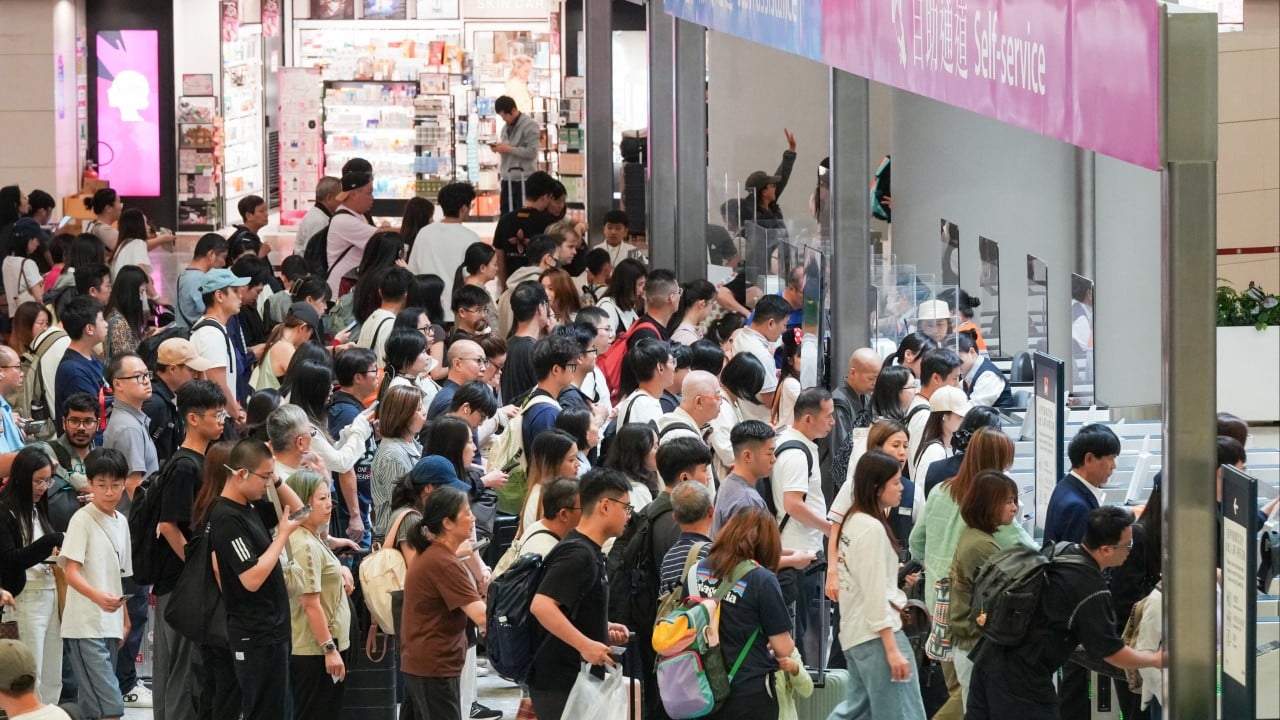
The Labour Day "Golden Week" was once a guaranteed windfall for Hong Kong’s retail and hospitality sectors. This year, the script has flipped. Instead of welcoming a flood of mainland tourists, Hong Kong is watching its own middle class flee north in record numbers. The flow across the Lo Wu and Lok Ma Chau checkpoints isn’t just a holiday trend. It is a fundamental shift in the economic gravity of the Pearl River Delta. Shenzhen is no longer just a cheaper alternative. It has become a superior consumer ecosystem that Hong Kong’s rigid, high-rent business model can no longer compete with.
The Mathematical Death Spiral of Hong Kong Retail
For decades, Hong Kong thrived on a "high-rent, high-margin" model. Landlords squeezed retailers, and retailers passed those costs onto consumers. This worked as long as Hong Kong held a monopoly on luxury goods and international dining. That monopoly has evaporated. Expanding on this topic, you can find more in: Stop Cheering for the Scotch Tariff Cut (It’s a Trap).
A middle-class family from Tai Po or Sha Tin looks at the numbers and sees a glaring disparity. In Shenzhen, the purchasing power of the Hong Kong Dollar—pegged to a strong US Dollar—goes nearly three times as far. We aren't just talking about cheap street food. We are talking about high-end omakase, expansive indoor theme parks, and membership warehouses like Sam’s Club and Costco that offer a scale of commerce impossible in Hong Kong’s cramped urban layout.
When a Hong Kong restaurant charges $80 for a basic lunch set served by a harried waiter in a 400-square-foot space, and a Shenzhen competitor offers a gourmet experience in a palatial setting for $30, the "loyalty" to local business fails. This is a cold, rational economic choice. Observers at CNBC have shared their thoughts on this situation.
Service as a Competitive Weapon
Hong Kong’s service industry is exhausted. Decades of labor shortages and high pressure have resulted in the infamous "attitude" that many locals now actively avoid. Shenzhen has moved in the opposite direction. The service culture in mainland malls—often characterized by aggressive politeness, tech-integrated ordering, and massive staffing levels—makes the Hong Kong experience feel archaic.
The technological gap is widening. While Hong Kong still fumbles with fragmented payment systems and paper loyalty cards, Shenzhen’s retail landscape is built on a seamless data spine. You enter a mall, and the infrastructure knows your preferences. Your car’s license plate is scanned for parking discounts before you even find a spot. This isn't just convenience. It is an optimized machine designed to capture and retain consumer attention.
The Sam’s Club Phenomenon
The rise of "bulk-buy tourism" is perhaps the most visible sign of this shift. Chartered buses now run daily from Hong Kong housing estates directly to Sam’s Club in Shenzhen. This isn't about luxury. This is about the daily cost of living. When residents start importing their toilet paper, detergent, and frozen meats from across the border, it signals a total loss of confidence in the local domestic supply chain.
Hong Kong’s supermarkets are dominated by a duopoly that has seen little reason to innovate for thirty years. They are now facing a competitor that operates on a global scale with a logistical footprint that dwarfs anything in the city. The result is a hollowed-out local grocery sector that can only survive on the convenience of being "downstairs." For everything else, the people are heading north.
Infrastructure as an Enabler of Flight
The very infrastructure meant to integrate the Greater Bay Area has become a one-way valve. The High-Speed Rail and the bridge networks were built to bring people in. Instead, they have made it easier than ever to leave. It is now faster for a resident of West Kowloon to reach a Shenzhen mall than it is for them to travel to a shopping district in the Eastern District of Hong Kong Island.
We are seeing the "suburbanization" of the border. Shenzhen is becoming Hong Kong’s backyard, its weekend playground, and its pantry. This creates a massive capital outflow that the Hong Kong government hasn't yet figured out how to plug. You cannot "Buy Hong Kong" your way out of a price and quality gap this wide.
The Rent Crisis Nobody Wants to Solve
The elephant in the room remains the property market. Hong Kong’s economy is a giant machine designed to keep land prices high. This trickles down into every cup of coffee and every bowl of noodles. In Shenzhen, while property is by no means cheap, the commercial spaces are vast and the supply is elastic.
A Shenzhen restaurateur can afford to dedicate 20% of their floor space to a waiting lounge with free snacks and manicures. A Hong Kong owner has to pack tables so close together that you can hear your neighbor’s heartbeat. Until the cost of space in Hong Kong undergoes a radical correction, the city will remain a high-cost, low-value destination for its own citizens.
A New Regional Identity
The younger generation of Hongkongers does not carry the same psychological barriers toward the mainland that their parents might have had. They see a city that is cleaner, newer, and more "Instagrammable." They are looking for "vibes," and currently, Hong Kong’s vibe is one of a tired, aging hub resting on its laurels.
Shenzhen’s attractions—from the massive "TeamLab" style digital art installations to the sprawling urban parks—are designed for a generation that values experience over ownership. Hong Kong’s attractions feel like relics of the 1990s. Even the iconic Harbour front is often criticized for its lack of seating, shade, and basic amenities compared to the meticulously planned bay areas of its northern neighbor.
The Survival of the Specialized
Can Hong Kong retail survive? Only if it stops trying to be a "everything" hub. The city cannot compete on price, and it can no longer compete on basic convenience. It must pivot toward extreme specialization—high-end experiences that cannot be replicated by the mass-market machines of the north.
This requires a total mindset shift. It means moving away from the "churn and burn" service model and toward true hospitality. It means landlords accepting lower yields to allow for creative, independent businesses to breathe. If the city remains a collection of the same five luxury brands and three supermarket chains, the exodus will only accelerate.
The Regulatory Gap
There is also the matter of regulatory friction. Shenzhen’s digital economy moves at the speed of light. New dining concepts, pop-up stores, and entertainment venues can launch and scale in weeks. Hong Kong’s licensing and fire safety regulations, while necessary for safety, are often cited by business owners as a suffocating bureaucratic maze that kills innovation before the first customer walks through the door.
When a Hong Kong entrepreneur wants to try something new, they face eighteen months of permit applications. In that same time, a Shenzhen competitor has already opened ten branches and iterated their menu five times based on real-time data. The speed of business in the north is simply higher.
The Long Road Back
The Labour Day exodus is a warning shot. It tells us that the "Greater Bay Area" integration is working exactly as intended, but with consequences that Hong Kong’s elite didn't fully anticipate. The city is being forced to compete on a level playing field for the first time in its history.
This isn't a temporary dip in local spending. It is the new baseline. Hong Kong’s business leaders need to stop blaming "outbound travel trends" and start looking at their own balance sheets and service standards. The consumer is voting with their feet, and they are walking across the bridge.
The solution isn't more marketing campaigns or "Night Vibes" carnivals. It is a structural overhaul of how space is used and how value is defined in a city that has become too expensive for its own good. If Hong Kong wants its people back, it has to earn them.
The era of the captive consumer is over.