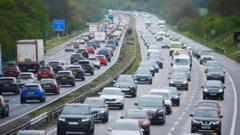
The coffee in the cupholder has transitioned from a comforting steam to a lukewarm skin. Outside the windshield, the red glow of brake lights stretches toward the horizon like a river of molten glass that has forgotten how to flow. You are not moving. Nobody is moving. To your left, a toddler in a silver SUV is pressed against the glass, making faces at a bored golden retriever in the hatchback ahead. To your right, a courier is drumming his fingers on the steering wheel in a staccato rhythm of pure, unadulterated frustration.
This is the British Easter Bank Holiday. It is the moment when a nation collectively decides to flee its living rooms, only to trade them for a metal box on the M25, the M6, or the A1. If you found value in this piece, you might want to read: this related article.
According to the latest figures from the RAC and INRIX, we are looking at the busiest Easter weekend on the roads in four years. An estimated 14 million leisure trips are planned between Friday and Monday. That is not just a statistic; it is a logistical mountain. It is the equivalent of the entire population of London and Birmingham combined deciding to pack a suitcase, grab a bag of salt and vinegar crisps, and head for the coast at exactly the same time.
The Ghost of 2019
We haven't seen numbers like this since before the world changed. In the years following the lockdowns, our travel patterns were tentative, fractured by lingering caution or the strange novelty of staying put. But the caution has evaporated. It has been replaced by a desperate, clawing need for the "Great British Getaway." For another look on this story, check out the latest update from Travel + Leisure.
Consider Sarah. Sarah is a hypothetical but painfully accurate representation of the 2.6 million people who will hit the tarmac on Good Friday alone. She has two kids, a husband who forgot to pack the chargers, and a dog that gets carsick if the vehicle moves at anything less than a steady crawl. Sarah’s goal is simple: reach her parents’ house in Devon before the roast lamb turns into leather.
The math is against her.
Data analysts suggest that travel times on major routes could be double their usual length. A journey that normally takes two hours will now take four. The "peak" isn't a peak anymore; it’s a plateau of congestion. On Friday, the danger zone sits between 11:00 AM and 3:00 PM. If you are on the road then, you aren't "making good time." You are the traffic.
The Physics of Frustration
Why does this happen every year? It’s a collision of biology and geography. We are wired for the ritual of the spring break. After the grey, damp slog of a British winter, the promise of a four-day weekend acts like a magnetic pull toward the edges of the island. But our road network was never designed for 14 million people to simultaneously enact a migration.
The bottleneck is a mathematical certainty. When the volume of cars exceeds the "flow capacity" of a lane, the slightest tap on a brake pedal three miles ahead creates a ripple effect. This is the "shockwave" phenomenon. One person slows down to look at a cloud; ten minutes later, someone five miles back comes to a dead stop.
The stakes are invisible until they aren't. We talk about "delays," but we don't talk about what is lost in those delays. We lose the first afternoon of the holiday. We lose the patience required to be kind to our partners. We lose the fuel—millions of pounds of it—idling away as exhaust fumes mingle with the scent of roadside gorse.
The Strategy of the Outsider
There is a way to beat the machine, but it requires the discipline of a monk and the timing of a heist.
The data is clear: the road belongs to the early and the late. If you can stomach a 5:00 AM departure, you are a ghost in the system. You pass through the interchanges before the heavy hitters have even found their car keys. Alternatively, waiting until after 8:00 PM on Friday turns a grueling trek into a cinematic night drive.
But most of us won't do that. We are creatures of habit. We want the full Friday. We want the breakfast at home. And so, we pay the tax of time.
The RAC warns that the M25 clockwise from Bromley to the Dartford Crossing will be a particular circle of hell. The M6 northbound between Liverpool and the Lake District will resemble a very long, very expensive parking lot. These are the arteries of the country, and right now, they are showing signs of a collective cardiac event.
The Human Cost of the "Quick Trip"
Think about the breakdown patrols. For them, Easter isn't a holiday; it’s a marathon. They will be attending to thousands of vehicles that simply weren't ready for the strain. Battery failures, punctured tires, and the dreaded "wrong fuel" calls spike during this window.
There is a specific kind of vulnerability in sitting on the shoulder of a motorway while the rest of the world thunders past at 70 miles per hour. It makes the car feel small. It makes the holiday feel fragile. We treat our vehicles like invincible bubbles, but 14 million trips mean 14 million opportunities for something to go wrong.
The pressure isn't just on the engines. It's on the people.
We’ve all been there. The tension in the shoulders. The way the radio suddenly feels too loud. The internal calculation of whether you can make it to the next service station without a bathroom break. We are a nation of people currently obsessed with "ETA." We refresh our maps, hoping for a sliver of green to replace the oppressive red line on the screen.
The Empty Seat at the Table
The real reason we endure this isn't because we love driving. It’s because of what waits at the other end. It’s the grandmother who hasn't seen the kids since Christmas. It’s the cottage by the sea where the air tastes like salt instead of diesel. It’s the ritual of the Easter egg hunt in a garden that isn't yours.
We accept the 14 million-person scrum because the alternative—staying put—feels like a surrender to the mundane. We are willing to sacrifice six hours of our lives to the tarmac gods just for the chance to sit in a different chair and look at a different patch of sky.
But perhaps we’ve got the rhythm wrong.
Maybe the "busiest roads in four years" is a warning we should heed differently. If everyone is going left, there is a profound, quiet power in going right. Or staying. Or leaving on the Tuesday when the world has already returned to its desk.
But as the clock ticks toward Friday, the first of those 14 million engines will cough into life. A child will ask if they are there yet before the car has even left the driveway. A parent will grip the wheel, take a deep breath, and plunge into the red line.
The road is waiting. It is hungry. It is indifferent. And it is going to be a very, very long weekend.