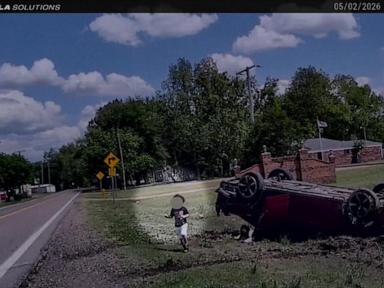
The metal cools first. That is the thing they never tell you about a car crash.
Before the sirens cut through the suburban quiet, before the flashing red and blue lights paint the leaves of the roadside trees, there is a distinct, heavy silence. The ticking of a dying radiator. The smell of scorched rubber and spilled fuel mixing with the damp earth of a ditch. And the metal, twisted and inverted, losing its engine heat to the pavement.
We see the headlines constantly. They blur into a background hum of modern anxiety. Police pursuit ends in crash. We click, we sigh, we judge, and we move on. We treat these events like a physics equation solved at high speed, a predictable outcome of bad choices and horsepower. But an equation has no heartbeat. It doesn't capture the terrifying frailty of a human body suspended upside down by a piece of nylon webbing, waiting for the glass to stop falling.
When a vehicle flips, the world loses its axis. Up becomes a distant memory. For an adult, the experience is a violent dislocation of reality. For a child, it is the sudden, inexplicable betrayal of the only cocoon they have ever known.
The Velocity of Bad Decisions
Every high-speed pursuit begins with a micro-choice. A foot presses down on a pedal instead of a brake. In that singular moment, the driver decides that flight is preferable to consequence. What they rarely calculate is the compounding interest of momentum.
A two-ton sedan moving at eighty miles per hour carries enough kinetic energy to shatter concrete. It becomes a missile guided not by telemetry, but by panic. When that pursuit weaves through residential streets, the stakes change from a legal dispute to a lottery where innocent people hold the tickets.
Consider the anatomy of a chase from the perspective of the officers involved. The adrenaline hit is immediate. The human body is not designed to operate a vehicle at the absolute limit of control while simultaneously communicating on a radio, predicting traffic patterns, and evaluating the shifting threshold of public danger. It is a high-wire act performed over a canyon of worst-case scenarios.
The policy manuals of police departments across the country are thick with guidelines on when to terminate a pursuit. They speak in cold terms of "proportionality" and "risk-to-severity ratios." Yet, the reality on the asphalt is fluid. A suspect accelerates. A cruiser follows. The gap closes and widens like an accordion.
Then comes the intersection. The curb. The overcorrection.
The moment a vehicle trips—whether by hitting a tire-deflation device, a median, or another vehicle—the laws of motion take over completely. The driver is no longer in control; they are merely a passenger in a chaotic demonstration of centrifugal force. The car rolls. One, two, three times. The roof collapses. The windows explode into thousands of granular, harmless-looking cubes that still manage to cut like tiny knives.
And then, the stillness.
The Cargo in the Back Seat
We often talk about criminals and cops as the dual protagonists of the nightly news. We analyze the perpetrator's rap sheet and debate the tactics of the law enforcement agency. But there is a third category of person in these stories, one who never signed up for the drama, who has no concept of the law, and who relies entirely on the adults in the room to keep the universe spinning on its tracks.
Imagine a toddler car seat. It is a brightly colored contraption of molded plastic, dense foam, and five-point harnesses. To a parent, it is a daily chore—the struggle with stubborn buckles, the adjustment of straps over winter coats, the wiping away of crushed cheerios. We view it as a mundane fixture of family life.
In a rollover crash, that piece of plastic becomes a spacecraft. It is the only barrier between a developing spine and the crushing weight of a collapsing steel roof.
When the car comes to rest on its roof, the mechanics of survival shift. An adult is trapped by their own mass, wedged between the seat and the dashboard, dealing with the sudden rush of blood to the head. But a child, secured properly, hangs suspended. They are looking at a world that has been turned entirely upside down. The ceiling is now the floor. The floor is cluttered with the detritus of a normal day—a dropped toy, a stray shoe, shattered glass—all pooling beneath them.
The terror of that moment is silent. Children often do not cry immediately after a severe impact. The shock is too absolute. The sensory overload of the sound, the pressure wave of the airbags deploying, and the sudden cessation of movement leaves them breathless. They are waiting for a familiar voice to fix the world.
The First Responders’ Worst Nightmare
Ask any paramedic or police officer what call makes their stomach drop faster than any other. It is not a shooting, a fire, or a robbery. It is the code that indicates a child is involved in a major trauma.
When the dust clears from a pursuit-ended crash, the officers approaching the vehicle are not thinking about the handcuffs or the arrest warrant. They are listening. They are looking through the smoke and the shattered tint of the windows, praying they do not hear the specific, high-pitched wail of an infant, or worse, absolute silence from the back seat.
The extraction of a toddler from an overturned vehicle is a masterclass in controlled desperation. The doors are often jammed, requiring the mechanical leverage of a crowbar or the hydraulic teeth of the Jaws of Life. The metal screeches as it torn open, a horrific sound that echoes through the neighborhood.
When the officer reaches inside, they are operating in a confined, dangerous space. There is the lingering threat of a fire from ruptured fuel lines. There is the risk of the vehicle shifting if it is not properly stabilized. But the focus narrows down to a few inches of nylon strap.
Unbuckling a child from an inverted car seat requires immense care. The moment the chest clip is released, gravity takes over. The officer must cradle the child’s head and neck, ensuring that the transition from the seat to the outside world does not exacerbate any hidden spinal injury.
It is a delicate ballet performed by large men and women wearing heavy tactical gear, their hands shaking with a mix of adrenaline and profound relief when they realize the child is moving, breathing, and intact.
The Physics of Protection
It feels like a miracle when a child walks away from a demolished vehicle without a scratch. The media loves to use that word. Miracle. It makes for a beautiful headline. It warms the heart.
But calling it a miracle does a profound disservice to the decades of unglamorous engineering, rigorous testing, and regulatory battles that made that survival possible. The kid didn’t survive because of luck. They survived because a team of engineers spent thousands of hours crashing dummies into walls to understand how to dissipate energy away from a fragile human torso.
The modern car seat is a marvel of energy management. The five-point harness distributes the force of an impact across the strongest parts of a child’s body—the shoulders and the hips. The shell of the seat absorbs the initial blow, flexing just enough to deform and take the brunt of the kinetic energy, rather than passing it along to the occupant.
Moreover, the crumple zones of modern vehicles are designed to sacrifice themselves. The hood buckles, the fenders crush, and the engine block is deflected downward beneath the passenger cabin rather than backward into it. The vehicle is destroyed so that the people inside do not have to be.
Yet, all that engineering is useless if the human element fails. A car seat that is not anchored correctly, or straps that are left too loose because a child was fussy, can turn a survivable incident into a tragedy in a fraction of a second. The margin between a sigh of relief and an unbearable loss is often measured in the two inches of slack left in a seatbelt.
The Aftermath Beyond the Asphalt
The sirens eventually fade. The tow trucks haul away the mangled sculpture of steel and glass. The street sweepers clean up the debris, and the traffic begins to flow again, moving over the dark gouges in the asphalt left by the rims of a flipping car.
The news cycle moves on within an hour. The video clip of the toddler being pulled from the wreckage is shared on social media, garnering thousands of likes, angry emojis directed at the driver, and expressions of gratitude for the police. By tomorrow, it will be replaced by another piece of viral footage.
But for the people inside that circle of violence, the crash never really ends.
The suspect faces a judicial system that will measure their actions in years of prison time. The community debates the necessity of high-speed chases, questioning whether the capture of a non-violent offender is worth the risk of turning a neighborhood into a racetrack.
And the child? The physical bruises fade within weeks. The scratches heal. But the mind remembers the sudden shift in gravity. The sound of tearing metal becomes a permanent part of their internal library of fears. Years later, a sudden brake application or the scent of hot engine oil can trigger a phantom memory of the day the world turned upside down.
We look at the footage of a child emerging from a ruined car and we feel a sense of closure. We think the story has a happy ending because the pulse continues. But the true cost of these moments is carried long after the cameras are turned off, packed away in the quiet, unseen spaces of a family’s life, where they must rebuild a sense of safety that was shattered in the span of two seconds.