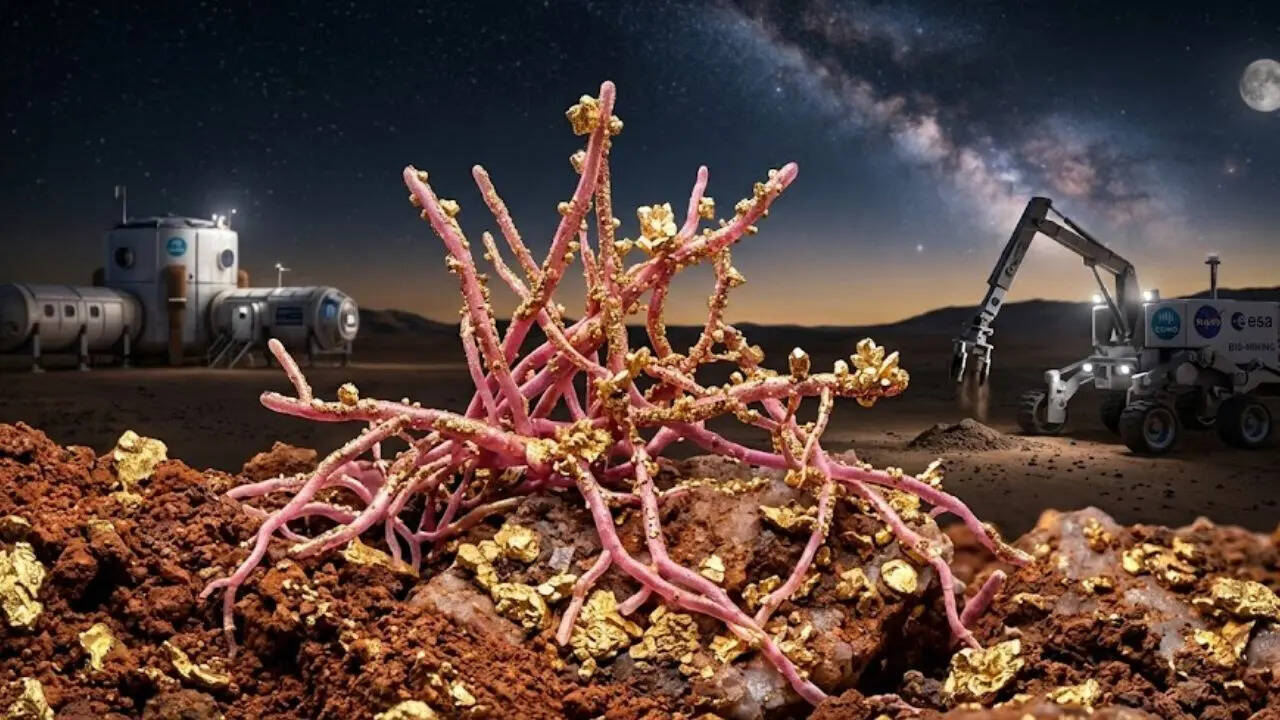
Hidden in the iron-rich soils of Western Australia, a strain of pink fungus known as Fusarium oxysporum is doing something that defies conventional biological logic. It is mining. While most life forms shy away from heavy metals due to their inherent toxicity, this specific organism seeks out gold, oxidizes it, and plasters the precious metal across its thread-like structures. It is a biological gold-plating machine. But the real story isn't about the novelty of a "metal-eating" mold; it’s about the desperate scramble by space agencies to turn this biological quirk into the backbone of an off-world economy. We are looking at the first legitimate candidate for extraterrestrial manufacturing, and the implications are as dangerous as they are lucrative.
The chemistry of a biological gold rush
To understand why this fungus matters, you have to look past the "gee-whiz" headlines and into the gritty biochemistry of the Boddington region. Fusarium oxysporum doesn't actually "eat" gold for nutrition in the way an animal eats plants. Instead, it facilitates a highly specific chemical reaction. By producing a potent superoxide, the fungus triggers a reaction with dissolved gold particles in the soil.
This process transforms the gold into a solid form, which then precipitates onto the surface of the fungal hyphae. Scientists have observed that fungi coated in these gold nanoparticles grow significantly faster and larger than those without. The gold acts as a catalyst for oxygen use, essentially turning the fungus into a more efficient metabolic engine.
For the mining industry on Earth, the potential is obvious. This is "biomining" at its most refined. Instead of massive open-pit mines that devastate local ecosystems and require millions of gallons of cyanide-laced water to leach gold from rock, we could deploy microscopic labor forces. These fungi can detect gold at concentrations so low that traditional sensors miss them entirely. They are the ultimate biological prospectors.
Scaling biology for the vacuum of space
The leap from the Australian outback to the lunar surface or the asteroid belt sounds like science fiction, but the physics of space travel makes it a necessity. The current cost of lifting heavy machinery out of Earth’s gravity well remains a primary barrier to any long-term presence in space. If you want to build a base on the Moon or a refinery on an asteroid, you cannot bring the factory with you. You have to grow it.
This is where the Australian fungus changes the calculation. Biology is the only technology we possess that is self-replicating and operates at a molecular scale without human intervention. By sending a few grams of fungal spores into space, engineers are essentially sending a self-assembling workforce.
The plan being discussed in research circles involves "seeding" asteroid regolith with modified fungal strains. Once introduced, the fungi would spread through the porous rock, drawing out precious metals—not just gold, but platinum-group metals essential for electronics—and concentrating them into easily harvested nodules. It is a closed-loop system. The fungi thrive on the waste products of the colony, and in return, they provide the raw materials for printed circuit boards and radiation shielding.
The problem of biological contamination
The enthusiasm for space-based biomining ignores a massive, looming shadow. Planetary protection protocols, established decades ago, are designed to prevent us from contaminating other worlds with Earth-based life. We spent billions of dollars ensuring the Mars rovers were sterile, yet now we are discussing the intentional release of an aggressive, metal-concentrating fungus into the solar system.
Fusarium oxysporum is not a benign organism. On Earth, various strains of this fungus are responsible for devastating crop failures, including the Fusarium wilt that threatens the global banana supply. It is hardy, adaptable, and notoriously difficult to eradicate once it takes hold.
If we introduce this fungus to a water-rich environment like Europa or Enceladus, we aren't just mining; we are terraforming in a way we cannot control. The risk of an "escape" scenario—where a fungus engineered for aggressive metal extraction begins to break down the hull of a spacecraft or a lunar habitat—is not being sufficiently addressed in the rush for mineral rights. When you build a tool that is designed to manipulate inorganic matter into organic structures, you are playing with a fire that doesn't need oxygen to burn.
Beyond the profit margin
The economic drive behind this research is undeniable. A single metallic asteroid can contain more gold and platinum than has been mined in all of human history. The nation or corporation that masters the ability to extract these resources without the need for heavy industrial equipment will effectively control the future of the global economy.
However, the "how" is just as important as the "what." We are seeing the emergence of a new branch of logistics: biological supply chain management. This isn't just about biology; it’s about the intersection of mycology, metallurgy, and aerospace engineering.
We must ask why this specific fungus evolved this trait in the first place. Evolution rarely creates such complex mechanisms without a survival pressure. In the harsh, nutrient-poor soils of Western Australia, the ability to use gold as a metabolic booster gave Fusarium oxysporum an edge. In the even harsher environment of space, that edge could turn into a runaway biological process.
The infrastructure of the future is alive
The transition from mechanical mining to biological extraction represents a shift in how we view technology. For the last century, we have focused on making machines stronger and faster. The next century will be defined by making biology more directed and predictable.
Using fungi to harvest gold is the proof of concept for a much broader vision. We are looking at a future where we don't build houses; we plant them. We don't manufacture computers; we brew them in vats of specialized fungi and bacteria. The Australian gold-eating mold is the first indicator that the barrier between "living organism" and "industrial tool" has completely dissolved.
Investors are already moving. Venture capital is flowing into synthetic biology startups that are looking to "tune" the Fusarium genome. They want to increase the rate of gold deposition and broaden the range of metals the fungus can interact with. They are trying to turn a natural curiosity into a high-throughput industrial engine.
The danger lies in the hubris of thinking we can control a living system as easily as we control a piece of software. Biology has a way of finding a path we didn't intend. We are taking a life form that has spent millions of years perfecting the art of survival in the dirt and asking it to build our empires in the stars. We should be careful what we wish for.
The gold is there for the taking, but the cost of the extraction might be the very environmental integrity of the solar system we are trying to inhabit. If we turn the moon into a giant fungal colony just to satisfy our thirst for precious metals, we may find that we have traded a barren rock for a biological nightmare that we can never turn off.
Stop looking at the fungus as a gimmick and start looking at it as a warning. We are about to outsource our most destructive industrial habits to organisms that don't know how to stop.