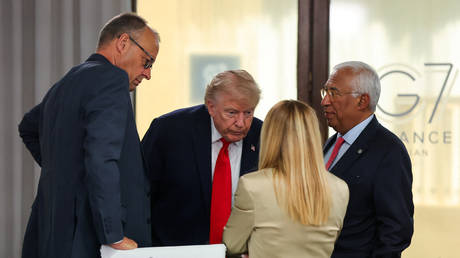
Donald Trump thought he could use his usual reality-television playbook on Rome. He guessed wrong. By claiming that Italian Prime Minister Giorgia Meloni begged him for a photo at the G7 summit in Évian, France, Trump managed to alienate one of his few remaining right-wing allies in Europe. Meloni didn't stay quiet. She fired back immediately with a blunt reminder that Italy doesn't take orders or beg for scraps.
This isn't just a petty spat over a photo-op. It's a major diplomatic fracture that shows how fragile the transatlantic alliance has become. When Meloni blasts Trump over fabricated photo claim rumors, she's drawing a line in the sand for European sovereignty.
The Interview That Exploded the Alliance
The drama started on Friday morning when Italian television network La7 broadcast a dubbed interview with Trump. In the clip, Trump boasted about his interaction with the Italian leader. He claimed she wanted a picture with him so badly that he only agreed out of pity.
"She begged me to take a picture with her," Trump said, according to the station's Italian translation. "I wouldn't have taken it, but I felt sorry for her."
Meloni didn't wait around for the news cycle to spin out of control. She posted a sharp video response directly to social media. She looked straight into the camera and called Trump's narrative completely made up.
"Donald Trump's declarations are totally invented," Meloni said. "Frankly, I am stunned. I don't know why the US president behaves this way towards his allies."
She didn't stop there. Meloni went on to point out a glaring double standard in American foreign policy. She noted that Washington often shows far more patience and indulgence toward the actual enemies of the West than it does toward historic European partners. She finished her message with a line that is already echoing across European capitals. Neither she nor Italy will ever beg.
Italy Closes Ranks Against Washington
If Trump thought this insult would pass as harmless political theater, the immediate blowback from Rome proved him wrong. The entire Italian political spectrum shut down the narrative. Political figures who usually spend their days fighting each other suddenly united behind their prime minister.
Italian Foreign Minister Antonio Tajani took the extraordinary step of cancelling his scheduled diplomatic trip to the United States. He was supposed to fly out for high-level meetings over the weekend. Instead, he stayed home and issued a blistering statement on social media. Tajani stated that Trump's offensive words insulted the entire country.
Other key cabinet ministers joined the defense. Defense Minister Guido Crosetto openly praised Meloni for maintaining her composure in recent months to protect Western interests, despite Trump's ongoing public provocations. Transport Minister Matteo Salvini summarized the national mood by declaring that an attack on Meloni is an attack on all Italians.
Even the country's widely respected head of state, President Sergio Mattarella, placed a personal solidarity call to Meloni. This level of rapid institutional unity is rare in Rome's notoriously fractured political scene. It shows exactly how deep Trump's insult cut.
What Most People Get Wrong About Meloni and Trump
Many political analysts initially viewed Meloni as the ultimate Trump whisperer in Europe. She was the only European head of government to attend his inauguration in 2025. She spent months positioning herself as a crucial diplomatic bridge between Brussels and Washington. They share deep ideological common ground on border security, traditional values, and conservative identity politics.
But ideology only goes so far when national interest and personal egos collide.
The relationship began cracking open earlier this year. The biggest sticking points aren't domestic policies. They are global conflicts. Meloni strongly pushed back against Trump over his handling of the US-Israel war in Iran, which Italy views as a highly dangerous escalation. Trump responded back in April by publicly calling Meloni cowardly for refusing to fall in line with Washington's military strategy. Meloni also remains a fierce supporter of defending Ukraine against Russian aggression, an issue where Trump has repeatedly wavered.
The G7 summit in France was supposed to fix these fractures. Photographs from the event showed the two leaders sitting together on a small sofa, appearing to chat amiably. European Council President Antonio Costa even joked that they were friends again. Meloni smiled and said they had always been friends, while Trump grumbled that he felt abandoned.
We now know that public display of unity was entirely superficial. Trump's subsequent television interview proved that he viewed the interaction not as a meeting of equals, but as a favor granted to a lesser power.
The Real Impact on Transatlantic Relations
This public falling out carries serious consequences for global politics. Meloni's top aides are no longer hiding their frustration with American leadership. Giovanbattista Fazzolari, a senior official in the prime minister's office, openly questioned whether Trump is destroying historic Western alliances out of sheer ineptitude or deliberate intent.
Fazzolari pointed out that these inappropriate outbursts achieve something Russia and China have struggled to do alone. They make the United States deeply unpopular across the European continent.
European leaders are watching this situation closely. They are realizing that ideological alignment with Washington offers zero protection against public humiliation. Meloni tried harder than almost anyone else in Europe to maintain a functional working relationship with Trump. If she can't make it work without sacrificing her national dignity, it's highly unlikely that other European leaders will even bother trying.
Pay close attention to how Rome handles upcoming NATO and European Union summits. Italy is already shifting its focus away from Washington, looking instead to build stronger security coalitions inside Europe. If you are tracking international trade or foreign policy, watch the actions of the Italian Foreign Ministry over the next few weeks. The traditional transatlantic bridge is officially broken, and Rome is busy building a fortress of its own.