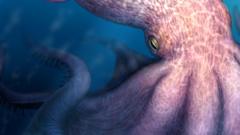
Size is a cheap drug for science journalism.
The headline screams about a 19-metre octopus "prowling" the Cretaceous seas, and suddenly everyone is a marine biologist. It’s a compelling image: a cephalopod the size of a semi-truck dragging its way through the depths 100 million years ago. It’s also largely a fantasy built on a shaky foundation of "Kraken" cultism and a desperate need for clicks.
If you’re looking for a monster movie, stay with the competitor’s piece. If you want to understand why we keep falling for the "Giant Cephalopod" trope despite a startling lack of physical evidence, let's look at the math.
The Ghost in the Fossil Record
Paleontology has a soft-tissue problem.
Octopuses are essentially swimming bags of muscle and water. Unlike their cousins, the ammonites, they don't leave behind convenient shells that last millions of years. They vanish. When a researcher claims to have found a massive prehistoric octopus, they aren't usually looking at a 19-metre skeleton. They are looking at "trace fossils"—marks in the mud or weird arrangements of ichthyosaur bones that they interpret as the work of a giant predator.
The "Kraken" theory, popularized by Mark McMenamin, suggests that the Triassic Shonisaurus (a massive marine reptile) was killed and arranged in a "midden" by a giant octopus.
Here is the truth: There is zero direct evidence of a 19-metre octopus.
What we have are bone arrangements that could just as easily be explained by currents, scavengers, or the natural settling of a carcass. To jump from "these bones look funny" to "a 19-metre octopus did it" is not just a leap; it is a vault over the Grand Canyon of scientific skepticism.
The Square-Cube Law Does Not Care About Your Narrative
Biology isn't just about imagination; it’s about physics.
When you double the length of an animal, you don't just double its weight. You cube it. An octopus that is 19 metres long would face staggering metabolic and structural challenges.
- Oxygen Demand: Cephalopods use hemocyanin to transport oxygen. It’s significantly less efficient than the hemoglobin found in our red blood cells. To keep a 19-metre organism fueled, the heart—or rather, the three hearts—would need to be massive, and the oxygen saturation in the water would need to be incredibly high.
- The "Soft" Problem: Without a shell, an octopus depends on hydrostatic pressure. A 19-metre octopus would be a literal puddle of jelly if it tried to move with any speed. The energy required to move that mass through water via jet propulsion would be astronomical.
- The Feeding Paradox: To maintain that body mass, a giant octopus would need to consume a terrifying amount of calories daily. In a prehistoric ocean filled with massive pliosaurs and mosasaurs, a giant, slow-moving, soft-bodied octopus isn't a "prowler." It’s a 19-metre buffet for anything with actual teeth.
The Architeuthis Fallacy
The public often confuses the Giant Squid (Architeuthis dux) with the octopus. This is where the 19-metre figure usually gets stolen from.
Giant squids can reach impressive lengths, but a huge portion of that is their two long feeding tentacles. Their actual body (the mantle) is relatively small. An octopus, however, has eight arms of roughly equal length and a much bulkier body structure. A 19-metre octopus would be vastly more massive than a 19-metre squid.
Comparing them is like comparing a whip to a wrecking ball.
We have found giant squid carcasses because they have chitinous beaks and internal "pens" that provide some structure. We have found almost nothing for giant octopuses. When the competitor article suggests these creatures "prowled," they are projecting the behavior of a modern, 5-kg Giant Pacific Octopus onto a hypothetical beast the size of a house.
The Midden Myth
The idea of the "cephalopod midden" is the cornerstone of this 19-metre claim. The theory goes that the octopus arranged the vertebrae of its prey in a pattern resembling the suction cups on its own arms.
Think about that for a second.
This implies a level of self-awareness and artistic expression in a Triassic invertebrate that we don't even see in modern primates. It suggests a predator that kills its prey, then spends hours playing Legos with the spine to create a self-portrait.
It’s a fun story. It’s great for selling books. It’s also complete nonsense.
In every instance where "midden" patterns have been identified, geologists have pointed to fluid dynamics. Water moves things. Bones settle in depressions. Over millions of years, the weight of the earth flattens those piles into patterns that the human brain—wired for pattern recognition—desperately wants to see as intentional.
Why We Want the Monster to Exist
The reason this "19-metre octopus" story keeps resurfacing isn't because of a new fossil find. It’s because the ocean is the last place on Earth where we can still pretend monsters live.
We've mapped the moon. We're sending rovers to Mars. But the deep ocean remains dark and largely unexplored. This "dark space" allows for the "Mega-Octopus" to exist in our minds. It fills the same psychological niche as Bigfoot or the Loch Ness Monster.
By framing these creatures as "prowlers" and "terrors of the deep," science writers trade accuracy for engagement. They ignore the fascinating real biology of cephalopods—their camouflage, their distributed nervous systems, their uncanny intelligence—in favor of a "big scary monster" narrative that would be laughed out of a freshman biology lab.
The Real Paleontology is More Interesting
If we stop hunting for phantom 19-metre krakens, we can actually look at what the fossil record tells us.
We know that prehistoric cephalopods were incredibly diverse. We have evidence of Tusoteuthis, a Cretaceous squid-like creature that reached lengths of maybe 6 to 10 metres. That’s huge. That’s terrifying. And more importantly, we have the "pen" (the internal shell) to prove it existed.
We have fossils of Palaeoctopus, a 30-centimetre octopus from the Late Cretaceous. It’s beautiful, perfectly preserved, and tells us that the basic octopus body plan has been a winning strategy for nearly 100 million years.
Why isn't a 30-centimetre octopus that survived the mass extinction of the dinosaurs enough? Why do we need it to be 19 metres long and capable of "prowling"?
The obsession with size reveals a lack of respect for evolution. An octopus doesn't need to be giant to be a perfect predator. It needs to be smart, fast, and invisible. When we force it into the role of a Kaiju, we stop looking at it as a biological entity and start looking at it as a movie prop.
The Verdict on the 19-Metre Octopus
I have spent years looking at how data gets massaged to fit a "Big Science" narrative. This is a classic case.
If you find a beak that suggests a massive size, show us the beak. If you find a fossilized sucker, show us the sucker. Until then, the 19-metre octopus remains a ghost generated by a combination of artistic license and a misunderstanding of how fossils form.
The ocean 100 million years ago was a brutal, fascinating place. It was filled with actual monsters—mosasaurs with double-hinged jaws and plesiosaurs with necks longer than their bodies. We don't need to invent a giant octopus to make the Cretaceous interesting.
The next time you see a headline promising a prehistoric monster of "unprecedented size," look for the word "interpretation." Look for the phrase "suggested by." Usually, you'll find that the "19-metre prowler" is actually just a few scattered bones and a researcher with a very active imagination.
Stop falling for the Kraken. The reality of evolution is far weirder than a giant octopus, and it doesn't need to inflate its measurements to get your attention.