The silence in the Exclusion Zone isn’t actually silent. It is a heavy, pressurized thing that rings in your ears until you notice the wind whistling through a cracked window in a nursery or the crunch of glass under a heavy boot. But mostly, it is the sound of a world that moved on without us. On April 26, 1986, the clocks in Pripyat stopped. Humans fled, leaving behind half-eaten meals and dolls on windowsills. We assumed we were leaving behind a graveyard. We thought the radiation would turn the Red Forest into a permanent wasteland, a scorched earth where nothing could ever truly live again.
We were wrong.
The atom is a strange god. It is invisible, indifferent, and incredibly patient. When Reactor 4 blew its lid, it scattered isotopes like Iodine-131 and Cesium-137 across thousands of square miles. These aren't just names on a periodic table; they are microscopic bullets that shred DNA. If you stayed in the hot zones for too long, your cells would forget how to be cells. That was the human perspective. We looked at the map of the 30-kilometer Exclusion Zone and saw a "dead zone."
But if you walk through the rusted gates today, you won’t find a desert. You will find a jungle.
The Great Unpeopling
Consider the Przewalski’s horse. These are stocky, ancient creatures that look like cave paintings come to life. In the late nineties, a handful of them were released into the zone as an experiment. Biologists wondered if they could survive the lingering "hot" patches. Today, they don't just survive; they thrive. They gallop past abandoned apartment blocks where Soviet murals peel like dead skin. They have reclaimed the streets.
The irony is thick enough to choke on. The worst nuclear disaster in human history created a sanctuary. By removing ourselves, we gave the Earth a gift we never intended to give: peace. It turns out that for a wolf, a lynx, or a wild boar, a little bit of radiation is a much fairer trade than a lot of humanity. We are louder than the atom. We are more destructive than a core meltdown. Our chainsaws, our cars, and our sprawling suburbs are far more lethal to the European bison than a lifetime of grazing on radioactive grass.
The Survival of the Weirdest
Life in the zone has changed, but not in the way horror movies promised. You won't find three-headed deer or giant glowing spiders. Evolution works in more subtle, shimmering ways.
Take the Eastern tree frog. Usually, these tiny creatures are a bright, lime green. But inside the Exclusion Zone, researchers found something startling. The frogs are turning black. This isn't a random mutation; it is a shield. Melanin, the same pigment that darkens human skin, can help dissipate ionizing radiation. The darker frogs survived better in the years following the blast, passing on their midnight-colored skin to the next generation. They are literally wearing armor forged from the tragedy of our mistakes.
Then there are the wolves.
The wolf populations inside the zone are estimated to be seven times higher than in nearby uncontaminated reserves. Without hunters to fear, they have become the undisputed kings of the ruins. They move through the ghost city of Pripyat with a haunting confidence. They sleep in the lobbies of old hotels. They raise their cubs in the shadows of the cooling towers.
There is a specific kind of bravery in their biology. Studies have shown that while these animals do have higher rates of certain mutations or cataracts, their immune systems have undergone a radical shift. They are showing resilience to cancer that shouldn't be possible. Their bodies are learning to repair the DNA damage in real-time. They are living laboratories of survival, teaching us how life persists when the environment turns hostile.
The Invisible Ledger
It is easy to romanticize this "new Eden," but the cost remains etched in the soil. If you bring a Geiger counter near the roots of certain pine trees, the device will scream. The radiation hasn't vanished; it has simply settled into the cycle of life. The fungus eats the decaying wood. The insects eat the fungus. The birds eat the insects. The cycle moves the isotopes through the food chain, a slow-motion dance of heavy metals.
This creates a tension that is hard to wrap your head around. On one hand, you see a lush, green paradise where brown bears—missing from the region for a century—have finally returned. On the other, you are standing in a place where you cannot safely plant a garden or raise a child.
We often think of nature as something fragile, a delicate flower that we must protect. Chernobyl proves that nature is actually a relentless, crushing force. It doesn't need our protection; it needs our absence. The moment we stepped back, the cracked pavement was split by saplings. The moment we stopped hunting, the lynx returned from the shadows. The planet isn't fragile. We are.
A Lesson in Humility
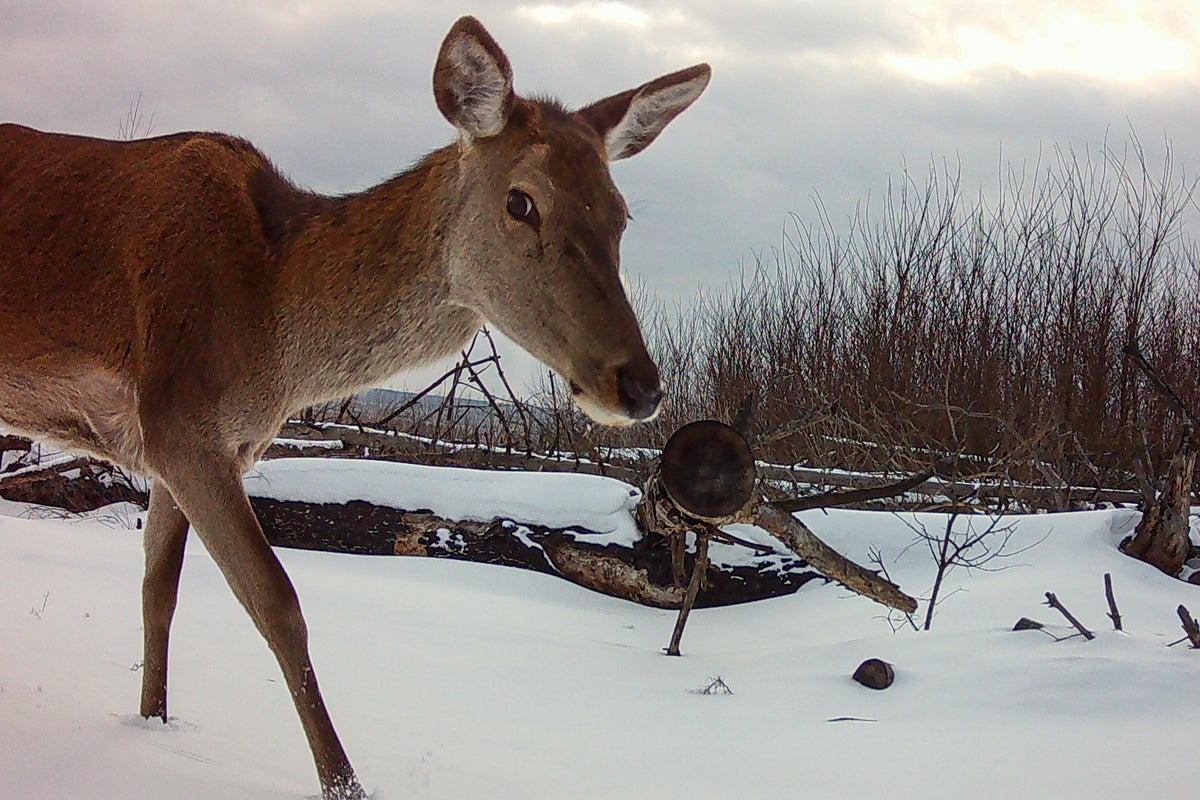
The Exclusion Zone is a preview of a world without us. It is beautiful, terrifying, and profoundly indifferent to our history. When we look at the footage of elk wandering through the abandoned schools, we feel a pang of loss. We see the rusted Ferris wheel and think of the children who never got to ride it. We see the tragedy.
The elk just sees a place to graze.
The animals aren't "thriving" because the radiation is good for them. They are thriving because we are gone. Our absence is a resource more valuable to them than clean soil or pure water. Every overgrown courtyard and every wolf pack in the Zone is a quiet indictment of the way we occupy the rest of the world.
There is a deep, unsettling comfort in knowing that the Earth can heal itself from our greatest sins, even if the scar tissue is a little radioactive. The ghosts of Pripyat aren't the people who left. They are the animals who stayed behind to witness the forest swallowing the concrete.
The wind picks up, rattling a loose sheet of metal on a roof in the distance. A hawk circles above the sarcophagus of the reactor, its eyes scanning the tall grass for movement. It doesn't know about the meltdown. It doesn't know about the Soviet Union or the energy crisis or the invisible bullets flying through the air. It only knows that the hunting is good, the sky is open, and for the first time in a thousand years, the humans have finally learned to be quiet.