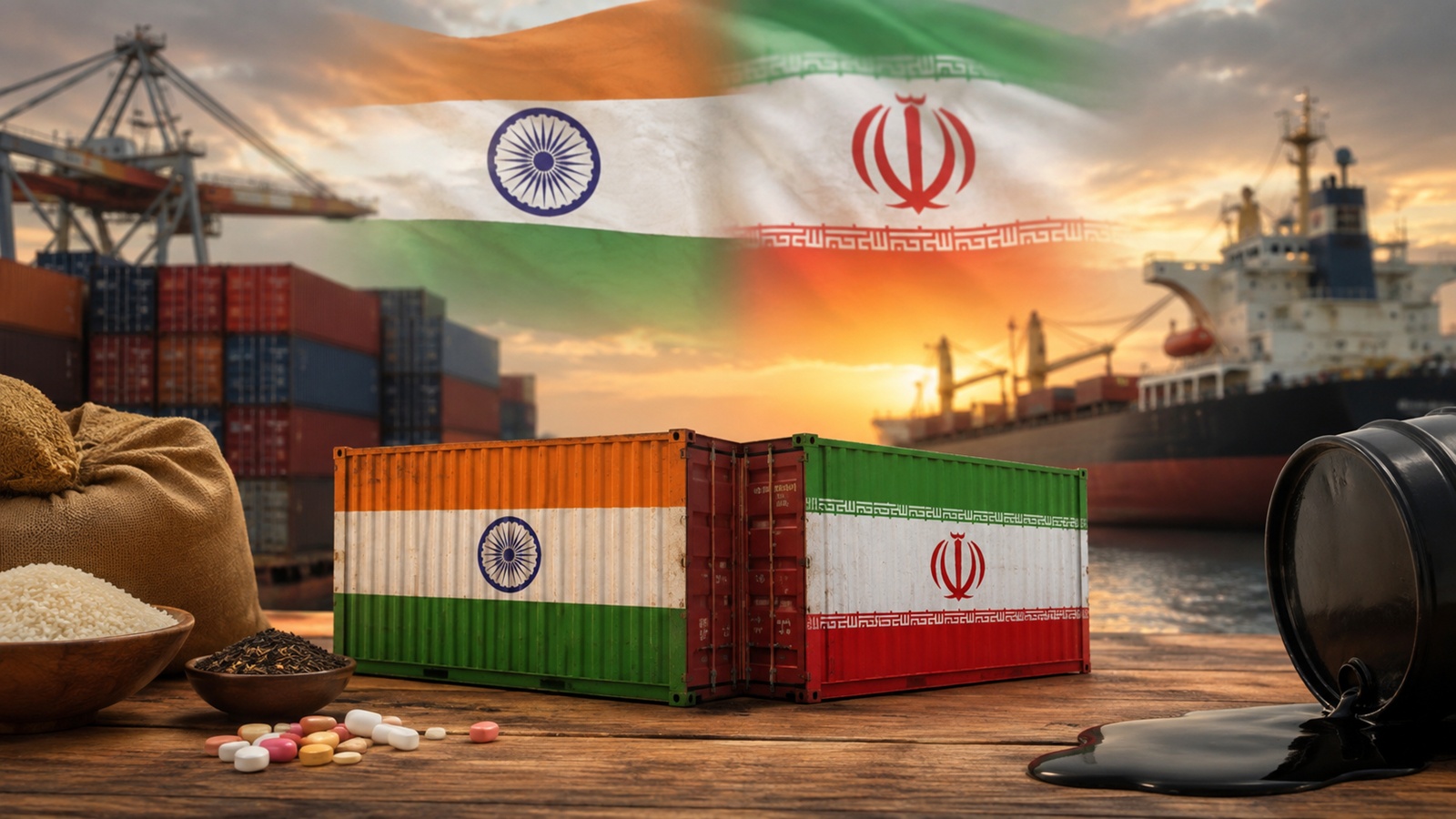
The air in Chabahar tastes like salt and fine, pulverized stone.
Stand on the dusty fringes of this Iranian port city, and you will hear a strange kind of silence. It is not the quiet of a sleeping desert or an empty beach. It is the industrial hush of giant cranes standing frozen against the Persian Gulf sky, their massive iron jaws empty, waiting for cargo ships that rarely dock anymore.
To look at the numbers is to see a cliff. Trade between India and Iran has plummeted by ninety percent. A corridor of ambition, once billed as the economic bridge that would bypass hostile borders and connect New Delhi to Central Asia, now looks less like a highway and more like a ghost town built of concrete and crushed hopes.
Look closer at the rust gathering on the container locks, and a heavier question rises from the dust. Is this port, long championed as a masterstroke of international diplomacy and trade, the next casualty of a distant superpower's silent war?
To understand how a multi-million-dollar maritime lifeline turned into a ghost port, you have to talk to people like Rajesh. (Note: Rajesh is a composite character representing the Indian logistics managers who spent the late 2010s packing containers bound for Bandar Abbas and Chabahar.)
Back in 2016, Rajesh remembers the euphoria. Indian Prime Minister Narendra Modi stood alongside Iranian and Afghan leaders to sign a historic pact. They were going to carve out a new trade route. India invested hundreds of millions of dollars to develop Chabahar’s Shahid Beheshti terminal. The logic was irresistible. Pakistan blocked the direct land route to Afghanistan and beyond. China was building its own maritime empire just down the coast at Gwadar. India needed its own anchor in the region. Chabahar was that anchor. It offered a straight shot to Afghanistan, bypassing Pakistan entirely, and opened a commercial artery straight up into the resource-rich heart of Eurasia.
Rajesh remembers the sound of forklifts running twenty-four hours a day. He remembers bags of Indian rice, pharmaceuticals, and industrial machinery stacking high in the warehouses.
Then came the quiet strangulation.
Sanctions returned. Not the loud, dramatic kind with rolling armies, but the quiet, suffocating kind written in legal code in Washington and enforced through the invisible machinery of global banking.
Here is the central irony of modern geopolitics. The United States government officially carved out a specific exemption for the Chabahar port. Recognizing its vital importance to the economic survival of landlocked Afghanistan, Washington wrote an exception into the Iran sanctions regime.
Paper exceptions do not pay shipping insurance.
Ask any captain, insurer, or trade financier about the Chabahar exception, and you will see them laugh. It is a bitter, nervous laugh. In practice, the threat of secondary sanctions is so absolute, so terrifyingly effective, that no major international bank will touch a transaction involving an Iranian port. It does not matter what the legal exemption says on page four hundred of a Treasury Department document. Compliance officers at banks in Frankfurt, Tokyo, and Mumbai look at the word "Iran" and slam the door.
Risk management eats diplomacy for breakfast.
And so, the trade dried up. Not because the cargo wasn't needed. Afghanistan still needed food and medicine. India still needed markets and strategic positioning. But the plumbing of global commerce—the SWIFT codes, the letters of credit, the maritime insurance underwriters—clotted and died.
Consider what happens next: a vacuum.
Nature hates a vacuum. Geopolitics hates it even more. When a democratic, pluralistic nation like India pulls back its economic footprint due to the creeping dread of financial penalties, other actors step into the empty room. Beijing watches the quiet harbor with keen interest. The Belt and Road Initiative rolls inexorably forward, and a dormant Iranian port surrounded by empty asphalt begins to look less like an Indian triumph and more like an open door for alternative partnerships.
We must confront a difficult, unvarnished truth. The architecture of global finance has become a weapon so precise that it can starve a cooperative regional development project without a single shot being fired.
When trade drops by ninety percent, the loss is not just statistical. It is measured in the small, ruined plans of merchants who bet their life savings on international supply chains. It is measured in the wheat left rotting in silos because the paperwork couldn't clear compliance. It is measured in the slow, grinding erosion of strategic trust.
Yet, to walk away entirely would be a monumental mistake.
India has quietly renewed short-term operational agreements for the port, keeping a tentative hand on the wheel. New Delhi understands that once you abandon a geopolitical choke point, you never get it back on favorable terms. The stakes are too high. Central Asia remains a vital prize, and the dream of an International North-South Transport Corridor cannot function if its southern lung is completely collapsed.
The sun dips below the horizon in Chabahar, casting long, bruised shadows across the idle container yards. The cranes do not move. The water laps against the concrete pier with a steady, indifferent rhythm. The ghost port waits in the dark, caught between the ambitions of empires and the cruel arithmetic of the modern bank account, holding its breath for a future that has not yet been written.