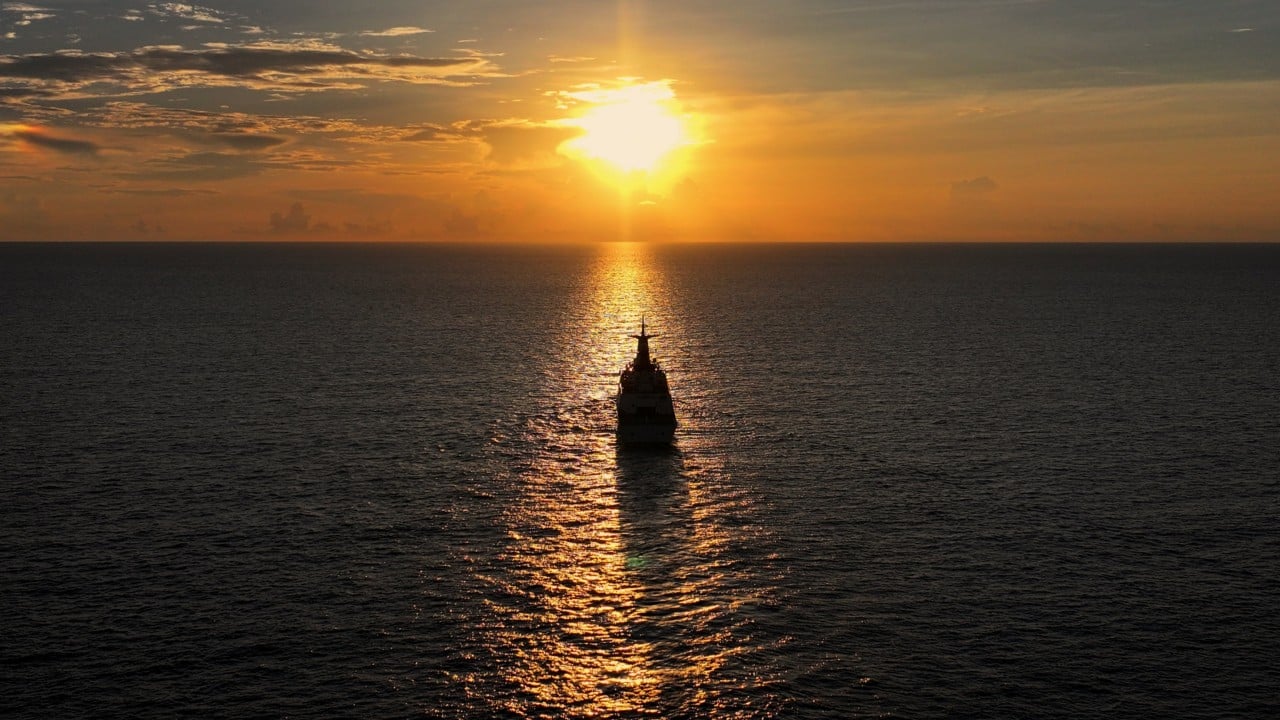
International law operates on a fundamental paradox: it possesses absolute moral clarity and zero organic enforcement. Ten years after the Permanent Court of Arbitration in The Hague unanimously invalidated China’s "nine-dash line" claims, the South China Sea is more militarized, more contested, and more volatile than it was in 2016. The legal victory achieved by the Philippines did not deter unilateral expansion; instead, it accelerated a transition from legal dispute to high-stakes grey-zone attrition.
To understand why a binding legal ruling under the United Nations Convention on the Law of the Sea (UNCLOS) failed to alter physical realities on the water, we must dissect the strategic mechanics of non-compliance, the economic cost functions of escalation, and the structural limitations of middle-power deterrence.
The Legal-Physical Disconnect: Entitlements vs. Control
The 2016 arbitral award resolved several critical ambiguities regarding maritime features, yet it fundamentally lacked the mechanism to enforce those clarifications. Under Article 121 of UNCLOS, the tribunal determined that none of the high-tide features in the Spratly Islands—including Itu Aba, Thitu, and West York Island—are legally "islands" capable of generating a 200-nautical-mile Exclusive Economic Zone (EEZ) or continental shelf. They are categorized merely as "rocks," generating a minimal 12-nautical-mile territorial sea at best.
This distinction stripped Beijing’s expansive maritime claims of legal validity, clarifying that the waters surrounding these features belong to the EEZ of the adjacent coastal states, primarily the Philippines. However, the tribunal possessed no jurisdiction over sovereignty—meaning it could not award actual ownership of the rocks themselves.
This created a major strategic vulnerability:
- The Legal Reality: The surrounding waters are sovereign EEZ areas where the Philippines holds exclusive rights to explore, exploit, and manage marine resources.
- The Physical Reality: Beijing maintains physical occupancy of several key reefs and has converted them into fortified military outposts equipped with runways, radar arrays, and missile batteries.
The resulting friction is not a failure of legal reasoning, but a demonstration of power asymmetry. Beijing quickly realized that while it could not win the legal argument, it could render the legal argument irrelevant by controlling the physical space. By denying the ruling as a "piece of waste paper," China established a precedent where domestic military capacity overrides international treaty commitments.
The Three Pillars of Beijing's Denial Strategy
China's response to the 2016 ruling is not merely a refusal to comply; it is a calculated, multi-layered campaign designed to neutralize the legal architecture of UNCLOS without triggering a kinetic military intervention. This strategy relies on three main pillars.
1. Gray-Zone Coercion and the Maritime Militia
Instead of deploying the People’s Liberation Army Navy (PLAN) as the primary tool of intimidation, Beijing relies heavily on the China Coast Guard (CCG) and the People’s Armed Forces Maritime Militia (PAFMM). These vessels operate in a calculated spectrum below the threshold of military conflict, employing non-lethal but highly destructive tactics such as high-velocity water cannons, intentional ramming, and acoustic weapons.
By using civilian-coded vessels, Beijing forces disputants like Manila to make a costly choice: either tolerate the slow annexation of their fishing grounds and shoals, or deploy military vessels to counter the militia, which would allow China to frame the Philippines as the instigator of armed conflict.
2. Customary Law Revisionism
To offset the loss of legal standing, Beijing has attempted to rewrite customary international law through continuous practice. By maintaining a constant presence in the EEZs of neighboring states, demanding foreign fishing vessels seek Chinese permission, and conducting unilateral survey missions, China seeks to establish a de facto history of administrative control. Under this logic, decades of uncontested presence could eventually be argued as establishing "historic rights" that bypass the text of UNCLOS.
3. Bilateral Splintering of ASEAN
The Association of Southeast Asian Nations (ASEAN) operates by consensus, a structural design that Beijing systematically exploits. By providing economic incentives and infrastructure investments to non-disputant members such as Cambodia and Laos, China effectively vetoes any unified, legally binding ASEAN stance on the South China Sea. The decade-long negotiations over a Code of Conduct (CoC) have served as a diplomatic stall tactic, ensuring that any final document remains non-binding and devoid of enforcement mechanisms.
The Cost Function of Manila's Assertiveness
Under the administration of Ferdinand Marcos Jr., the Philippines shifted from the accommodation strategy of the Duterte era to a policy of transparency and assertive patrol. This strategy actively documents and publicizes Chinese gray-zone operations. While this has successfully mobilized international diplomatic support—evidenced by a 14-nation joint statement reaffirming the 2016 ruling—it introduces significant economic and strategic costs.
                     [ Philippines Assertive Patrols ]
                                    │
                  ┌─────────────────┴─────────────────┐
                  ▼                                   ▼
     [ Diplomatic Alignment ]               [ Economic Friction ]
  - US-Japan-Australia support           - Maritime insurance spikes
  - Multilateral joint patrols           - Supply chain rerouting costs
  - Publicized gray-zone video           - Risk of localized escalation
The primary economic bottleneck is the pricing of maritime risk. The Waters of the South China Sea carry over $3 trillion in annual trade. Uncontrolled escalation at flashpoints like Second Thomas Shoal (Ayungin Shoal) or Scarborough Shoal directly impacts commercial shipping.
- Insurance Premiums: As confrontations involving water cannons and hull collisions increase, underwriters price in higher conflict risks. This raises the cost of shipping for vessels passing through the Philippine Sea and Luzon Strait.
- Energy Insecurity: The Philippines’ Malampaya gas field, which supplies a critical portion of Luzon’s power grid, is near depletion. The country's inability to exploit alternative reserves within its EEZ—such as the Reed Bank—due to Chinese naval harassment creates a severe, long-term economic penalty.
- The Deterrence Dilemma: The 1951 Mutual Defense Treaty (MDT) between the United States and the Philippines is the ultimate security guarantee for Manila. However, relying on this treaty creates a dangerous operational ceiling. If Manila triggers the treaty over a gray-zone incident, it risks sparking a superpower conflict. If it fails to trigger the treaty in the face of persistent coercion, the credibility of the U.S. alliance network degrades.
The Strategic Trilemma of Regional Stakeholders
The internationalization of the South China Sea dispute has forced external powers to balance three competing, often incompatible priorities. This strategic trilemma shapes the policies of the United States, Japan, Australia, and European partners.
                       Deterrence of Expansion
                                 /\
                                /  \
                               /    \
                              /      \
                             /________\
             Economic Stability        Alliance Credibility
- Deterring Chinese Expansionism: External powers must actively challenge China's unilateral maritime claims through Freedom of Navigation Operations (FONOPs) and joint maritime patrols to maintain the integrity of global maritime law.
- Preserving Economic Interdependence: Most nations in the anti-coercion coalition, including Japan and Australia, count China as their largest trading partner. Pushing security deterrence too aggressively risks retaliatory economic sanctions or supply chain disruptions.
- Maintaining Alliance Credibility: To prevent a collapse of the rules-based order in the Indo-Pacific, the U.S. and its allies must show tangible support for partners like the Philippines. Yet, excessive militarization risks validating Beijing’s narrative that external actors are the true drivers of instability in the region.
The entry of Japan into a more active security role in the South China Sea exemplifies this friction. Beijing’s swift diplomatic protest against Tokyo’s involvement highlights how regional defense integration is viewed as a direct challenge to China’s maritime security perimeter.
The Realist Strategic Playbook
Ten years of non-compliance prove that legal declarations without material enforcement mechanisms cannot alter the behavior of a major power. For the Philippines and its international partners, the strategy must shift from hoping for compliance to managing an enduring gray-zone environment.
This requires a transition away from symbolic diplomatic statements toward a strategy of denial:
- Symmetrical Cost Imposition: Rather than responding to maritime militia tactics with military assets, the Philippines and its allies must impose financial and reputational costs. This includes sanctioning the state-owned enterprises that build Chinese maritime militia vessels and dredge disputed reefs.
- Joint EEZ Development Coalitions: Manila should pursue joint hydrocarbon exploration and marine research with non-claimant nations and private corporations, shifting the conflict from a bilateral dispute to one that directly impacts multinational economic interests.
- Asymmetric Maritime Defense: The Armed Forces of the Philippines must accelerate their transition from internal security to external defense, prioritizing shore-based anti-ship missile systems, long-range drone surveillance, and sub-surface capabilities that raise the military cost of any potential Chinese invasion of occupied features.
Ultimately, the 2016 Hague ruling remains a valuable instrument of international legitimacy, but it is not a shield. In a system governed by realpolitik, the law only protects those who possess the material capability to defend their rights on the water.
India Global Review Analysis of the South China Sea Verdict is highly relevant as it offers an analytical perspective on the limitations of international law and the practical challenges of enforcing the 2016 Hague ruling.