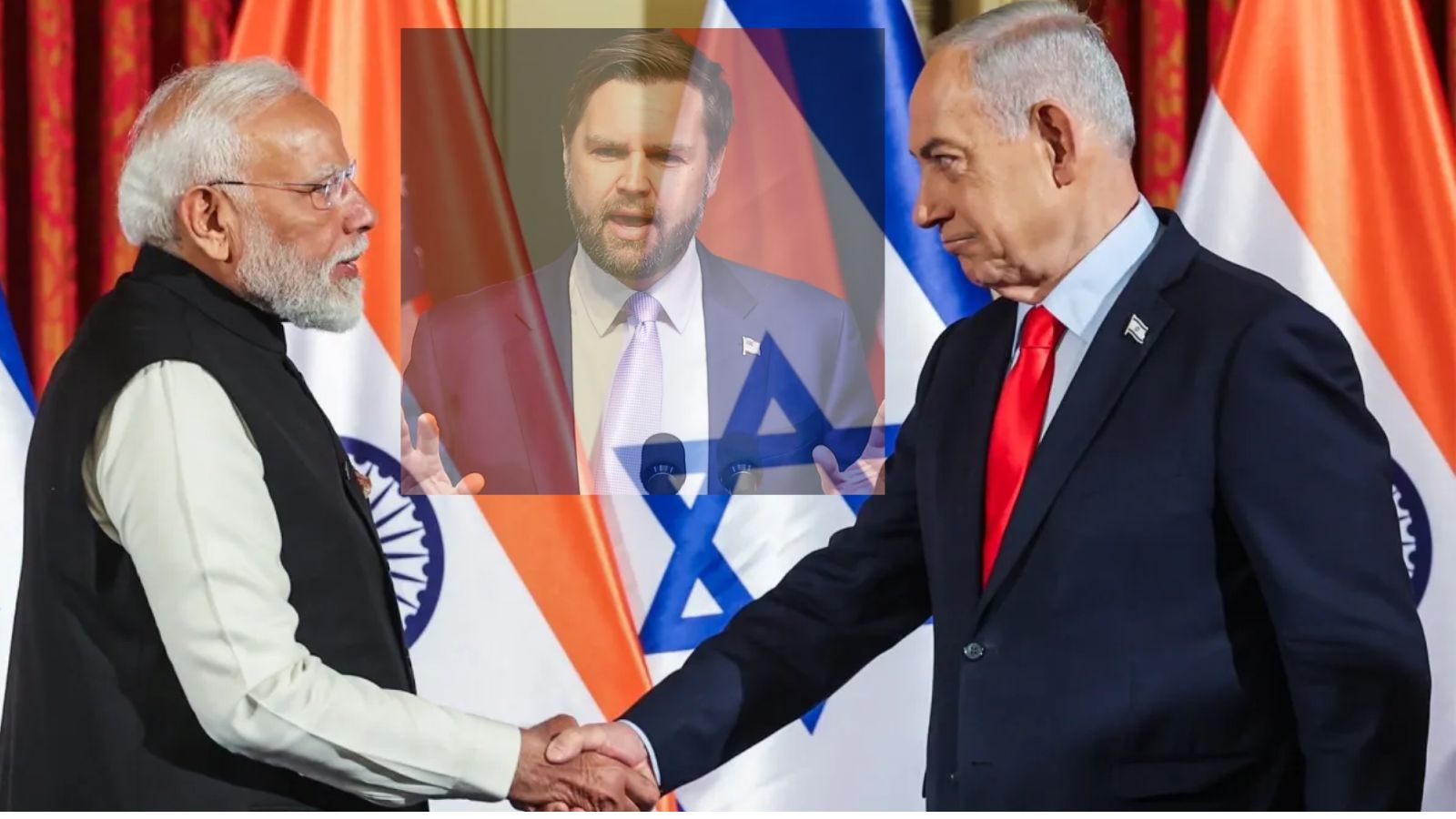
Small-state diplomacy relies on a fundamental equation: balancing asymmetric dependence on a superpower with diversified secondary alliances to preserve strategic autonomy. When US Vice President JD Vance asserted that the United States is Israel’s "only powerful ally" left in the world, he exposed the structural friction inherent in this equation. Israeli Prime Minister Benjamin Netanyahu’s public pushback—specifically highlighting India’s 1.4 billion population and digital alignment—was not merely a rhetorical retort. It was a calculated demonstration of how a secondary alignment can be leveraged to resist superpower dictation.
The exchange highlights a deep systemic divergence regarding the definition of national security architecture, the boundaries of transactional diplomacy, and the mechanics of modern international influence.
The Friction Coefficient: Asymmetric Dependence vs. Autonomy
The tension between Washington and Jerusalem stems from a mismatch in strategic utility functions. The United States provides the critical baseline of Israel's military capabilities. As Vance noted, approximately two-thirds of Israel’s defensive weapons are manufactured by American hands and financed via American tax dollars. This creates a high baseline dependence.
When a superpower provides the majority of a state's defensive capital, it expects a corresponding veto over that state's theater-level operations. Vance’s critique focused on two primary policy bottlenecks where Israel's independent actions run counter to current US regional architecture:
- The Iran Memorandum of Understanding (MOU): Washington views the current peace agreement as a structural mechanism to stabilize the Strait of Hormuz, manage escalation, and secure broader regional trade routes. Israeli ministers' public opposition to the MOU threatens the viability of this US-led diplomatic framework.
- Theater Expansion in Lebanon: US strategic planners view Israeli strikes in civilian-adjacent population centers in Beirut as an escalation risk that destabilizes ongoing Washington-Tehran negotiations.
Vance's warning to the Israeli cabinet—stating they should not attack "the only powerful ally" they have left—presumes a strict transactional hierarchy: material dependence must equal strategic compliance. From a pure resource-accounting perspective, a state of 9 million people cannot indefinitely substitute external superpower military financing.
The Counter-Leverage Framework: Netanyahu’s Three Pillars of Diversification
Netanyahu’s rebuttal on Fox News rejected this hierarchical model by introducing an alternative matrix of international support. To offset Vance's logic of material dependency, Netanyahu deployed three distinct conceptual pillars designed to prove that international alignment is multi-dimensional rather than unipolar.
1. Demographic and Market Diversification (The India Vector)
By explicitly citing India as a critical partner, Netanyahu referenced a relationship grounded in structural reciprocity rather than asymmetric aid. The India-Israel bilateral matrix operates on a highly integrated trade and defense framework developed over the past decade:
- Military-Industrial Co-production: Unlike the US-Israel model of direct aid financing, the Indo-Israeli relationship is built on technology transfers, joint ventures, and defense procurement. India represents a massive market for Israeli aerospace and missile defense systems, making the economic relationship mutually beneficial rather than charitable.
- Asymmetric Scale: Referencing India's population of 1.4 billion directly counters the argument of global isolation. It signals that while Western public sentiment may fluctuate, Israel retains deep institutional ties with a rising global power.
2. Dual-Track Diplomacy: Private Alignment vs. Public Constraints
Netanyahu highlighted a critical mechanism in contemporary diplomacy: the divergence between a foreign state's public posture and its private strategic calculus. While international forums and social media algorithms frequently display intense anti-Israel sentiment, the institutional demands of sovereign states tell a different story.
Netanyahu noted that multiple world leaders maintain private channels to request bilateral transactions, specifically focusing on two highly specialized fields:
- Cybersecurity and AI Infrastructure: Israel ranks as the number two global power in cyber capabilities. For governments managing internal security, counter-terrorism, or infrastructural vulnerability, Israeli tech exports are non-substitutable assets.
- Tactical and Military Doctrine: Foreign militaries actively seek transfer of operational knowledge gained from Israel's active-theater engagements.
This creates a transactional shield. A nation may vote against Israel in a public multilateral forum to satisfy domestic political opinion, yet simultaneously execute bilateral intelligence and technology contracts in private.
3. The Digital Populism Multiplier
Netanyahu’s mention of being "flooded by overwhelming support" on Facebook from Indian users points to a modern component of statecraft: transnational digital alignment. In a hyper-connected information ecosystem, grassroots public support in a partner nation creates domestic political capital for that nation’s leadership to maintain close ties. For New Delhi, strong digital and popular alignment with Jerusalem reinforces the strategic convergence maintained by Prime Minister Narendra Modi’s administration.
The Structural Limitations of Secondary Alignments
While Netanyahu’s framework effectively counters the narrative of absolute isolation, it contains a critical systemic vulnerability. Secondary alignments like the Indo-Israeli partnership cannot easily substitute for the unique operational support provided by the United States.
+----------------------------+----------------------------------------+-----------------------------------------+
| Capability Layer           | United States Baseline                 | India / Secondary Vector                |
+----------------------------+----------------------------------------+-----------------------------------------+
| Strategic Resupply         | High: Direct resupply of munitions     | Low: Industrial co-production; long     |
|                            | and advanced interceptors.             | lead times, no direct airlift mandates. |
+----------------------------+----------------------------------------+-----------------------------------------+
| Multilateral Veto Power    | Absolute: UN Security Council veto     | Limited: Strategic abstentions, but     |
|                            | shields Israel from global sanctions.  | lacks unilateral veto shielding.        |
+----------------------------+----------------------------------------+-----------------------------------------+
| Financial Subsidization    | Direct military aid grants integrated  | Transactional: Hard currency purchases  |
|                            | into national defense budgeting.       | and joint commercial investments.       |
+----------------------------+----------------------------------------+-----------------------------------------+
The primary limitation of the Indian vector is the absence of a global diplomatic umbrella. When international bodies threaten binding legal or economic sanctions against Israeli state entities, India's standard diplomatic posture is strategic autonomy and abstention, whereas the United States possesses—and deploys—the unilateral veto power required to insulate Jerusalem. Furthermore, India’s own complex energy dependencies on Iran and the Gulf states mean New Delhi cannot fully align with Israel on theater-wide containment strategies.
The Strategic Play
The diplomatic friction between Vance and Netanyahu demonstrates that the US-Israel alliance is shifting from an ideological partnership to a highly contested, interest-driven negotiation. Netanyahu's impending visit to Washington to meet Donald Trump represents the next operational clearinghouse for these differences.
Jerusalem's optimal move is to leverage its unique technology and intelligence assets to maintain its freedom of action in Lebanon and Iran, while avoiding an open breach with Washington's overarching regional economic plans. By visibly elevating partners like India, Israel signals to Washington that treating the relationship as entirely one-sided miscalculates Israel's value as a global security exporter. However, Jerusalem must execute this diversification without triggering a structural retrenchment of American military resupply lines, which remain the irreplaceable foundation of its kinetic defense capabilities.