The public repatriation and funerary cycle of a high-ranking Iranian state official operates far beyond the bounds of standard state grief; it serves as a high-fidelity signaling mechanism and an operational tool for domestic mobilization. When supreme leadership or senior command structures experience sudden transitions, the subsequent state rituals are meticulously engineered to project institutional continuity and enforce ideological alignment. Analyzing these events requires peeling away the sensationalized media focus on crowd rhetoric to examine the structural levers of power being deployed: domestic consolidation, asymmetric deterrence signaling, and regional proxy alignment.
Understanding this dynamic requires mapping the precise cause-and-effect relationships that govern Iranian state choreography during periods of acute geopolitical friction. The visible public anger is not an organic, unmanaged variable; it is a calculated asset utilized by the state to manage both domestic vulnerabilities and external adversaries.
The Tri-Border Architecture of Public Mobilization
State-sanctioned funerary processions in the Islamic Republic of Iran rely on a specific three-part operational architecture designed to achieve maximum political utility.
1. The Domestic Legitimacy Multiplier
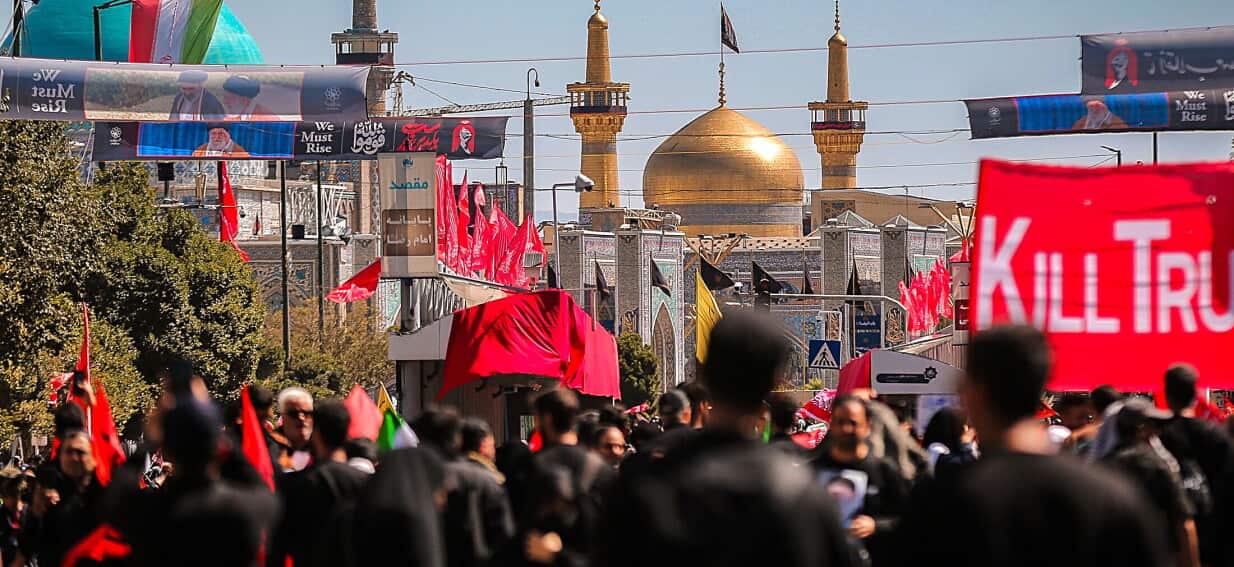
Sudden transitions or the loss of key figures inherently introduce systemic risk into a highly centralized governance model. The state mitigates this destabilization by transforming public spaces into displays of overwhelming ideological uniformity. The physical presence of massive crowds at sacred sites—such as Shia shrines—functions as a visual plebiscite. It signals to domestic dissidents and factional rivals that the security apparatus retains total logistical control and can command the physical presence of the populace at scale.
2. The Asymmetric Deterrence Signal
Mass mobilization serves a distinct external function. By broadcasting images of highly charged crowds chanting existential threats against foreign adversaries, Tehran establishes a baseline of popular mandate for potential retaliatory actions. The state uses the collective voice of the populace to establish a credible threat of asymmetric response without committing formal state forces to immediate, conventional military actions. This creates an ambiguous escalation layer that complicates the strategic calculus of Western defense planners.
3. The Proxy Integration Node
The inclusion of regional proxy networks—the Axis of Resistance—within these state rituals acts as a operational synchronization mechanism. Leaders from Lebanese Hezbollah, Yemeni Houthi movements, and Iraqi paramilitary groups are systematically positioned within the funeral proceedings. This physical proximity reinforces a unified command structure and signals to external intelligence agencies that the network's operational cohesion remains intact despite the loss of central leadership nodes.
The Mechanics of State Rhetoric vs. Operational Realities
Media outlets frequently over-index on specific slogans shouted during state-managed rallies, such as direct threats against specific foreign leaders. A rigorous strategic analysis separates this rhetorical theater from actual operational doctrine.
The Iranian security architecture operates on a doctrine of strategic patience and calculated asymmetry. Rhetoric is cheap; kinetic retaliation is expensive and structurally hazardous. The state permits and encourages extreme rhetorical escalation within the borders of a religious shrine because it fulfills a critical psychological function for the regime's core support base. It builds an internal pressure valve, satisfying the immediate demand for anger and retribution without forcing the supreme command into a premature or disadvantageous conventional military engagement.
The true risk metric is not the volume of the crowd's chants, but the specific movements of logistical assets behind the scenes. While the public focus remains fixed on the shrine rituals, the Islamic Revolutionary Guard Corps (IRGC) systematically reallocates command structures, secures communication lines, and adjusts the deployment vectors of its missile and drone networks. The public spectacle acts as a smoke screen for structural reorganization.
Systemic Vulnerabilities in the Succession Matrix
While the state projects total control through synchronized public mourning, these transition points expose fundamental vulnerabilities within the Iranian power structure.
- The Succession Bottleneck: The concentration of authority within the Supreme Leader and a tightly knit circle of clerics and military commanders creates an acute single point of failure. When a key node in this network is removed, the informal patronage networks that govern the Iranian economy and security state are destabilized. The public ritual attempts to hide these internal negotiations, but the friction between pragmatic state actors and ideological hardliners intensifies during these periods.
- The Economic Cost Function: Mobilizing millions of citizens for multi-day state events requires significant economic suspension. For an economy already operating under severe international sanctions, the operational costs of halting commerce, providing state-funded transportation, and deploying vast security cordons strain an already depleted treasury. The state must constantly calculate the tipping point where the political utility of prolonged mobilization is outweighed by the economic damage of systemic disruption.
- The Enforcement Dilemma: Relying on mass public displays introduces the risk of counter-mobilization. The security apparatus must deploy significant intelligence and physical assets to ensure that grief-driven gatherings do not morph into anti-regime protests, as seen during previous economic and social upheavals. The state’s control over these crowds is never absolute; it requires continuous, resource-heavy monitoring.
The Realignment of the Regional Balance of Power
The strategic outcome of an Iranian leadership transition is rarely determined by domestic sentiment alone. The long-term trajectory depends on how the state recalibrates its regional posture in the immediate aftermath of the funerary cycle.
[State Loss] ──> [Funerary Mobilization] ──> [Proxy Consolidation] ──> [Asymmetric Recalibration]
Once the period of official mourning concludes, the state transitions from symbolic signaling to operational execution. The incoming leadership cohort must rapidly validate its authority both internally and externally. Historically, this validation does not manifest as a direct, conventional strike against a major superpower—which would invite catastrophic retaliation—but rather through a series of calibrated, deniable operations across the region.
This typically involves increasing the frequency of maritime interdictions in strategic chokepoints, accelerating the transfer of precision-guided munitions to proxy elements, or conducting cyber operations against critical infrastructure. These actions allow the new command structure to demonstrate competence and maintain deterrence without crossing the threshold into open warfare. The strategic goal is to re-establish the status quo ante, proving to external observers that the systemic operational capacity of the state is entirely independent of any single individual.