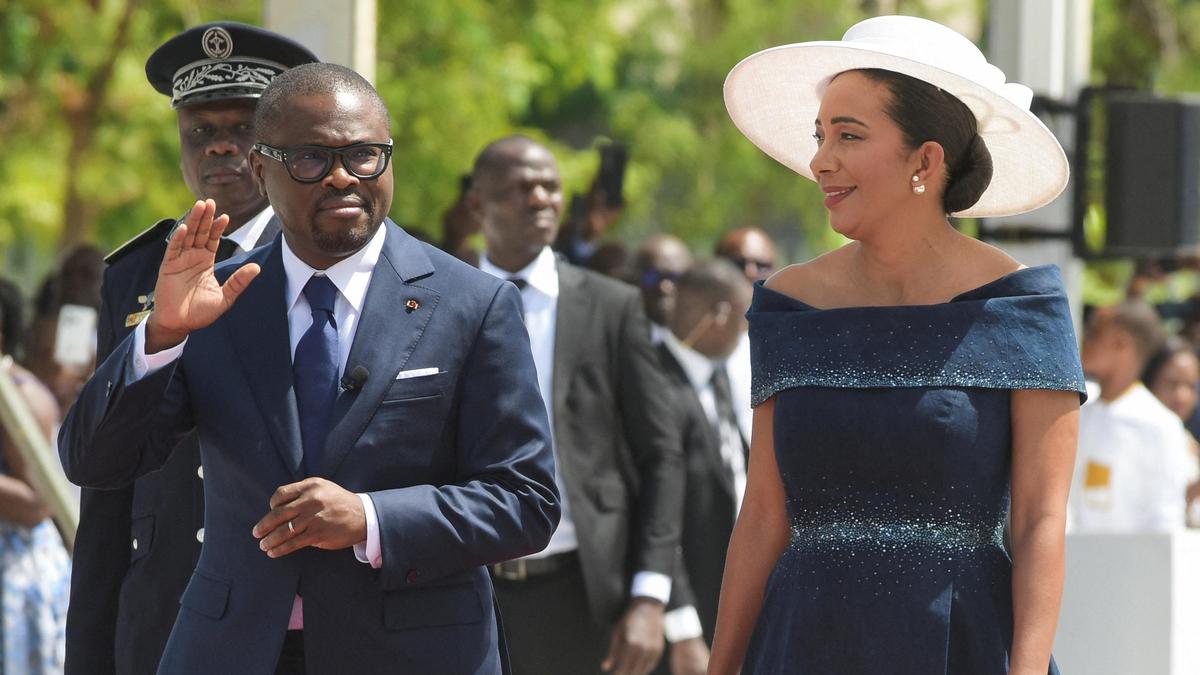
The diplomatic estrangement between Benin and Niger following the July 2023 coup d'état was fundamentally an economic and security bottleneck driven by personalized political frictions, rather than a permanent structural divergence. The arrival of Benin’s newly inaugurated President, Romuald Wadagni, in Niamey on June 2, 2026, represents a calculated institutional reset designed to resolve a mutually destructive economic stale-mate. By replacing the confrontational stance of his predecessor, Patrice Talon, with a technocratic neighborhood diplomacy, Wadagni's administration is attempting to unlock the landlocked Sahelian trade routes while mitigating the asymmetric security threats plaguing the shared northern frontier.
This analysis deconstructs the bilateral crisis into three core operational variables: the maritime transit bottleneck, the infrastructure monetization dilemma, and the border security coordination breakdown. For an alternative look, consider: this related article.
The Maritime Transit Bottleneck: Recomputing Niger's Supply Chain Cost Function
Prior to the July 2023 security transition in Niamey, the economic interdependence between Benin and Niger was dictated by geographical optimization. Niger, as a landlocked economy, relied heavily on Benin's maritime infrastructure for its import and export logistics.
[Port of Cotonou (Benin)] ---> (Transit Corridor via Niger River Bridge) ---> [Landlocked Nigerien Markets]
                                             |
                                  [80% of Freight Offline
                                   During Border Closure]
- Freight Dependence: Historically, approximately 80% of Niger’s total import freight transit utilized the corridor originating from the Port of Cotonou, moving through Benin to reach Niamey.
- The Sanction Shock: The enforcement of Economic Community of West African States (ECOWAS) sanctions by former President Patrice Talon fundamentally disrupted this network. The subsequent prolonged closure of the physical border by Niger's military council—even after ECOWAS lifted sanctions—forced a re-routing of supply chains.
- Alternative Corridor Inefficiencies: Niger attempted to substitute Cotonou with longer maritime transit corridors through Lomé (Togo) and across the Tsamiya-Kamba corridor via Nigeria. This logistical substitution function introduced significant systemic inefficiencies:
- Increased Transit Times: Overland transit routes through alternative coastal entry points increased travel durations by several days due to infrastructure deficits.
- Higher Fixed Costs: Transport operators faced increased fuel expenditures and vehicle wear-and-tear.
- Variable Administrative Costs: Multi-border crossings introduced additional regulatory checkpoints and informal tariffs.
This artificial distortion of the supply chain inflated domestic prices within Niger for essential goods, demonstrating that alternative transit routes cannot match the structural cost efficiency of the Cotonou-Niamey corridor. For Niger, normalization is an economic necessity to lower the cost function of its imports. Further insight on this trend has been published by NBC News.
The Infrastructure Monetization Dilemma: Hydrocarbon Inflexibility
While general cargo transit suffered a near-total stoppage, bilateral energy infrastructure presented a distinct operational reality. The Niger-Benin crude oil pipeline—designed to transport crude from Niger's Agadem oilfields to Benin's Sèmè-Kpodji terminal—serves as a primary example of mutual economic vulnerability preventing complete decoupling.
The infrastructure can be quantified by its operational constraints:
$$Q_{\text{export}} = f(\text{Pipeline Integrity}, \text{Terminal Access}, \text{Sovereign Regulatory Approval})$$
When the Talon administration restricted pipeline access at the Sèmè-Kpodji maritime terminal in 2024 to pressure Niamey, Niger responded by halting upstream production. This reciprocal obstruction proved unsustainable for both state budgets. For Niger, the pipeline represents the primary mechanism for sovereign revenue diversification away from traditional uranium exports. For Benin, transit fees collected at the maritime terminal represent a critical source of non-tax revenue utilized to service external debt obligations.
The continuation of intermittent pipeline operations during the height of the diplomatic crisis underscores a clear geopolitical rule: fixed-capital infrastructure investments worth billions of dollars generate a baseline of engagement that neither state can afford to permanently dismantle. Wadagni's background as an economist and former finance minister positions him to treat this infrastructure as a commercial asset to be optimized rather than a diplomatic lever to be weaponized.
The Security Coordination Breakdown: Fragmented Counter-Insurgency
The political fracture between Cotonou and Niamey introduced a severe intelligence and operational vacuum along their shared border zone, a territory increasingly targeted by militant groups linked to the Islamic State and Jama'at Nasr al-Islam wal-Muslimin (JNIM).
[Northern Benin Security Zone] <--- (Intelligence Vacuum / Closed Border) ---> [Southern Niger Security Zone]
                                             |
                                   [Asymmetric Jihadist
                                    Infiltration Corridor]
Benin’s northern departments have faced an increasing rate of asymmetric attacks over the last three years. Concurrently, Niger’s southern flank remains vulnerable to cross-border militant incursions.
Under the Talon administration, security cooperation collapsed due to zero-sum political accusations. The military government in Niamey alleged that Benin hosted French military installations designed to launch destabilizing operations against the Alliance of Sahel States (AES)—the confederation formed by Niger, Mali, and Burkina Faso. Despite consistent denials from both Cotonou and Paris, this perception led to a total suspension of joint border patrols and real-time intelligence sharing.
The consequences of this security coordination breakdown are clear:
- Militant networks exploit the uncoordinated border spaces, treating the frontier as a safe haven to evade kinetic operations from either state.
- Benin’s defense budget escalated to $394 million, driven by the need to fortify its northern perimeter without external regional support.
- Niger faced severe domestic security strains, highlighted by the March 2026 attack on Niamey's airport, which further intensified regional blame structures.
Wadagni’s diplomatic itinerary—visiting Nigeria first, followed immediately by Niger and Burkina Faso—indicates an operational recognition that containment of asymmetric security threats requires a synchronized regional approach. Resuming tactical coordination along the Niger River frontier is a core objective of this outreach.
The Structural Limits of the Reset: Navigating the AES-ECOWAS Cleavage
While the personal transition from Talon to Wadagni provided the necessary window of opportunity to initiate a diplomatic reset, structural geopolitical barriers constrain the speed and depth of normalisation.
First, Niger’s foreign policy is anchored in its commitment to the Alliance of Sahel States (AES). The creation of this confederation alongside Mali and Burkina Faso represents a permanent institutional break from the ECOWAS framework. Benin remains a member of ECOWAS and maintains close economic ties with Nigeria, the bloc's primary economic power. Wadagni must balance easing tensions with the AES junta leaders while maintaining his institutional commitments to coastal West African partners.
Second, the domestic political narrative within Niger relies heavily on anti-colonial rhetoric, specifically targeting French influence in the region. Nigerien Interior Minister Mohamed Toumba’s public demand for explicit "goodwill gestures"—requiring Benin to formally decouple from French strategic interests—creates a complex diplomatic hurdle. Wadagni cannot easily alter Benin’s broader international defense partnerships without compromising his country's internal security framework.
Strategic Action and Structural Forecast
The resumption of bilateral ties will likely progress through a phased operational sequence rather than an immediate, comprehensive resolution.
- Phase I: Technical Normalization (Weeks 1–4): Institutional focus will center on reopening the physical transit bridge linking the two nations across the Niger River. This will allow general freight to resume moving through the Cotonou corridor, relieving inflationary pressure in Niamey and generating immediate customs revenue for Benin.
- Phase II: Security De-escalation (Months 2–6): Expect the establishment of joint technical verification committees to inspect border facilities. This mechanism will allow Benin to demonstrate the absence of hostile foreign military bases, offering Niger the necessary political justification to formalize a security pact.
- Phase III: Hydrocarbon Optimization (Long-term): The stabilization of the Sèmè-Kpodji export pipeline will likely lead to expanded throughput agreements, insulating the commercial project from future political disputes through third-party international arbitration clauses.
Wadagni's neighborhood diplomacy demonstrates that economic and geographic realities eventually override ideological divides. The success of this reset will not be measured by diplomatic ceremonies, but by the volume of freight moving across the Niger River and the return of coordinated military patrols along the northern frontier.