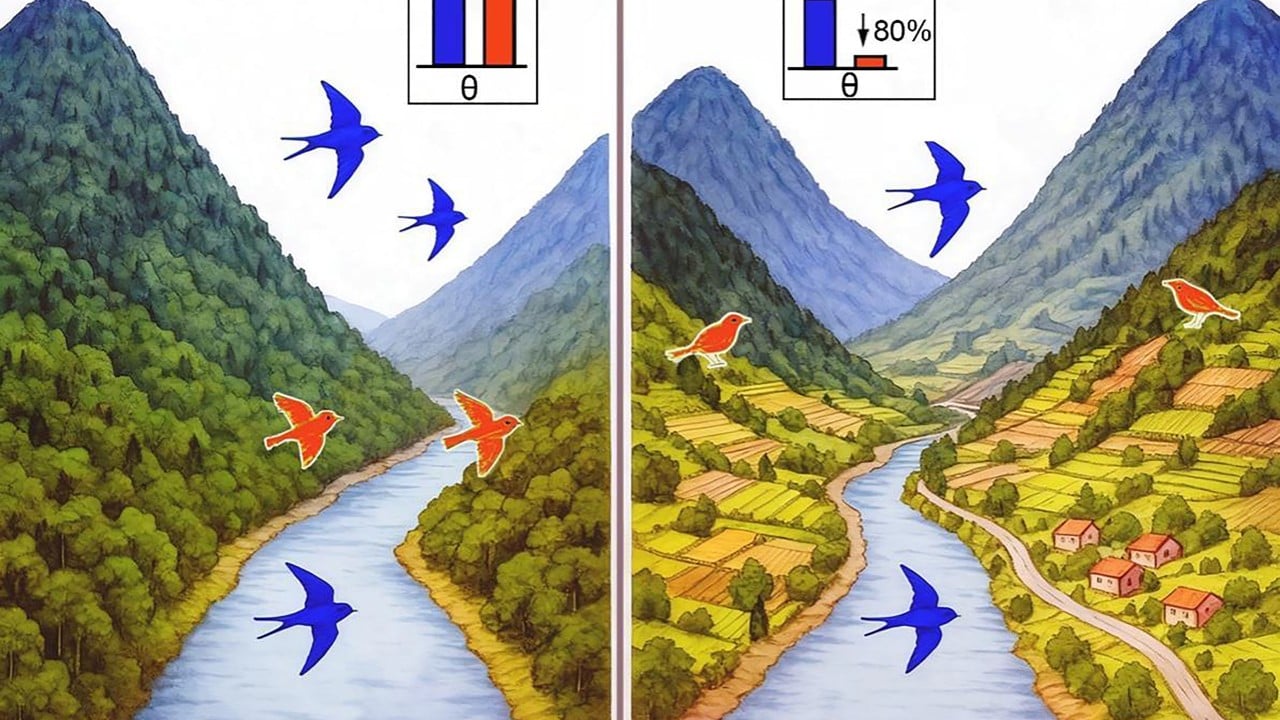
The loss of nearly half of genetic diversity within Chinese mountain bird populations over a fifty-year window signals a structural collapse in evolutionary capacity rather than a simple decline in headcount. When isolated alpine species experience a 50 percent contraction in allelic richness and heterozygosity across half a century, they cross a critical demographic threshold where deterministic environmental pressures meet stochastic genetic decay. Standard conservation metrics rely heavily on census population size ($N$), tracking raw numbers of breeding pairs while ignoring effective population size ($N_e$). This creates a severe analytical blind spot: a population can appear numerically stable in visual surveys while suffering catastrophic internal homogenization that strips away its ability to adapt to thermal shifts, novel pathogens, and habitat fragmentation.
The Mechanics of Rapid Allelic Attrition
To understand how avian populations lose half their genetic variation in five decades—a compressed timeframe representing roughly 15 to 25 generations for most passerines—one must examine the mechanics of island biogeography applied to terrestrial peaks. High-elevation mountain ecosystems function as "sky islands." Unlike oceanic islands separated by water, sky islands are isolated by lowland thermal barriers and anthropogenic land-use matrices.
When climate warming forces montane species upslope to track their preferred thermal envelopes, the available surface area shrinks geometrically due to the conical topography of mountain ranges. This upward range contraction triggers three compounding mechanisms of genetic loss:
- Demographic Bottlenecks and Genetic Drift: As habitable area contracts, carrying capacity drops. In small, isolated populations, random sampling error during reproduction—genetic drift—overwhelms natural selection. Alleles are lost purely by chance at a rate inversely proportional to twice the effective population size ($1 / 2N_e$). Once an allele drifts to zero frequency, it cannot be recovered without external gene flow or de novo mutation, the latter operating on geological rather than ecological timescales.
- Elimination of Gene Flow: Connectivity between adjacent peaks depends on dispersing juveniles crossing lower-elevation valleys. Agricultural expansion, infrastructure corridors, and rising lowland temperatures convert these valleys into physiological dead zones. Without immigrants introducing novel alleles, each mountain peak becomes a closed genetic system.
- Inbreeding Depression and Genetic Load: As population density falls within contracted summit zones, mating between close relatives becomes statistically inevitable. This increases homozygosity, exposing recessive deleterious mutations that were previously masked in heterozygous states. The resulting reduction in individual fitness—manifesting as lower hatchability, reduced fledgling survival, and compromised immune function—further depresses population growth, locking the species into an extinction vortex.
The Failure of Census-Based Conservation Metrics
Conservation policy frequently misallocates capital because it measures output variables (bird counts) rather than state variables (genetic variance). A population of 500 birds restricted to a single mountain massif may exhibit an effective population size ($N_e$) of fewer than 50 individuals due to skewed sex ratios, variance in reproductive success, and historical bottlenecks.
Under the 50/500 rule of conservation genetics, an $N_e$ of 50 is the bare minimum required to prevent immediate inbreeding depression, while an $N_e$ of 500 is necessary to retain long-term evolutionary potential. Losing nearly half of standing genetic variation in 50 years demonstrates that these Chinese montane populations have operated well below the $N_e = 500$ threshold for decades. By the time census counts register a sharp decline, the genetic architecture required to reverse the trajectory has already been dismantled.
The Structural Vulnerability of Montane Endemics
Not all avian species respond uniformly to altitudinal compression. Comparative genomic analyses of historical museum specimens against modern samples reveal that life-history traits dictate the velocity of genetic erosion.
- Dispersal Capacity and Wing Morphology: Sedentary, understory-dwelling insectivores—such as babblers, laughingthrushes, and parrotbills—possess rounded wings adapted for short, agile flights through dense vegetation rather than sustained traversal across open matrices. Their natal dispersal distances are measured in hundreds of meters rather than kilometers. In contrast, canopy frugivores or migratory species maintain higher gene flow across fragmented ridges, buffering them against localized drift.
- Thermal Specialization: Tropical and subtropical mountain birds evolve within narrow temperature bands because seasonal temperature fluctuations at low latitudes are minimal. Having evolved high physiological specialization, these species lack the phenotypic plasticity to tolerate warming lowlands, rendering valleys impenetrable barriers even when physical habitat remains intact.
- Niche Breadth: Species restricted to specific microhabitats, such as alpine bamboo thickets or timberline rhododendron zones, face double jeopardy. They must wait for slow-growing botanical communities to migrate upslope before they can colonize higher elevations, creating a severe temporal lag between thermal displacement and habitat availability.
Historical Baselines vs. Contemporary Genomic Reality
Evaluating a 50-year decline requires establishing an accurate baseline, a process made possible only through museomics—the extraction and sequencing of degraded DNA from historical museum skins collected in the mid-20th century. Comparing historical genomes to contemporary populations eliminates the "shifting baseline syndrome," where modern researchers mistake a depleted ecosystem for a natural state.
However, interpreting these comparisons requires distinguishing between neutral genetic diversity and adaptive genetic diversity. Whole-genome sequencing measures neutral markers (such as microsatellites or non-coding single nucleotide polymorphisms) that reflect demographic history and drift. While neutral diversity tracks overall population health and inbreeding risk, adaptive diversity—located in functional regions like the Major Histocompatibility Complex (MHC) responsible for immune response—determines immediate survival against pathogens.
When a population loses 50 percent of its overall genetic diversity, the loss is rarely uniform across the genome. Balancing selection may temporarily preserve variation at critical immune loci, meaning functional capacity might persist slightly longer than neutral metrics suggest. Conversely, if drift overwhelms selection completely, adaptive loci erode alongside neutral ones, leaving the entire population uniformly susceptible to a single novel pathogen, such as avian malaria expanding upslope with warmer temperatures.
The Cost Function of Genetic Rescue and Corridor Engineering
Addressing a 50 percent drop in genetic variation requires shifting from passive habitat protection to active genetic management. Drawing a boundary around a mountain peak on a map does nothing to stop thermal compression or genetic drift. Conservation managers must evaluate interventions through a strict cost-benefit framework, accounting for biological risks and capital constraints.
Strategy 1: Altitudinal Corridor Restoration
Connecting fragmented forest patches along elevational gradients allows species to track shifting climates without crossing hostile agricultural land.
- Mechanism: Reforesting degraded mid-elevation slopes using native, multi-strata flora creates continuous cover for understory specialists.
- Limitations: Corridors require decades to mature into functional old-growth structure. Furthermore, if the target species has already reached the physical summit of a mountain range—the "escalator to extinction"—corridors cannot create higher elevation where none exists.
Strategy 2: Assisted Gene Flow (Translocation)
To immediately counteract genetic drift and mask deleterious recessive alleles, managers can physically capture individuals from larger, genetically distinct populations on adjacent mountain ranges and introduce them into depleted summit populations.
- Mechanism: Introducing even one to two effective migrants per generation can halt genetic drift and restore heterozygosity, a phenomenon known as genetic rescue.
- Limitations: Translocation carries the risk of outbreeding depression. If two populations have been separated for millennia, they may have evolved locally adapted gene complexes. Mixing them can disrupt these adaptations, producing hybrid offspring with lower fitness than either parent population. Additionally, moving birds risks transferring novel parasites or diseases between isolated sky islands.
Strategy 3: Ex-Situ Cryobanking and Captive Assurance
When in-situ survival is compromised by irreversible thermal loss, preserving genetic material becomes the final failsafe.
- Mechanism: Collecting somatic tissue, primordial germ cells, or gametes from wild individuals across multiple peaks creates a frozen repository of standing genetic variation before further drift occurs.
- Limitations: Captive breeding programs for specialized montane passerines are notoriously difficult, expensive, and prone to rapid adaptation to captivity—where traits favored in cages (docility, altered foraging behavior) replace traits required for wild survival. Cryobanking preserves the code, not the ecological behavior learned across generations.
Operational Protocol for Montane Conservation
To arrest genetic erosion before populations cross into irreversible extinction vortices, regional conservation agencies must restructure their monitoring and intervention pipelines.
- Replace Census Surveys with Genomic Monitoring: Mandate biennial non-invasive genetic sampling (using molted feathers, fecal samples, or buccal swabs) across sentinel montane species. Track effective population size ($N_e$), runs of homozygosity (ROH) to quantify recent inbreeding, and mutational load rather than relying solely on point-count visual surveys.
- Prioritize Low-Dispersal Endemics: Allocate funding disproportionately toward sedentary, understory specialists with narrow elevational bands. High-dispersal generalist species do not require immediate genetic intervention; low-dispersal endemics face imminent functional extinction.
- Execute Micro-Translocations Under Genomic Guidance: Before moving birds between peaks, sequence both source and recipient populations to verify that genetic divergence is driven by recent anthropogenic drift (within the last century) rather than deep evolutionary divergence. Where drift is the primary driver, initiate controlled translocations of 3 to 5 individuals per isolated peak every two generations to restore heterozygosity without triggering outbreeding depression.
- Secure Cool Microrefugia: Identify and strictly protect north-facing slopes, deep ravines, and cold-air drainage basins within mountain ranges. These topographic features decouple local microclimates from regional warming trends, providing stationary thermal buffers that buy decades of time for slow-moving botanical habitats to shift upslope.