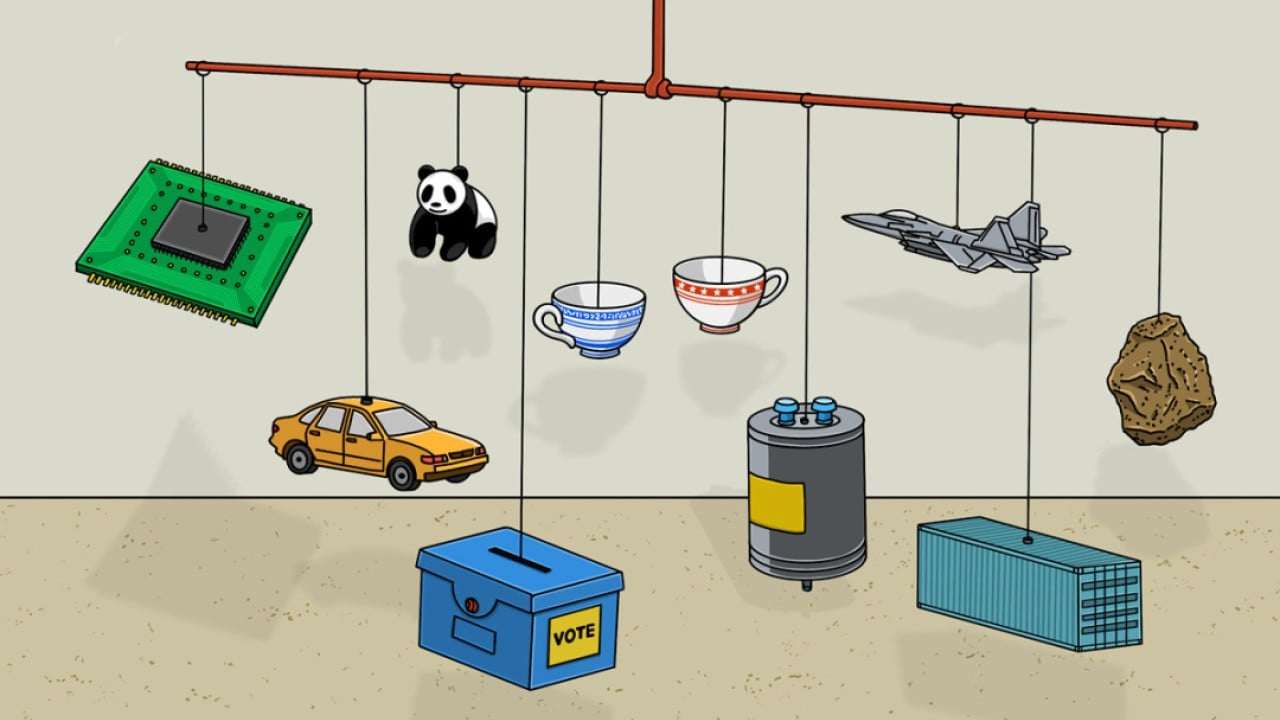
Diplomacy is often performed under chandeliers, but great power competition is settled in the quiet boardrooms of semiconductor foundries and the damp shipping lanes of the Malacca Strait. Washington and Beijing may posture for domestic television audiences, signing trade communiqués that soothe jittery stock markets, yet the structural fault lines between the two superpowers continue to widen. The official narrative is one of guardrails and managed competition. The reality on the ground is a relentless, unacknowledged economic cold war where every supply chain disruption is a strategic skirmish.
The central friction point in US-China relations is no longer simply about tariffs or territorial posturing in the South China Sea. It is about industrial sovereignty. For decades, globalization operated on a simple premise: efficiency trumps security. Factories were built wherever labor was cheapest, and supply chains stretched across oceans without regard to geopolitical borders. That era is over. Both capitals have recognized that dependence is a vulnerability. When a single factory shutdown in Shenzhen can halt automotive production lines in Detroit, interdependence ceases to be a bond of peace and becomes a hostage situation.
The Weaponization of Infrastructure
Consider the quiet expansion of maritime logistics control. Over the past fifteen years, state-backed entities from Beijing acquired stakes in dozens of critical ports across Europe, Africa, and South Asia. On paper, these were commercial investments designed to facilitate global trade. From a strategic perspective, they established dual-use chokepoints. Washington's response has been a scramble to onshore critical manufacturing, a process hindered by decades of de-industrialization. Building a modern fabrication plant for advanced microelectronics takes years of capital allocation, environmental reviews, and workforce training. It cannot be conjured into existence by executive order or congressional funding bills.
This industrial lag creates a dangerous window of vulnerability. If economic decoupling happens too fast, inflation spikes and global markets freeze. If it happens too slowly, one side achieves decisive technological dominance over the other. The export controls enacted by the United States on advanced computing hardware were designed to freeze China's semiconductor capabilities at a specific threshold. Yet sanctions rarely work the way architects intend. Instead of halting progress, trade restrictions often act as a forced-growth stimulus for domestic innovation, driving targeted state subsidies into alternative supply chains that bypass Western intellectual property entirely.
Financial Entanglements and Sovereign Debt
Beneath the trade headlines lies a quieter, more complex battlefield involving sovereign debt and currency dominance. For generations, the greenback served as the undisputed anchor of international commerce. Nations accumulated US Treasuries as a safe harbor asset. However, the weaponization of the SWIFT financial messaging network against various adversaries sent a clear signal to Beijing and other non-aligned capitals. Relying exclusively on a financial infrastructure controlled by Washington is an unacceptable long-term risk.
Bilateral currency swaps and alternative payment settlements are expanding, slowly chipping away at the margins of dollar hegemony. This transition will not happen overnight; financial inertia is a powerful force. Yet the trend line is unmistakable. Both economies are quietly building parallel financial architectures, preparing for a scenario where commercial integration is severed entirely. When capital can no longer flow freely across the Pacific, asset values will recalibrate in ways that few contemporary investors are pricing into their models.
Miscalculation in the Maritime Domain
Economic friction inevitably spills over into military posture. The risk of direct kinetic conflict between Washington and Beijing is low, but the risk of catastrophic miscalculation is rising. As naval patrols increase in frequency around Taiwan and the South China Sea, warships operate in confined spaces with razor-thin margins for error. A collision between a surveillance aircraft and a destroyer is no longer a theoretical exercise for war colleges. It is a persistent operational hazard.
During the Cold War, Washington and Moscow established rigid communication protocols and hotline systems to manage crises and prevent escalation spirals. The modern US-China relationship lacks this institutional maturity. Military-to-military dialogue channels are frequently suspended whenever diplomatic disputes flare up, leaving tactical commanders to make split-second decisions without reliable political backchannels. When communication breaks down, rumor and worst-case assumptions fill the vacuum.
The Domestic Imperative
Both political systems face profound internal pressures that constrain their foreign policy flexibility. In Washington, foreign policy has become a bipartisan contest of toughness, where any compromise with Beijing is framed as appeasement. In Beijing, the legitimacy of the ruling party is closely tied to continued economic growth and the narrative of national rejuvenation. Neither leadership can afford to be perceived as backing down during a standoff.
This domestic dynamic turns foreign policy into a high-stakes game of chicken. If an external shock occurs—whether a cyberattack on critical infrastructure, a maritime incident, or an unexpected political development—neither side may have the political space required to de-escalate. The institutional guardrails meant to stabilize the relationship are routinely discarded for short-term political posturing.
The assumption that trade prevents war rests on the belief that rational economic actors will always choose profit over conflict. History suggests otherwise. In 1914, the economies of Europe were deeply integrated, yet that interdependence did not prevent a catastrophic collapse. When national survival and technological supremacy take precedence over quarterly balance sheets, commercial logic is discarded. The summit meetings will continue, and diplomats will pose for photographs, but the underlying trajectory remains tilted toward a deeper, more permanent fracture.