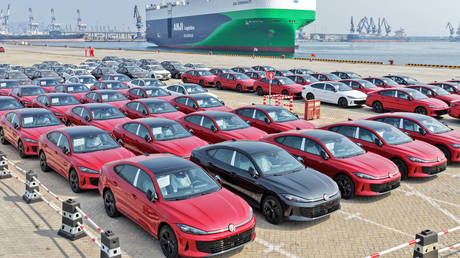
The headlines rolled in with predictable hysteria. Europe’s largest automaker pulls four million vehicles off the asphalt. Safety advocates clutch their pearls. Pundits scream about corporate negligence, profit margins carved out of human lives, and the decay of manufacturing standards.
Here is the truth nobody in the mainstream automotive press has the stomach to print: a massive recall is not a sign of failure. It is proof that a machine is too smart for its own good, designed to flag microscopic variances that would have passed for normal wear and tear twenty years ago. You might also find this connected article insightful: The Structural Failure of Modern Media Distribution Economics and Structural Fixes for Investigative Publishing.
I have watched compliance departments turn into panic rooms. When a fleet reaches a scale where millions of units share identical software architectures, a minor sensor glitch in Munich triggers a mandatory software patch in Madrid, Beijing, and Chicago. We are confusing hypersensitivity with catastrophe.
The Myth of Absolute Zero Error
Walk onto any modern assembly line and you will see robots tolerances measured in microns. We live in an era obsessed with zero defects. It sounds noble on a corporate slide deck, but it creates an engineering trap. When you program a car to monitor every millimeter of brake pressure, every thermal fluctuation in an alternator, and every millisecond of CAN bus latency, you guarantee that the vehicle will eventually find something to complain about. As highlighted in recent coverage by Harvard Business Review, the implications are significant.
Old-school mechanical engineering relied on massive safety margins. A steel arm was built twice as thick as it needed to be because the engineers knew they could not calculate every stress point. Modern automotive design runs on razor-thin optimization. We trim every gram of weight to squeeze out another tenth of a mile per gallon or an extra mile of EV range.
When you optimize that aggressively, components operate closer to their operational limits. The software watching those components has to be paranoid. If a component operates at ninety-eight percent efficiency, the onboard diagnostic system treats a ninety-seven percent reading as a five-alarm fire.
Four million cars did not spontaneously explode on European highways. Four million cars reported a data anomaly that lawyers and regulators forced the boardroom to address with a sledgehammer instead of a scalpel.
The Regulatory Theater of Modern Compliance
Let us look at why these recalls happen in clusters. It is rarely a sudden burst of bad engineering. It is the intersection of software updates and bureaucratic liability.
Regulatory bodies across the European Union operate under a zero-risk mandate that defies the laws of physics. If a single component fails in a lab simulation under extreme thermal stress, lawyers advise management that failing to recall the entire production run opens them up to uncapped liability in civil courts.
Imagine a scenario where a supplier changes the chemical compound of a plastic clip holding a wiring harness. In 1995, that clip goes unnoticed for fifteen years. Today, continuous telemetry uploads millions of operational hours per day to central servers. An algorithm flags a slight uptick in harness vibration frequency. The engineers investigate, find zero actual failures in the field, but the regulatory playbook demands immediate transparency.
Transparency sounds virtuous. In practice, it weaponizes routine maintenance into a PR crisis.
We have incentivized automakers to cry wolf. When every minor component firmware tweak requires a government-mandated safety campaign labeled as a major recall, consumers lose the ability to distinguish between a burning brake line and a dashboard screen reboot loop.
The Real Danger Is Software Bloat
If you want to get angry about modern car manufacturing, point your finger at the right culprit. It is not the mechanical hardware. It is the millions of lines of untestable, unmaintainable code jammed into every dashboard.
Traditional mechanical systems degrade gracefully. A rusty exhaust pipe gets loud before it falls off. A worn brake pad squeals. You have time to react.
Software fails catastrophically and invisibly. A memory leak in an infotainment cluster can cascade through the vehicle network until the central processing unit reboots while you are passing a semi-truck at seventy miles per hour. Automakers are no longer mechanical companies; they are mediocre software shops bolted onto heavy industrial assembly lines.
The four million cars in this latest sweep are victims of over-digitization. We added sensors to monitor sensors, and now we are drowning in the feedback loop.
What Actually Happens Next
The executives will bow, pay the fines, update the compliance metrics, and double down on automated testing. Nothing fundamental will change because the market demands connected, autonomous, hyper-intelligent rolling computers.
Consumers say they want safety, but they vote with their wallets for touchscreens, driver-assist suites, and cloud-connected entertainment ecosystems. You cannot have a vehicle connected to fifty cloud services without inviting fifty potential points of software friction.
Stop treating every recall like an apocalyptic moral failure. It is the cost of living inside a civilization that demands perfection from machines built by humans.
Next time you see a headline screaming about millions of vehicles recalled, look past the panic. Check whether a single person actually got hurt, or if a computer simply decided it did not like the temperature of your transmission fluid.
You are driving a smartphone with wheels. Stop acting surprised when it needs an update.