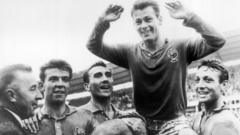
Thirteen goals in six games. Let that sink in. Modern stars celebrate if they score six across an entire month-long tournament. In 2022, Kylian Mbappé won the Golden Boot with eight goals, and people acted like they witnessed a miracle. It was an exceptional run, sure, but he needed seven matches to get there. Go back further to 2002, and Ronaldo hit eight in seven games for Brazil.
Nobody gets near Just Fontaine. The French forward turned the 1958 World Cup in Sweden into his personal shooting gallery. What makes his legendary feat outright ridiculous is the absolute chaos behind the scenes. He wasn't supposed to start. He forgot his boots. He didn't even get a real trophy for his troubles.
The Absolute Chaos of the 1958 French Squad
You probably think a guy who scores 13 goals at a World Cup was the centerpiece of his team's strategy. He wasn't. Fontaine wasn't even a guaranteed starter when the French squad packed their bags for Sweden. He had only played five international matches in the previous four and a half years.
France pinned their hopes on René Bliard and Thadée Cisowski. Then injuries hit. Bliard went down right before the tournament began, forcing coach Albert Batteux to change his plans. He knew Fontaine well from their time together at Stade de Reims, so he threw him into the starting lineup.
There was a massive problem. Fontaine packed lightly. He brought only one pair of football boots to Sweden because he didn't expect much playing time. During a final pre-tournament training session, those boots split in half. He didn't have a backup.
French football rules back then weren't like they are today with massive corporate sponsorships and endless supplies of custom gear. If your shoes broke, you found a solution yourself. Fontaine turned to Stephane Bruey, a reserve striker sitting on the bench. Bruey shared the same shoe size and agreed to lend his spare pair.
Fontaine went on to terrorize the tournament in borrowed shoes. He later joked that his goals came from combining two spirits inside the same footwear.
Demolishing World Cup Defenses in Six Matchdays
Fontaine started his campaign against Paraguay by dropping a hat-trick in a 7-3 victory. He didn't stop scoring after that. He hit a double against Yugoslavia, scored the winner against Scotland, and bagged another brace against Northern Ireland in the quarter-finals.
The 1958 World Cup Scoring Breakdown
- Paraguay: 3 goals
- Yugoslavia: 2 goals
- Scotland: 1 goal
- Northern Ireland: 2 goals
- Brazil: 1 goal
- West Germany: 4 goals
By the time France met Brazil in the semi-finals, Fontaine was flying. He scored after just nine minutes to equalize against the eventual champions. But France suffered a brutal blow when defender Robert Jonquet broke his leg later in the first half. Substitutions weren't allowed back then. France played the rest of the game with ten men and lost 5-2 to a young prodigy named Pelé and a rampant Garrincha.
Most players would have deflated after losing out on the final. Fontaine did the opposite. In the third-place playoff against reigning champions West Germany, he went completely ballistic, scoring four goals in a 6-3 demolition to secure the bronze medal.
An Air Rifle and a Platinum Boot
If you win the Golden Boot today, you get a massive PR campaign, global recognition, and a shiny trophy presented on international television. Fontaine got none of that. The official Golden Boot award didn't exist until 1982.
A Swedish newspaper decided his sharpshooting performance deserved a prize, so they handed him a literal air rifle. It sounds bizarre now, but he was happy with it.
The football world eventually realized they needed to give Fontaine his proper due. In 2014, during the World Cup in Brazil, FIFA invited him as an honored guest. Brazilian legend Ronaldo walked out and presented Fontaine with a custom, one-of-a-kind Platinum Boot. Ronaldo explicitly stated he was proud of his own eight-goal tournament in 2002, but scoring 13 in fewer games was legendary.
Why Modern Football Makes This Record Unbeatable
Tactics have changed dramatically since 1958. Defenses are highly organized, sports science prevents the kind of structural breakdowns Fontaine exploited, and teams rotate their squads constantly to preserve energy.
Fontaine had a secret weapon that summer: freshness. He had a major knee operation in December 1957 and didn't return to the pitch until February 1958. That forced winter break meant he arrived in Sweden full of energy while every other defender was completely exhausted from a long domestic season.
Fontaine's career ended far too early. He suffered two horrific leg breaks in 1960 and was forced to retire in 1962 at just 28 years old. His final international record stands at 30 goals in 21 games. That's a staggering 1.43 goals per match, the highest efficiency rate of any player with at least 20 international caps.
If you want to understand how secure his record is, look at the math for the expanding 48-team tournament structure. Even with extra games on the schedule, a player would need to average nearly two goals every single match to challenge his numbers. Fontaine used to joke that his record would still stand if he came back in 200 years. He was probably right.
If you want to appreciate pure goalscoring efficiency, stop looking at modern highlights and study how a guy in borrowed shoes conquered the world in 1958. Go watch archival footage of that French frontline if you can find it online; it changes how you view modern attacking play.