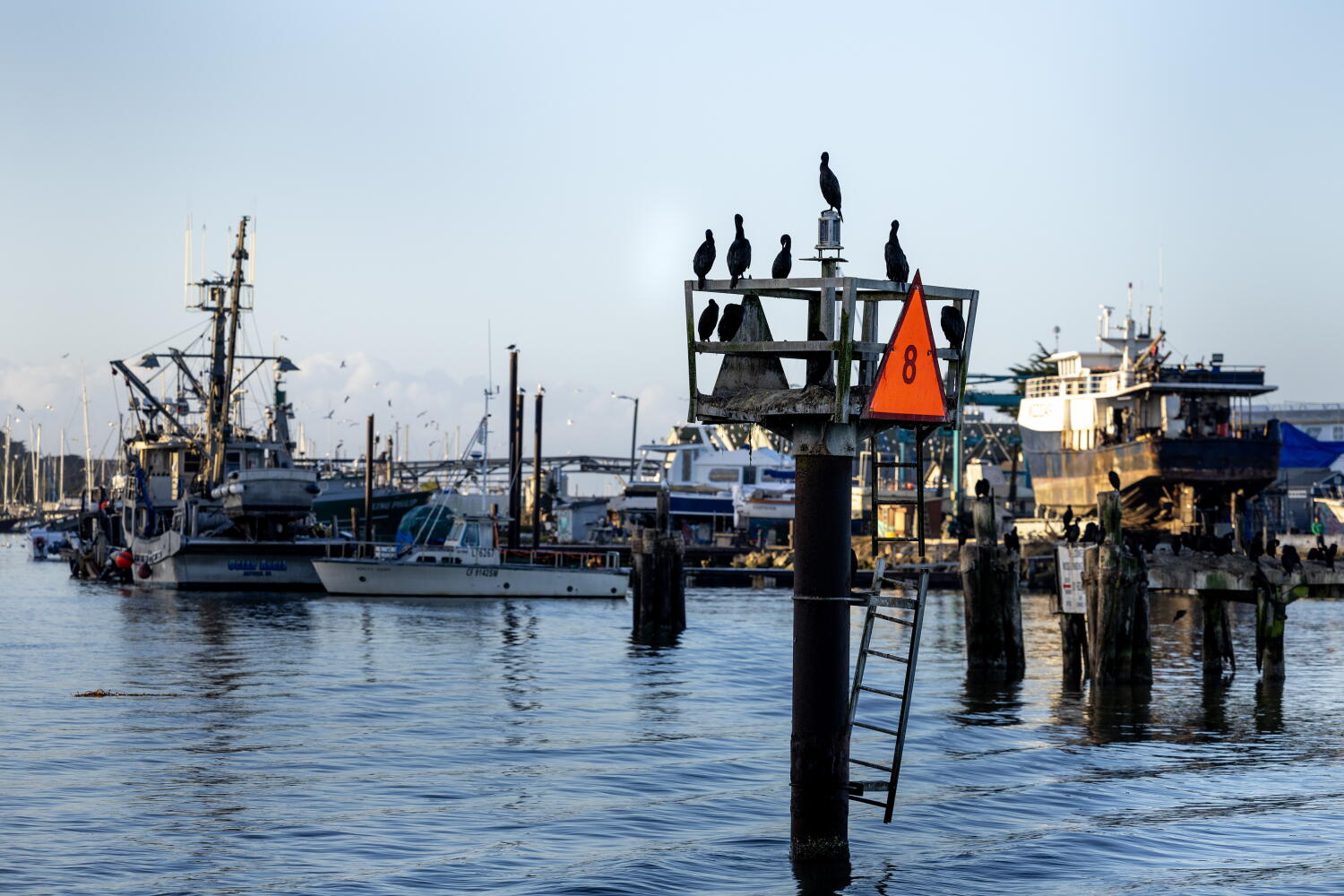
Salt. Diesel. Cold kelp rotting on the tide line.
If you have ever stood on the edge of the Elkhorn Slough just before dawn, you know the exact weight of the Monterey Bay fog. It does not drift; it settles into your coat, muffles the clang of the trawler rigging, and turns the towering twin smokestacks of the power plant into ghosts. Moss Landing is a place built on work—commercial fishermen hauling Dungeness crab pots in the dark, marine biologists wading through mudflats, families whose roots run deep into the coastal loam of Monterey County. It is the kind of unincorporated harbor town where people wave from the cabs of rusted pickup trucks because they recognize the dent on your bumper.
Until sirens tear the morning open.
Most news reports give you the skeleton of a tragedy and call it journalism. They tell you that an 18-year-old was arrested in connection with a deadly Moss Landing shooting. They give you a booking number, a penal code section, a street intersection near Highway 1, and a timestamp from the Monterey County Sheriff’s Office. Then they move on to the weather.
Stop. Look closer at the numbers on that police blotter.
Eighteen.
That is not a hardened syndicate boss. That is someone who, a few months ago, was sitting under fluorescent classroom lights worrying about prom tickets or whether his beat-up Honda would pass smog inspection. In the cold ledger of a press release, a deadly shooting in Moss Landing is reduced to two names—one attached to a morgue tag, the other attached to a booking photo at the county jail in Salinas. Two lives ended in the span of a single pulled trigger, though only one of them stopped breathing.
The Anatomy of a Split-Second Ruin
To understand how gunfire echoes across a quiet coastal harbor, you have to understand the invisible fault lines running beneath rural California communities. People driving south on Highway 1 toward Big Sur see Moss Landing as a postcard—sea otters floating on their backs in the harbor channel, pelicans skimming the swells, roadside stands selling artichokes and strawberries dusted with coastal dirt.
They do not see the pressure cooker behind the highway.
I spent years covering rural courtrooms along the Central Coast, sitting on hard oak benches watching teenagers walk through the side door in orange jumpsuits and leg irons. The pattern is always the same, and it never gets easier to watch. You see a young man whose shoulders haven't even finished broadening, staring at his own shoes while a prosecutor reads out charges that carry twenty-five years to life. The mothers sit in the second row, clutching tissues that have been shredded to lint, trying to trace the exact moment their son crossed an invisible line from a kid making bad choices to a defendant facing the machinery of the state.
Consider a hypothetical scenario—call him Mateo—to see how that line disappears. Imagine an 18-year-old growing up ten minutes inland from the harbor, where agricultural fields meet cramped apartment complexes. Everyone knows everyone, which means every slight, every rumor on a phone screen, and every perceived disrespect carries the weight of a public humiliation. In a big city, you can disappear into a crowd of millions. In a small coastal corridor like Moss Landing, Castroville, or Pajaro, there is nowhere to hide from your own reputation.
Now add a handgun.
A firearm does not create anger, and it does not invent a feud. What it does is compress time. Without a gun, a teenage argument at a coastal turnout or behind a shuttered warehouse ends with bruised knuckles, a torn sweatshirt, and an apology three weeks later when tempers cool. With a gun, an impulse lasting less than half a second becomes permanent. Physics takes over where judgment failed. A piece of lead travels at roughly a thousand feet per second, faster than regret, faster than a second thought, faster than the brain's prefrontal cortex—the very region responsible for weighing consequences, which neuroscientists tell us does not fully finish wiring itself until around age twenty-five—can slam on the brakes.
What Happens After the Tape Goes Up
When deputies from the Monterey County Sheriff’s Office string yellow crime scene tape across a stretch of asphalt near the harbor, the town holds its breath. Neighbors stand behind their screen doors. Shop owners sweep the same patch of sidewalk three times while waiting for cruisers to clear the road.
People immediately start asking the predictable questions, searching for a simple villain to blame so the rest of us can feel safe. Was it gang-related? Was it a robbery gone wrong? Did they know each other?
In almost every fatal shooting involving an 18-year-old suspect in Monterey County, the answer to that last question is the most heartbreaking one: usually, yes. Stranger-on-stranger murder in a town of a few hundred permanent residents is exceedingly rare. Far more often, the victim and the shooter share a zip code, a mutual friend, a school hallway, or a history that curdled over something that, five years later, neither of them would have even remembered.
When investigators make an arrest in a deadly Moss Landing shooting, the legal machinery grinds forward with terrifying speed. At eighteen, the law no longer sees a juvenile. There is no sealed record, no youth rehabilitation camp, no gentle second chance. Turning eighteen changes the legal universe overnight. A crime committed on a Tuesday at seventeen puts a teenager in a juvenile detention hall with counseling and a shot at release in their twenties; the exact same act committed on Wednesday at eighteen sends that same teenager to adult county jail, facing felony murder charges and sentencing enhancements that can add decades behind concrete walls.
Let that sink in. Twenty-four hours on a calendar separates a child the state tries to save from an adult the state locks away.
The Ripples Nobody Counts
The press release stops at the arrest. Real life does not.
Think about the diner down the road from the harbor, where commercial fishermen drink burnt coffee at five in the morning before heading out past the jetties. For weeks after a fatal shooting, the conversation at the counter drops to a murmur whenever someone new walks through the door. Parents start checking their teenagers' phones with a quiet, desperate panic, scrolling through messages looking for slang they don't understand, terrified of finding a photo of a friend holding something metallic in a bedroom mirror.
I remember talking to a commercial fisherman in Monterey County a few years ago after a similar tragedy shook his stretch of the coast. His hands were scarred from decades of hauling wet lines in freezing swells, the kind of man who rarely flinched at twenty-foot waves. Yet when he talked about the young men dying and going to prison in his community, his voice cracked. He told me that out on the water, if a deckhand makes a stupid mistake with a winch, you grab him by the collar, yell until your throat hurts, and teach him how to do it right the next day. "On land," he said, staring down at his mug, "these kids don't get a next day. One mistake and the ocean swallows them whole."
That is the invisible cost of every deadly shooting that gets reduced to a three-paragraph police blotter.
We lose the victim—a son, a brother, a friend whose laugh will never again echo off the harbor pilings, whose future becomes a permanent question mark frozen at whatever age he was when the shots rang out. We lose the 18-year-old suspect, whose life shrinks to an eight-by-ten cell, a steel toilet, and a lifetime of staring through scratched Plexiglas at his mother growing old on the other side of a visiting room phone. And the community loses a piece of its trust, replacing open doors and easy waves with locked deadbolts and suspicious glances at every unfamiliar car idling near the slough.
Why Cold Facts Fail Us
If we only read the headline—18-year-old arrested in deadly Moss Landing shooting—we are tempted to file it away as just another tragic statistic in a country numb to gunfire. We check the date, confirm it wasn't our street, and scroll down to the next story.
Doing that is a quiet surrender.
When we treat youth gun violence as an inevitable weather pattern, like the fog rolling in off Monterey Bay, we absolve ourselves of asking how an 18-year-old got his hands on a lethal weapon in the first place. According to federal tracing data from the Bureau of Alcohol, Tobacco, Firearms and Explosives, teenagers under twenty-one cannot legally purchase handguns from licensed dealers anywhere in the United States. Every single time an 18-year-old pulls a trigger in a town like Moss Landing, a chain of adult failures happened first—an unlocked nightstand drawer, an unreported theft from a pickup truck, an illegal straw purchase, a community intervention that arrived six months too late.
The deputies who worked through the night to track down leads, interview witnesses, and make an arrest did their job. Justice requires accountability; taking a human life demands a reckoning under the law, and no amount of empathy for youth erases the grief of a family planning a funeral.
Yet accountability at the end of a tragedy is a poor substitute for prevention at the beginning of one.
Down at the Moss Landing harbor tonight, the tide will turn just as it has for ten thousand years. The sea lions will bark from the wooden pilings near the yacht club, loud and oblivious to human sorrow. The twin smokestacks will blink their red warning lights into the coastal mist, guiding fishing boats safely back through the narrow channel between the jetties. Somewhere inland, a porch light will stay on all night over an empty driveway, waiting for footsteps that are never coming home.