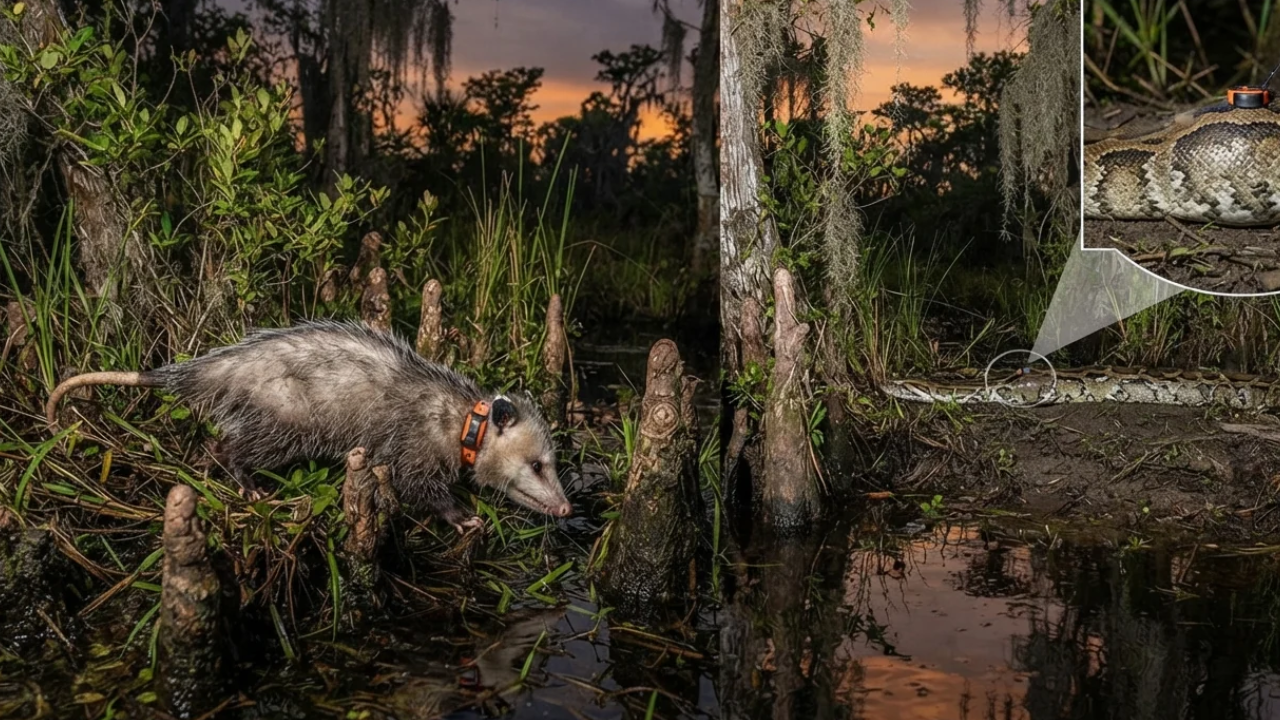
Imagine spending millions of dollars on thermal drones, trained scent dogs, and dozens of full-time human hunters, only to come up empty-handed in the Florida Everglades. That's the reality of fighting invasive Burmese pythons. These snakes don't just blend into the sawgrass; they practically vanish into thin air. So researchers at the Conservancy of Southwest Florida decided to flip the script and use GPS-collared opossums to track hidden pythons.
It sounds like a dark joke. You take a small, slow-moving marsupial, strap a radio transmitter to its neck, and turn it loose in a swamp crawling with 15-foot apex predators. Basically, the opossum acts as a living, breathing scout. When the opossum's signal stops moving and starts acting weird—or moves in a slow, winding path that doesn't match mammal behavior—researchers know a python just ate their tracking device.
The Invisible Predator Problem in South Florida
To understand why scientists resorted to using live prey as tracking beacons, you have to understand how absurdly difficult it is to find a Burmese python in the wild. Even if you're standing three feet away from one, you probably won't see it. Their patterned skin mimics the dappled sunlight and decaying leaves of the Everglades floor with terrifying precision.
Studies conducted by the U.S. Geological Survey (USGS) have shown just how low human detection rates actually are. In controlled experiments where researchers knew exact numbers of pythons were present in an enclosed area, trained human searchers found less than 1% of them. Read that again. Less than one percent.
Traditional methods hit a brick wall years ago.
- Road cruising only catches snakes that decide to cross paved levees at night, missing the massive breeding populations deep inside the wetlands.
- Scout snakes—male pythons fitted with radio transmitters to lead biologists to breeding females—work well during the winter mating season, but they lose effectiveness during the warmer months when snakes disperse.
- Thermal imaging fails miserably in South Florida because the water, mud, and ambient air often stay at nearly the exact same temperature as the cold-blooded reptiles.
When your detection rate hovers near zero, you aren't controlling an invasive species. You're just collecting occasional trophies while the population explodes behind the tree line.
How GPS-Collared Opossums Change the Game
Ian Bartoszek, a wildlife biologist and environmental science project manager at the Conservancy of Southwest Florida, helped pioneer this unconventional approach alongside researchers from the University of Florida. Instead of asking humans to look for snakes, they let the snakes find the bait.
Virginia opossums are native to Florida, abundant, and sit right on the Burmese python's favorite menu. Before invasive snakes took over the region, opossums thrived in the swamps. Now, along with raccoons, marsh rabbits, and bobcats, their populations in the core Everglades have plummeted by over 90% in some areas.
Here is how the tracking protocol actually works in the field. Researchers trap wild opossums in areas adjacent to known python habitats, fit them with lightweight GPS and VHF radio collars, and release them back into the wild. Every single day, biologists monitor the telemetry signals from these animals.
A healthy opossum has a distinct movement signature. They forage at night, climb trees, and den up during the day. When a python ambushes and swallows a collared opossum, the data shifts immediately. The transmitter continues broadcasting right through the snake's digestive tract.
Suddenly, the collar stops climbing trees. It stops following typical foraging routes. Instead, it starts slithering slowly through thick brush or submerging underwater for hours at a time—something an opossum would never do. Biologists track that anomalous signal straight to the brush pile, pull out a massive, freshly fed python, and remove it from the ecosystem before it can lay another clutch of 50 to 100 eggs.
The Ethical Reality of Using Live Mammals as Trackers
Whenever a story like this hits the mainstream news, the comments section immediately splits in two. Half the readers think it's brilliant ecological triage. The other half think it's cruel to put a collar on an animal knowing it might get eaten.
Honestly, it's worth looking at the biology before jumping to outrage. Researchers aren't tying opossums to stakes in the middle of the swamp like scenes from a monster movie. These are wild animals living their normal lives in their natural habitat. Whether they wear a collar or not, they face the exact same daily risk of predation from pythons, bobcats, alligators, and owls.
The collar doesn't slow them down or make them easier targets. In fact, many collared opossums survive for months, providing valuable data on native mammal movement, habitat use, and survival rates in python-infested zones. When one does fall victim to a python, its death isn't wasted. That single event often leads to the removal of a breeding female python, which saves dozens of other native mammals from suffering the exact same fate.
Conservation biology rarely offers clean, painless choices. When an invasive apex predator is actively wiping out native wildlife across millions of acres, sitting back and doing nothing is the cruelest option on the table.
Why Other Mammal Species Are Being Tested Too
Opossums aren't the only animals wearing transmitters for this project. Researchers have also deployed collars on raccoons and marsh rabbits to build a clearer picture of how native prey interacts with invasive constrictors.
Each species tells a slightly different story.
Marsh rabbits are small, fast breeders, and they were historically one of the primary food sources in the Everglades. Reintroducing collared marsh rabbits into areas where they had been completely wiped out acts like an early warning system. If the rabbits survive and reproduce, the python removal efforts in that sector are working. If the collars start broadcasting from inside snake bellies within two weeks, biologists know they still have a major infestation on their hands.
Raccoons offer another layer of intelligence. They're larger, smarter, and more aggressive than opossums, meaning only massive adult pythons can take them down. Tracking raccoons helps researchers specifically target the largest, oldest breeding snakes—the ones capable of producing massive egg clutches every spring.
What Happens When a Python Swallows a Collar
You might wonder if stomach acid destroys the electronics or if the snake gets hurt by the hardware. Neither happens.
Modern wildlife tracking collars are built to survive brutal conditions, including immersion in saltwater, mud, and extreme heat. A python's digestive system is strong enough to dissolve bones, teeth, and hooves, yet the sealed plastic and metal casing of a VHF transmitter passes right through without breaking down.
Once biologists locate the snake using handheld directional antennas, they capture it alive. After humanely euthanizing the python—as required by Florida law for invasive constrictors—researchers perform a necropsy in the lab. They recover the collar, clean it, test the battery, and put it right back into rotation on another animal.
That single piece of hardware pays for itself multiple times over.
The Data Goldmine Inside the Stomach
Removing the snake is only half the victory. The necropsy provides hard data that helps scientists map the collapse and recovery of the Everglades food web.
By examining the stomach contents alongside the GPS collar data, researchers learn:
- Exact digestion timelines in wild temperatures, showing how long a snake stays hidden and inactive after a major meal.
- Post-feeding travel distances, which reveals how far a heavy, slow-moving python will travel to find a safe thermal refuge.
- Secondary prey items, because a python that ate a collared opossum often has the remains of wading birds, deer, or smaller reptiles in its gut as well.
This information feeds directly into predictive models. Instead of guessing where snakes might be hiding during different seasons, wildlife managers can pinpoint the exact microhabitats—like specific elevations of hardwood hammocks or canal banks—where pythons ambush prey.
Common Misconceptions About Florida's Python Crisis
Because viral headlines love sensationalism, most people have a skewed idea of what's actually happening on the ground in South Florida. Let's clear up a few persistent myths.
Myth 1: Bounty hunters are solving the problem.
Programs like the Florida Python Challenge generate great publicity and bring in hundreds of enthusiastic hunters every year. They do remove snakes, and every dead python helps. However, amateur hunters mostly catch snakes along easily accessible levees and roads. They barely scratch the surface of the deep-swamp population, which is where GPS-collared prey and scout snakes do the heavy lifting.
Myth 2: Pythons are taking over the entire state of Florida.
Burmese pythons are tropical snakes. They lack the cold tolerance to survive hard freezes, which naturally limits their northern expansion. While occasional outliers get dumped by irresponsible pet owners near Orlando or Tampa, established breeding populations remain concentrated in the southern third of the peninsula, roughly from Lake Okeechobee down to Key Largo.
Myth 3: Alligators keep the python population in check.
You've probably seen the famous photos of an alligator and a python locked in a death match. While adult alligators do eat pythons—and large pythons occasionally eat juvenile alligators—native gators aren't reproducing fast enough or hunting efficiently enough to stop the invasion. Pythons mature faster, lay way more eggs per clutch, and hide far better than alligators ever could.
What You Can Actually Do If You Live in or Visit Florida
You don't need a biology degree or a telemetry antenna to help protect native wildlife from invasive reptiles. If you spend time in South Florida, a few practical habits make a genuine difference.
- Report sightings immediately using the IveGot1 app. Don't just post a blurry photo on Facebook. The Florida Fish and Wildlife Conservation Commission (FWC) relies on real-time GPS-tagged reports through the IveGot1 reporting system or their hotline (1-888-IVE-GOT1) to dispatch rapid-response removal teams before the snake slithers back into the sawgrass.
- Learn to identify native snakes before swinging a shovel. Every year, panicked homeowners kill harmless native species like eastern indigo snakes, black racers, and water snakes thinking they're baby pythons. Burmese pythons have distinct dark brown, giraffe-like blotches bordered in black, along with a dark arrowhead shape on the top of their heads. If you aren't 100% sure, take a photo from a safe distance and call local wildlife authorities.
- Never release exotic pets into the wild. The entire Everglades disaster started because captive snakes escaped or were intentionally dumped by owners who couldn't handle a 12-foot reptile. If you or someone you know can no longer care for an exotic pet, use FWC's Exotic Pet Amnesty Program, which allows owners to surrender nonnative animals with zero legal penalties or fees.
- Support local conservation organizations directly. Agencies like the Conservancy of Southwest Florida rely heavily on private donations and grants to fund telemetry collars, fuel boats, and pay full-time field biologists. Following their seasonal research updates gives you a front-row seat to the actual science happening in the swamp.


