The air in Gongyi was thick with the usual humidity of a Central China afternoon. On June 30, residents went about their Sunday rituals—hanging laundry, checking phones, or preparing for the evening meal. They knew the Space Pioneer facility was nearby. They knew the Tianlong-3 rocket was strapped to its test stand, a steel skeleton designed to hold back the fury of nine engines.
Then the sound changed.
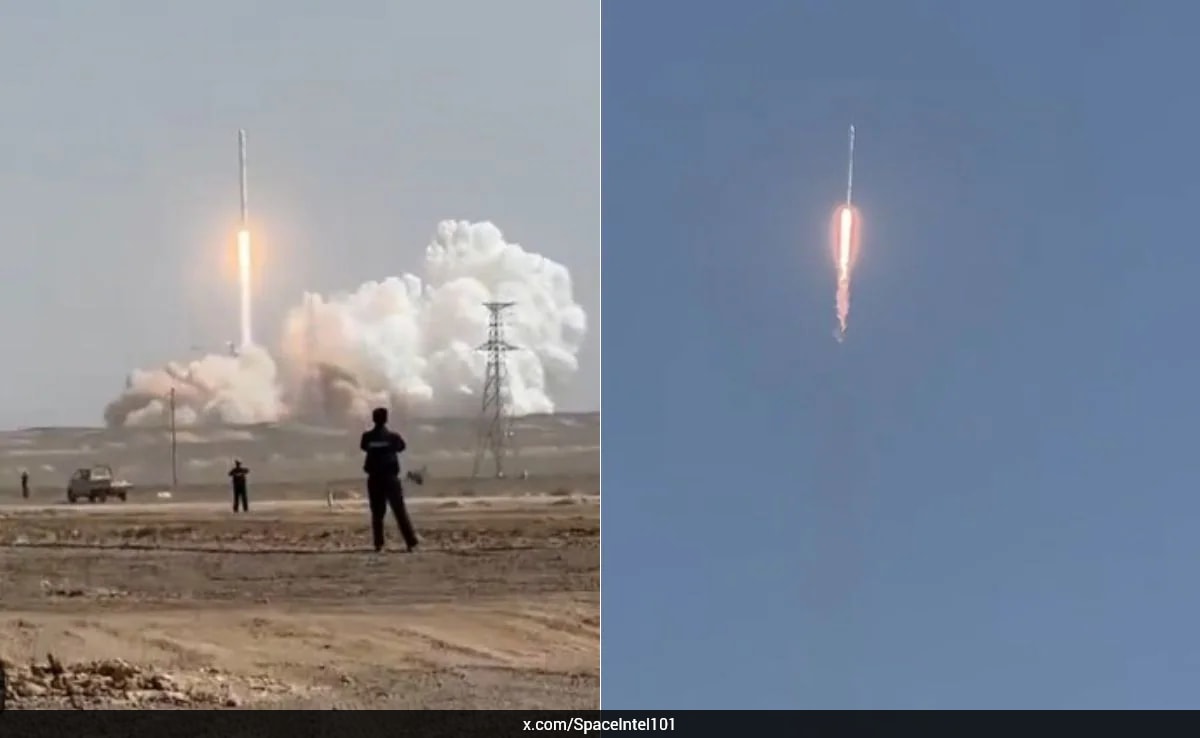
It wasn't the controlled, rhythmic hum of a static fire test. It was a roar that vibrated through the marrow of the bone. In an instant, the silver needle of the rocket wasn't just firing; it was climbing. It tore away from its moorings, defying the very clamps meant to keep it grounded. For a few heart-stopping seconds, the Tianlong-3 became a ghost of the future China wants to build—a reusable, powerful machine soaring toward the clouds.
Then the engines cut out.
The silence that followed was more terrifying than the noise. The rocket tipped, a multi-ton javelin of aluminum and kerosene, and began its long, clumsy arc back toward the hills. When it struck the earth, the explosion sent a mushroom cloud of black smoke and orange flame into the sky, shattering the windows of the present and casting a long, dark shadow over the race for the stars.
The Weight of the Invisible Anchor
We often talk about space as a vacuum, but the industry is heavy with the weight of national pride and billions of yuan. This wasn't just a hardware failure; it was a visceral reminder of the friction between ambition and physics. Space Pioneer, or Beijing Tianbing Technology, isn't just another startup. They are the frontline of China’s attempt to match the vertical integration and rapid-fire cadence of SpaceX.
To understand why this failure hurts, you have to look at the math of the "New Space" era. The Tianlong-3 is designed to be the twin of the Falcon 9. It uses liquid oxygen and kerosene. It aims for reusability. It is the vessel intended to carry the weight of China’s planned satellite megaconstellations—thousands of eyes in the sky that require a bus service more reliable than anything currently in the state-owned hangar.
When the rocket broke free from its test stand, it didn't just fail a structural test. It exposed the frantic pace of a private sector trying to sprint before it can crawl. In the West, we’ve seen Elon Musk’s "fail fast, learn faster" philosophy produce spectacular fireballs in the Texas scrubland. But in China, where the line between private enterprise and national image is thin, a fireball in a populated province like Henan carries a different kind of cost.
A Failure of the Clamps
Imagine standing on a platform, holding a fire hose that has enough pressure to knock down a brick wall. Now imagine that hose is actually nine separate engines producing $820$ tons of thrust. That is the power the Tianlong-3 was generating. The structural failure occurred at the connection point between the rocket body and the test bench. The earth simply couldn't hold it down.
This is the "invisible" side of aerospace. We obsess over the flight, the telemetry, and the satellites. We rarely think about the bolts. We don't consider the metallurgy of the clamps or the reinforced concrete of the stand. Yet, those are the things that keep a "static" test from becoming an accidental launch.
The rocket reached an altitude where the air begins to thin before the onboard computer realized something was wrong and initiated a shutdown. It fell into a hilly area roughly a mile away from the test site. While local authorities reported no casualties, the psychological shrapnel is widespread. For the engineers at Space Pioneer, years of eighteen-hour days literally went up in smoke because of a mechanical interface that failed to respect the laws of Newtonian physics.
The Shadow of the Dragon
There is a specific kind of silence that fills a control room when the telemetry goes flat. It is a cold, hollow feeling. You see it in the eyes of the young graduates who moved to Beijing or Xi’an to be part of the "Galactic Era." They aren't just building machines; they are building a narrative of parity.
For decades, the Long March rockets—reliable, state-controlled, and traditional—were the only game in town. They are the old guard. They get the job done, but they are expensive and disposable. Space Pioneer represents the "New Space" rebels, the agile firms meant to disrupt the status quo.
The stakes go beyond a single company. China is currently racing to build its own version of Starlink, a project often referred to as "Guowang" or the National Network. This requires a launch cadence that the traditional Long March series cannot sustain. It requires the Tianlong-3 to work. Every month of delay caused by this explosion is a month where the orbital shells are filled by competitors, and the "high ground" of low-earth orbit becomes more crowded.
The Human Cost of the Sprint
Consider the hypothetical lead engineer—let’s call him Chen. Chen hasn't seen his daughter for more than an hour a day for six months. He believes in the mission. He believes that for China to be a modern power, it must have a highway to the stars that is as efficient as the high-speed rail lines crisscrossing the mainland.
When he watches the video of the rocket tumbling—captured on a shaky smartphone by a local villager—he doesn't just see a lost prototype. He sees the "996" work culture (9 am to 9 pm, six days a week) failing to account for the one thing you can't shortcut: the brutal reality of vibration and stress.
The industry is currently in a state of hyper-compression. What took NASA or the Soviet Union decades, China’s private sector is trying to achieve in years. This leads to a terrifying paradox. To innovate, you must take risks. But when you are a private company in a system that prizes perfection, a high-profile risk that ends in a fireball near a village is a crisis of trust.
Why We Should Care About the Rubble
It is easy to dismiss this as a setback for a rival or a simple engineering mishap. But the explosion in Henan tells us something deeper about the state of human technology in the 2020s. We are in a second space race, and this one is far more chaotic than the first.
The first race was a duel between two superpowers with unlimited budgets and a willingness to accept "acceptable losses." This new race is a gold rush involving venture capital, geopolitical positioning, and a desperate scramble for bandwidth. When a rocket like the Tianlong-3 fails, it ripples through the global supply chain. It shifts insurance premiums. It alters the timeline for global internet coverage.
It also serves as a sobering reminder that space is hard. It remains the most unforgiving environment we have ever attempted to master. You can have the best AI-driven design software and the most advanced carbon-fiber composites, but if the steel bolts on the ground can't handle the heat, the dream stays grounded.
The Hillside in Gongyi
Hours after the crash, the smoke began to clear. The charred remains of the Tianlong-3 lay scattered across the green hills, looking less like a marvel of engineering and more like the bones of a fallen giant. The local residents returned to their dinner tables, talking about the day the sky fell.
Space Pioneer issued a statement. They will analyze the data. They will fix the structural issues. They will try again. This is the mantra of the age. But the image of the rocket ascending without a destination—a powerful, aimless climb toward a vacuum—remains burned into the collective memory.
We are watching a civilization try to leap into the future while still tethered to the complexities of the present. The fire in Henan wasn't just an explosion of fuel and oxygen. It was the sound of a thousand ambitions hitting a wall of reality. The race continues, but for one afternoon in June, the stars felt a little further away, and the ground felt much, much harder.
The charred crater will eventually be covered by grass, and a new rocket will eventually stand on a new, stronger test bed. But as the engineers return to their screens and the villagers to their fields, they all know the same truth: the heavens do not grant passage easily, and the price of the ticket is often written in fire.