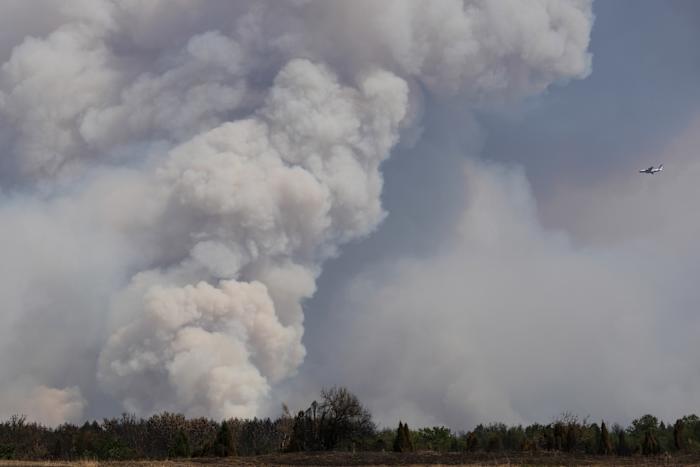
The air smells of wet slate and old ash. It is a strange, jarring combination, the scent of a continent at war with its own climate. Across Germany, the rain did not fall so much as it arrived like a physical blow. Rivers swelled in the dark, turning village streets into churning brown corridors where recycling bins float like lost boats. Down south, the air tastes completely different. In the Balkan interior, the sky glows with an angry, bruised orange. The trees do not bend under the weight of water there. They burn.
We talk about extreme weather as if it were a visitor, something that drops in from out of town, stays for a weekend of destruction, and leaves a forwarding address for the insurance claims. But this is no visitor. This is a permanent resident.
Consider what happens in a German valley when four inches of rain compress into forty minutes. The earth, baked hard by previous weeks of stubborn heat, refuses to drink. It rejects the water. The asphalt rejects it. The concrete channels engineered by cautious municipal planners reject it. Water has only one instinct, which is to find the lowest possible point, and tonight, those low points happen to be people's basements, ground-floor kitchens, and sleep-heavy bedrooms.
Imagine a hypothetical homeowner named Dieter, living in a timber-framed house near the edge of the Sauerland hills. At midnight, he hears a sound like a freight train rolling through the garden. It is not a train. It is the local stream, usually a polite, trout-filled trickle that children skip across in June, now transformed into a hydraulic battering ram. He gets up, his bare feet touching cold tile that is already slick with seepage. By the time he reaches the hallway, the water is at his ankles. By the time he wakes his wife, it is at his knees.
There is a terrifying democracy to these crises. They do not care about property deeds, political affiliations, or carbon offset portfolios. They simply arrive, demanding an immediate accounting of everything we have built and everything we have neglected.
Meanwhile, thousands of miles away in geography if not in spirit, the Balkan states tell a matching, inverted story. Here, the enemy is not the volume of water, but its total absence. The pine needles are crisp as cornflakes underfoot. The soil is powdery and gray. When a spark catches—whether from a discarded cigarette, a lightning strike, or the dry friction of rubbing branches—the forest does not smolder. It detonates.
Firefighters in countries like Greece, Croatia, and Bosnia face an impossible arithmetic. How do you surround an enemy that travels forty miles an hour up a steep limestone ridge on the wings of a dry Adriatic wind? They work for twenty-hour stretches, their faces caked in soot that mixes with sweat until they look like actors in a tragic play. They operate ancient water trucks that groan up unpaved logging roads, praying the axles hold. They watch centuries-old olive groves vanish in seconds, turning into pillars of gray smoke that drift across borders, turning the sunset in neighboring capitals into a sickly, apocalyptic smear.
We have built a civilization on the comforting fiction of moderation. Our infrastructure, our building codes, our insurance pools, and our mental models assume that the future will look roughly like the past, just with slightly better Wi-Fi. That assumption is now a liability.
The meteorologists call this a blocked atmospheric pattern. High-pressure ridges lock stubborn heat domes over one region while funneling destabilized, moisture-laden troughs directly into another. It sounds clinical. It sounds manageable if you draw enough arrows on a weather map. But translation: the atmosphere is breaking down its old habits and inventing violent new ones.
Think about the psychological toll. This is the part that does not fit neatly into morning news bulletins or government disaster relief ledgers. It is the low-grade hum of dread that settles into a community when the sky turns a peculiar shade of green in the afternoon. It is the way children flinch when the wind rattles the windowpanes too hard. We are training a new generation to view nature not as a provider of quiet weekends in the woods, but as a volatile landlord who might evict them at midnight with no warning.
In the German towns, emergency workers use heavy industrial pumps to clear the cellars. They drag ruined drywall, waterlogged sofas, and family photo albums coated in river mud out to the curbs. It is a strange kind of mourning. You can replace the drywall. You can buy a new sofa. But the albums—the physical proof of birthdays, weddings, and quiet Sunday afternoons—are gone forever, dissolved into gray pulp.
In the Balkan foothills, the firefighters pack their hoses, exhausted, only to watch the wind shift directions yet again. The fire jumps a containment line that took six hours to carve into the brush. They have to start over.
We look at these dual catastrophes—the drownings in the north and the burnings in the south—as two distinct tragedies happening on separate stages. They are not. They are the left hand and the right hand of the same planetary fever.
The rain will eventually stop falling in Germany. The ground will dry, the insurance adjusters will arrive with their clipboards, and the politicians will issue solemn statements about resilience and green transitions. The fires in the Balkans will eventually be beaten back by a lucky shift in the wind or the sheer exhaustion of the flames running out of fuel.
Until the next shift. Until the atmosphere draws another breath, tightens its grip, and reminds us once more of our fragile place on a restless earth.