Smoke.
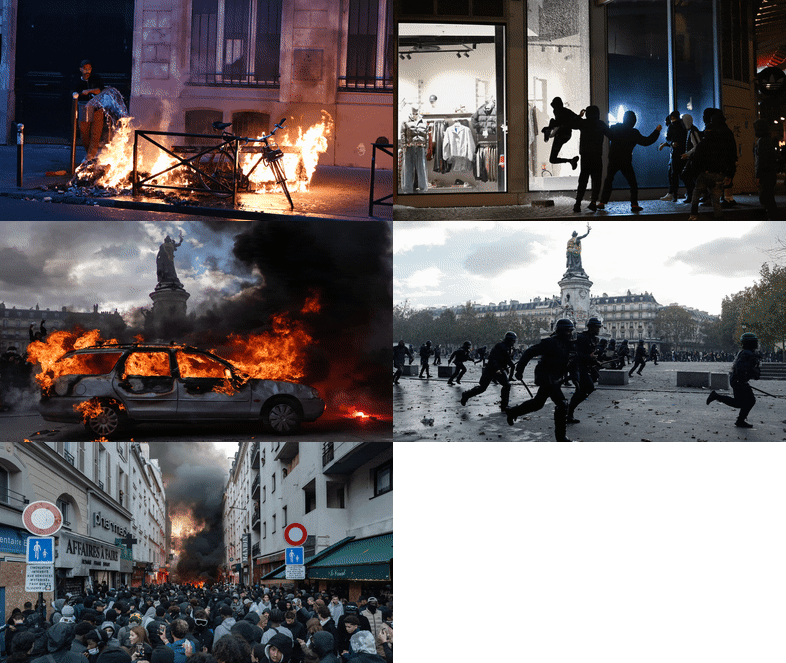
It does not smell like a campfire, warm and nostalgic, carrying hints of cedar and autumn nights. In the outskirts of Paris, Lyon, and Marseille, the smoke smells of melting polycarbonate, scorched rubber, and cheap diesel accelerating across wet asphalt. It clings to the back of your throat for days. It stains the cuffs of your coat. Meanwhile, you can read related events here: Batons in Rome and Tear Gas in Paris Expose Europe's Broken Public Order Playbook.
When the news cameras arrive, they always point their lenses at the flames. They love the spectacle of a burning tram or the jagged silhouette of a shattered bus shelter against the orange glow of a flare. Commentators sit in climate-controlled studios, thousands of miles away or just across the Seine, and ask the same tired, bewildered question: Why are they destroying their own neighborhoods?
It is a logical question if you only look at the surface. Burning down the local library or smashing the pharmacy on the corner looks like madness. It looks like self-sabotage. To explore the full picture, we recommend the recent report by The Guardian.
Yet, when you walk those streets the morning after—when the ash is swept into gray drifts against the curb and the air is sharp with bleach and cold rain—you realize the fire was never about the pharmacy. The cobblestones are just the only target within arm’s reach.
The Architecture of Invisible Walls
To understand why a twenty-year-old in a grey tracksuit picks up a paving stone, you first have to understand how a city can become a cage without a single bar of iron.
Consider a hypothetical young man—let us call him Tariq—living in a high-rise housing project in Seine-Saint-Denis, just north of Paris. On a map, Tariq lives less than ten miles from the glittering boutiques of the Champs-Élysées and the marble corridors of the French ministries. Ten miles. A brisk morning jog.
In reality, Tariq lives on another planet.
He wakes up to the hum of an aging elevator that has been out of service three weeks out of the last four. His mother works nights cleaning office buildings in La Défense, riding two buses and a commuter train in the dark so that executives can walk onto spotless floors at eight in the morning. Tariq has a vocational diploma, a clean record, and a stack of forty-two rejected job applications.
Last month, he ran an experiment. He sent out two identical resumes for an entry-level logistics position. On one, he used his real name and his real postal code: 93200. On the other, he used a traditional French surname and an address in the 15th arrondissement of Paris.
The second resume got a call back in forty-eight hours. The first never got a reply.
Sociologists in France have documented this phenomenon for decades through large-scale resume correspondence studies, consistently finding that applicants with North African or Sub-Saharan sounding names, or addresses in disadvantaged banlieues, receive significantly fewer interview invitations than equally qualified peers. You cannot throw a brick at an algorithm that filters out your postal code. You cannot set fire to an unconscious bias sitting behind a mahogany desk.
The anger builds. Silently. Daily.
The Illusion of the Colorblind Republic
France prides itself on a noble, fiercely guarded ideal: universalism. Under the tricolor flag, there are no hyphenated identities. There are no communities, minorities, or racial statistics—only citizens, equal before the law.
On paper, it is poetry. In practice, it often functions as a blindfold.
Because the French state officially refuses to collect data on race or ethnicity—a policy rooted in the painful memory of the Vichy regime during World War II—it struggles to measure the very discrimination it claims does not exist. When you forbid yourself from counting a problem, you effectively forbid yourself from solving it.
Meanwhile, the reality on the concrete tells a different story. According to data from France’s national statistics institute, INSEE, the poverty rate in the quartiers prioritaires—the designated priority urban neighborhoods—is roughly three times the national average, hovering above forty percent. Youth unemployment in these zones routinely doubles the rate of the rest of the country.
Imagine being told every single day in school that you are an equal citizen of a great republic, only to step outside and realize that your zip code dictates the quality of your teachers, the frequency of your trains, and the way armed police look at you when you walk home from soccer practice.
That contradiction is gasoline.
The Spark and the Street
It rarely takes much to light it. Usually, it is an encounter between a young man and a police patrol.
In June 2023, the fatal shooting of seventeen-year-old Nahel Merzouk by a police officer during a traffic stop in Nanterre triggered nights of intense unrest across the country. Within hours, barricades went up. Town halls burned. Billions of euros in damage rippled through municipalities from the Atlantic coast to the Swiss border.
Critics and political analysts immediately split into familiar camps. Some pointed to a breakdown in parental authority, criminal opportunism, and a lack of respect for the rule of law. Others pointed to decades of heavy-handed policing, systemic neglect, and a state that treats its outer suburbs like occupied territory rather than neighborhoods to be served.
Both observations miss the deeper tragedy of the moment: the sheer powerlessness of the rage.
Think about what happens when human beings are trapped in a pressure cooker with no release valve. In French political history, riots and street protests are practically a constitutional tradition. Farmers dump manure outside prefectures; transport workers shut down rail networks; unions march down broad boulevards with banners and brass bands. Those groups have leverage. They have organizations, spokespeople, and a seat at the table when the dust settles.
The youth of the banlieues have none of that. They have no union. They have no lobby in the National Assembly. Most do not even vote, convinced that whichever party wins in Paris, the broken elevator in their building will remain broken on Monday morning.
When you have no lever to pull inside the system, you attack the physical symbols of the system standing on your block.
The municipal building. The police cruiser. The surveillance camera. The tramway that connects your world to theirs.
What the Flames Actually Destroy
Walking past a burned-out community center in a working-class suburb is a gut-wrenching experience. You see the melted plastic of children’s chairs. You see blackened textbooks curled like dead leaves on the floor.
The people who suffer most from these nights of fury are never the policymakers in Paris or the corporate executives who ignore resumes from the 93rd department. It is Tariq’s mother, who now has to walk two miles in the rain because the bus line was suspended after its depot burned. It is the local grocer, an immigrant himself who worked twenty years to open a shop, standing ankle-deep in shattered glass while sweeping up ruined produce.
The tragedy is double-edged. The rioters tear up their own streets because the real architects of their exclusion are untouchable, invisible, and miles away. And in doing so, they deepen the very isolation they are screaming against. Investors pull back. Bus routes are rerouted. Hardline politicians point to the ashes as proof that more force, more surveillance, and tougher sentencing are the only answers.
It is a closed loop of despair.
The Anatomy of a Frustrated Generation
If you sit down and talk to young people in these neighborhoods—away from the cameras, away from the adrenaline of the night—the bravado evaporates quickly. What replaces it is a quiet, heavy exhaustion.
I remember speaking with a twenty-two-year-old mechanics apprentice outside a battered vocational school in the Lyon suburbs a few years back. He had grease under his fingernails and a quiet, measured way of speaking. He hadn't thrown a single stone during the protests the week before, though his younger brother had been arrested.
"You want to know why they break things?" he asked me, leaning against a rusted chain-link fence. "Because when we are quiet, nobody knows we are alive. You only look at us when something is on fire."
That sentence stays with you. It strips away all the high-minded political theory and reduces the crisis to its rawest human truth: the terror of being invisible.
In psychology, frustration-aggression theory suggests that when a person’s path to a basic goal—dignity, security, belonging—is repeatedly blocked, the resulting frustration inevitably seeks an outlet. If the true obstacle cannot be reached, the aggression is displaced onto whatever stands nearby.
A storefront window. A parked car. A cobblestone.
Beyond the Tear Gas
France has tried pouring concrete at the problem. Over the past twenty years, the National Agency for Urban Renewal has spent tens of billions of euros tearing down grim 1960s tower blocks and replacing them with lower-rise apartments, wider avenues, and shiny new sports complexes.
New buildings look wonderful in press releases. They do not fix a broken social contract.
You can paint a hallway in bright pastel colors, but if the young man walking down it knows he will be stopped and frisked three times on his way to the train station simply because of the color of his skin, the paint does not matter. You can build a state-of-the-art library, but if the local schools are staffed by the youngest, least experienced teachers because veteran educators transfer out as soon as they earn enough seniority, the inequality remains baked into the foundation.
Real change requires confronting ghosts that French society has spent generations trying to ignore. It requires honest conversations about policing practices, hiring discrimination, and the silent segregation that divides French cities into zones of opportunity and zones of containment.
It requires listening before the sirens start wailing.
The Morning After
Go back to that street corner at six in the morning, just as the sky turns the color of a bruised plum.
The riot police have packed their shields into the backs of blue vans and driven away. The television crews have packed their tripods and headed back to their hotels to file their morning segments.
Out of the doorway of a scarred apartment block steps a woman in a heavy wool coat, carrying a plastic bag lunch. She looks down at the blackened cobblestones, at the twisted metal frame of a burned scooter, at the dark smudge of soot climbing the wall of the bakery.
She steps carefully over the broken glass, pulls her collar tight against the chill, and begins the long walk toward the station to catch the first train into the city.
Until the country she is walking into finally decides to see her—and her son—the stones beneath her feet will never truly rest.