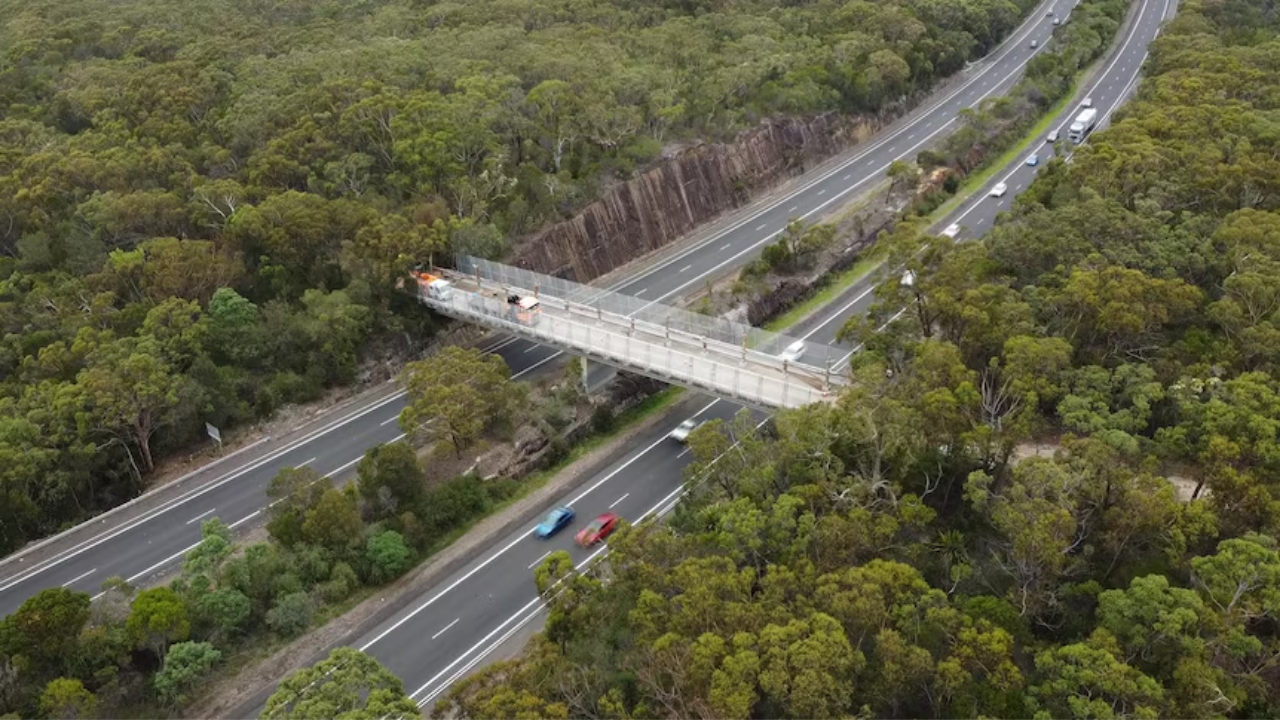
The media wants you to weep tears of pure joy over Cawleys Bridge. They want you to read about Australian ranger Bob Crombie proposing a wildlife corridor over a Sydney motorway back in 1974, wait half a century, and marvel at the heartwarming triumph of bureaucratic patience.
Save your applause.
Fifty-two years isn't a slow burn of progress. It is a monumental, multi-generational policy failure disguised as a feel-good human-interest story. While committees debated, planners shuffled papers, and budgets vanished into bureaucratic black holes, four lanes of the Princes Motorway acted as an unyielding abattoir for local fauna. Celebrating a fifty-two-year lag to slap some dirt, logs, and a two-thousand-dollar rope onto an existing concrete slab is like praising a fire department for arriving half a century after the house burned down.
We have swallowed a lazy consensus about conservation timelines: the comforting myth that systemic environmental inertia is an acceptable cost of doing business.
Let us dismantle the narrative.
The Delusion of Incremental Patience
Every major infrastructure piece written about this crossing leans hard on the trope of endurance. Life finds a way. Nature is resilient. Give the government half a century and they will eventually bolt a few blackbutt logs across a trench of asphalt.
This is dangerous nonsense.
Ecosystems do not operate on five-decade administrative timelines. Genetic isolation does not pause because a municipal council is low on funds. When populations of koalas, quolls, and wombats are severed by asphalt, inbreeding depression and local extinctions happen on a scale of years, not generations. Waiting fifty-two years to reconnect the Royal National Park to Heathcote National Park means entire lineages of native species quietly blinked out of existence while everyone waited for the paperwork to clear.
Imagine a scenario where a corporate board delayed a critical safety fix for fifty years after an employee pointed out a gaping hazard on the factory floor. Executive jail cells would fill up by sundown. Yet when public transport departments slice through biodiversity hotspots and take half a century to fix their own fragmentation mess, they get a ribbon-cutting ceremony and a profile in the local paper.
The Real Economics of Retrofitting
Let us talk about what actually happened here. We did not build a marvel of modern engineering from scratch. We retrofitted an existing service bridge that should have been dual-purposed from the moment the concrete was poured in the seventies.
The technology required to help animals cross a road is profoundly simple. It requires dirt, local vegetation, fencing to funnel traffic, and a length of rope for gliders. Total material costs for these biological additions are a rounding error in any standard highway maintenance budget. The barrier was never fiscal or technological. The barrier was an institutional imagination deficit.
For decades, transport planners viewed asphalt as a hard boundary. Nature was something that lived entirely outside the right-of-way, managed by a separate department with a fraction of the budget. Roads were built to move heavy machinery and human commuters at ninety kilometers an hour, and if a few dozen wallabies or endangered red-crowned toadlets got crushed beneath forty thousand daily vehicles, well, that was just the cost of progress.
Except it is not progress. It is bad design.
Why Multi-Species Architecture is Still Failing
Even now, as we celebrate Cawleys Bridge, we are treating wildlife connectivity as an afterthought, an expensive luxury project rather than a baseline requirement of civil engineering.
Look at how the project came back to life. It took a retired ranger, a local environment centre, and an accidental alignment with modern bureaucrats to drag the idea across the finish line. Policy should not rely on retired octogenarians refusing to drop a grudge they picked up in their twenties. Infrastructure updates should be automated, triggered the moment an ecological audit proves a road is acting as a genetic guillotine.
Furthermore, most wildlife crossings are designed with tunnel vision. Planners build them for koalas because koalas sell newspapers and pull heartstrings. If you look closely at how this specific bridge was shaped, conservationists had to fight to ensure the ants, lizards, and micro-frogs were factored into the design. Bob Crombie pointed out the obvious truth that the mainstream media missed: the insects and reptiles are the foundation of the trophic pyramid. If the ants cannot cross, the pollinators vanish. If the pollinators vanish, the forest dies, no matter how many furry marsupials successfully navigate the rope bridge.
Stop Praising Minimum Viable Compliance
We need to stop treating environmental mitigation as corporate philanthropy or government charity. When a state agency paves a road through a national park, they create a permanent ecological debt. Paying back that debt fifty years later with a few truckloads of soil and a single modified service bridge is not a victory. It is the bare minimum execution of basic stewardship, delayed until the political optics finally made sense.
If we keep normalizing multi-decade delays for basic ecological fixes, we are signaling to future planners that they can stall indefinitely on environmental mandates. We are teaching agencies that if they wait long enough, the public will forget the damage, and they will look like heroes when they finally do what they should have done in the first place.
Do not look at the new bridge over the Princes Motorway and feel comforted by the triumph of patience. Look at it as a monument to fifty years of institutional negligence, and demand that the next ecological corridor takes fifty days, not fifty decades.


