Smoke.
It does not move like a wall or a curtain, though people who have only watched ceremonies on television often expect it to. Out here in the cool highland air of Guatemala, the white breath of copal resin rises in thin, stubborn threads, twisting through pine needles before catching the morning sun like spun glass. Your throat tightens first. Your eyes sting a second later. And then, slowly, the smell of burnt tree sap pushes every modern noise out of your head. You might also find this similar article useful: Why the Port of New Orleans Is Suing for Control of a Tanker After a Mississippi River Cruise Ship Crash.
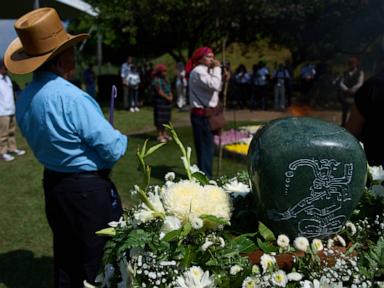
I stood near the edge of a stone courtyard in the Guatemalan highlands watching an ajq'ij—a Maya spiritual guide—lay out colored candles in a careful circle. Red for the east and the rising sun. Black for the west and the resting place of the ancestors. White for the north. Yellow for the south. Blue and green in the center for the sky and the earth. If you have ever attended a Maya fire ceremony, you know it is not a performance staged for cameras. Nobody checks a watch. Nobody rushes the fire. You wait until the wood decides to catch, and you listen to the rhythm of the Maya calendar names being spoken aloud like a roll call of the living and the dead.
On this morning, the names being called into the fire belonged not just to ancient lineages, but to a man whose bronze bust sits in Paris and whose remains waited half a century to come home. As discussed in detailed reports by TIME, the results are worth noting.
Miguel Ángel Asturias.
If you only know his name from a dusty syllabus or a trivia answer—Guatemala’s Nobel Prize in Literature winner, laureate of 1967, author of El Señor Presidente and Men of Maize—it is easy to treat a Mayan ceremony honoring him as a pleasant cultural postcard. A polite nod between Indigenous elders and a famous dead writer.
Look closer, though, and the story becomes much sharper, much stranger, and far more urgent. Because honoring Miguel Ángel Asturias with Maya fire is not a simple victory lap. It is an act of reconciliation fifty years in the making, carried out in a country still arguing over who gets to speak for its soul.
The Ghost in Père Lachaise
To understand why a fire had to be lit in Guatemala, you first have to picture a graveyard in Paris.
For fifty years after his death in Madrid in June 1974, Miguel Ángel Asturias lay buried in Père Lachaise Cemetery, thousands of miles away from the volcanoes, cornfields, and cobblestone streets that haunted every page he ever wrote. A replica of a Maya stela stood over his Parisian grave, carved with ancient glyphs under gray European skies. It was poetic, in a tragic sort of way. It was also exile made permanent in stone.
Asturias had spent much of his adult life outside Guatemala, pushed out by dictatorships, political paranoia, and the brutal Cold War convulsions that tore Central America apart during the twentieth century. Even after winning the Nobel Prize in Literature in 1967—the first Latin American novelist to claim that honor—returning home permanently remained complicated, shadowed by military rule and the danger attached to his name.
Picture a hypothetical reader today, say a twenty-two-year-old university student in Guatemala City named Mateo, picking up Men of Maize for the first time on a crowded bus. Mateo knows the headlines of his own country: corruption scandals, migration north, Indigenous communities still fighting in courtrooms and on highways to protect their water and land. When Mateo opens Asturias’s novel, he does not find polite folklore. He finds a fierce, hallucinatory warning about what happens when men treat sacred corn—the very substance from which Maya creation stories say humanity was kneaded—as nothing more than a cash crop to be stripped, sold, and exhausted.
That tension never stayed locked inside Asturias’s books. It followed his bones.
For decades, debates flickered over whether his remains should stay in France or return to Guatemala. When the long-awaited repatriation finally moved forward, bringing the Nobel laureate back to Guatemalan soil after half a century abroad, the question was never merely logistical. Where do you put a man who belonged to two worlds that spent five hundred years colliding?
Do you give him only military honors, flags, and speeches by politicians in dark suits? Or do you bring him back to the fire?
Why the Fire Matters More Than the Marble
Most people outside Central America misunderstand what a Maya ceremony actually is. We are trained by museums and textbooks to look at Maya civilization in the past tense—pyramids abandoned to the jungle, glyphs decoded by scholars, a vanished empire frozen behind glass.
Spend ten minutes beside a ceremonial fire in Guatemala and that illusion collapses immediately.
The Maya are not a rumor from the past. More than forty percent of Guatemala’s population is Indigenous, belonging to over twenty distinct Maya linguistic communities—K'iche', Kaqchikel, Mam, Q'eqchi', and others—each carrying living traditions that survived invasion, forced conversion, and a thirty-six-year internal armed conflict that devastated Indigenous villages.
When an ajq'ij builds a ceremonial fire, think of it less like a monument and more like a telephone line. The sugar, chocolate, copal, flowers, and colored candles are not random props. They are offerings meant to feed the energy of the day—the nahual on the sacred 260-day Cholq'ij calendar—and open a dialogue with ancestors, natural forces, and memory itself. Nothing is wasted. Nothing is hurried.
I will admit something that anyone who has stood at the edge of one of these ceremonies eventually feels: if you were raised outside this tradition, it can feel intimidating at first. You worry about standing in the wrong spot, stepping across an invisible boundary, or misreading gestures layered with centuries of meaning. You watch elders murmur prayers in K'iche' or Kaqchikel while flames lick at mounds of sweet resin, and you realize how shallow our modern habit of "commemoration" really is. We slap a name on a street sign and call it remembrance. Here, remembrance requires heat, patience, and witnesses.
Honoring Miguel Ángel Asturias through a Maya ceremony flips the usual script of literary fame. Instead of placing Asturias above the culture that inspired him, the ceremony places him back inside it—as a son, a listener, and, truthfully, a complicated figure.
The Uncomfortable Truth About Asturias
If we pretend Miguel Ángel Asturias was a saint without contradictions, we ruin the story and insult the intelligence of the people lighting the fire.
Truth matters here. Born in 1899 in Guatemala City to a mestizo family of judges and teachers, Asturias grew up insulated from the daily realities of rural Indigenous life, even though his childhood years in Salamá gave him early contact with Maya communities. Later, as a young law student in the early 1920s, he wrote a thesis on the "social problem of the Indian" that reflected the paternalistic, assimilationist ideas common among urban intellectuals of his era—ideas that modern scholars and Indigenous thinkers rightfully criticize.
Then something changed.
In the 1920s, Asturias went to Paris to study anthropology and ancient Mesoamerican religions at the Sorbonne under Georges Raynaud, helping translate the Popol Vuh—the sacred K'iche' Maya creation narrative—into Spanish. Immersion in those texts cracked open his imagination. He stopped writing like a detached legal reformer and began writing from inside the mythic bloodstream of Guatemala.
Out of that transformation came Legends of Guatemala in 1930, El Señor Presidente in 1946—a blistering portrait of dictatorship that helped birth the Latin American "Boom" generation—and Men of Maize in 1949, a book so dense with Indigenous cosmology, oral cadence, and surrealist fire that it still feels electric seventy-five years later. When the Swedish Academy awarded him the Nobel Prize in Literature in 1967, they praised his writings "rooted in national traits and traditions of Indian peoples of Latin America."
Yet the paradox remained. Could a non-Indigenous writer channel Maya worldview on the world stage without speaking over Maya people themselves?
Imagine Elena, a hypothetical Kaqchikel weaver and community educator in Chimaltenango, watching news of the ceremony on her phone while sorting bundles of dyed cotton thread. Elena respects what Asturias did to force Paris, Stockholm, and Madrid to take Maya mythology seriously when Guatemala’s own elites wanted to erase it. At the same time, she knows firsthand how often Indigenous voices have been admired in books while ignored in parliament. For someone like Elena, a Maya ceremony honoring Asturias is not blind worship. It is reclamation. It is Indigenous spiritual authorities stepping forward on their own terms to say: You carried our stories out into the world; now we welcome your spirit back through the fire of our ancestors.
That distinction changes everything.
What Happens When Memory Comes Home
Watch the choreography of the ceremony and you see how carefully that balance is struck.
Before a single match is struck, the ground itself is cleaned and blessed. Pine needles—juncia—are scattered across the earth, releasing a sharp, clean scent every time someone shifts their weight. Elders trace patterns on the stone or dirt with sugar and sesame seeds, building an altar that looks like a mandala made of harvest gifts. Cigars, cinnamon sticks, sweet bread, and bundles of resin are arranged according to the four cardinal directions.
As the fire catches, the ajq'ij invokes the Creator and Heart of Sky, Heart of Earth, asking permission from the day’s energy to speak Asturias’s name. Notice the order of operations. Even a Nobel laureate does not walk into a Maya sacred space unannounced. Permission is asked first. Humility comes before applause.
Around the circle stand cultural officials, writers, students, diplomats, and ordinary neighbors who came simply to witness history touch the ground. Some bow their heads. Some hold cameras steady at chest height. An older woman wipes smoke from her cheek without stepping back from the heat.
Why do people travel hours over winding mountain roads to stand around a fire for a writer who died in 1974?
Because in Guatemala, memory is never neutral territory.
Between 1960 and 1996, Guatemala endured a civil war that killed or disappeared roughly 200,000 people, with a United Nations-backed truth commission finding that more than eighty percent of the victims were Maya. Sacred sites were desecrated. Spiritual guides were hunted. Whole communities were told their languages and rituals were backwards or subversive.
Against that history, every public Maya ceremony is quietly revolutionary. Lighting copal in the open air to honor the nation’s most celebrated writer sends an unmistakable signal: the spiritual backbone that state violence tried to break is still standing, still speaking, and still capable of blessing the country’s highest literary legacy.
Beyond the Headline
Read a standard wire report about a Mayan ceremony honoring Miguel Ángel Asturias and you will get three brisk paragraphs: who attended, when the Nobel Prize was won, maybe a line mentioning traditional candles and incense. Clean. Efficient. Completely bloodless.
Strip away the human stakes and you miss why this moment resonates far beyond Guatemala’s borders.
Every country struggles with what to do with its complicated heroes and its unfinished promises. In the United States, in Canada, across Latin America and Europe, societies are wrestling with how to honor artistic achievement without whitewashing history, and how to move past hollow symbolism toward genuine cultural respect.
Guatemala’s tribute to Asturias offers a rare, tangible model of what that looks like when done without shortcuts. Nobody erased his flaws. Nobody turned him into a marble statue safe from scrutiny. Instead, his return became an occasion for dialogue between literary history and living Indigenous spirituality—two forces that need each other if the country is ever going to tell its whole story honestly.
There is also a quieter lesson tucked inside the smoke for anyone who writes, creates, or tries to build something meant to outlast them. Asturias spent decades away from home, typing in rented apartments in Paris and Buenos Aires, worrying whether his books would ever truly reach the people whose rhythms pulsed inside his sentences. He died without knowing when, or if, he would return to Guatemalan earth.
Yet half a century later, his words brought people together around a ring of fire in the country he never stopped dreaming about.
The Last Ember
By late morning, the tall flames settle into a bed of glowing coals, white ash ringing the edges like frost. The copal has melted into dark, fragrant pools that hiss softly whenever a stray breeze sweeps across the courtyard. People linger near the warmth, reluctant to break the circle and step back into traffic, deadlines, and phone notifications.
An elder bends down, presses two fingers briefly toward the earth, and murmurs a final word of gratitude as the last thread of white smoke lifts toward the volcanoes on the horizon, disappearing into the bright highland sky.