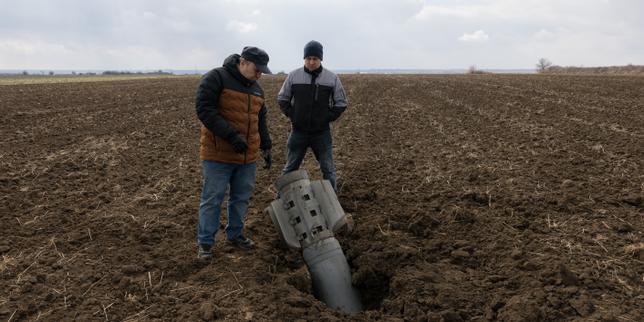
The prevailing narrative regarding Ukrainian soil is a dangerous mix of toxic optimism and scientific reductionism. You have seen the headlines. They suggest that as long as we clear the mines and check for heavy metals, the "Breadbasket of Europe" will simply resume its scheduled programming. This is not just wrong; it is a fundamental misunderstanding of soil biology and the brutal physics of modern kinetic warfare.
We are told that non-mined areas remain "clean" and suitable for farming subject to monitoring. This assumes that war is a neat, localized event. It treats a battlefield like a spilled bottle of ink on a hardwood floor—wipe it up, and the surface is as good as new. In reality, the damage to Ukraine’s chernozem is systemic, deep-seated, and likely irreversible on a human timescale.
The Myth of the "Clean" Zone
The idea that a field is "clean" just because it isn't littered with TM-62 anti-tank mines is a fantasy. Warfare doesn't respect property lines or the arbitrary boundaries drawn by soil scientists in laboratory conditions.
When a Grad rocket or an artillery shell hits the earth, the immediate explosion is the least of the long-term problems. The shockwaves alone shatter the soil structure. We are talking about the destruction of the macro-pores and micro-pores that allow for water infiltration and root respiration. You can't just plow your way out of soil compaction caused by supersonic pressure waves.
Furthermore, the "monitoring" everyone speaks of is a logistical nightmare masquerading as a solution. Ukraine has over 32 million hectares of arable land. Even if the conflict ended tomorrow, the idea that we can effectively monitor every hectare for the complex cocktail of propellant residues, TNT degradation products, and heavy metal leaching is laughable. I have seen soil remediation projects in industrial Europe struggle with five-acre plots. Scaled to a national level, "monitoring" becomes a buzzword used to keep insurance premiums down and grain exports moving, regardless of the actual health of the crop.
Chemical Ghosting and the Bioavailability Trap
Standard soil tests are designed for peace-time problems. They look for nitrogen, phosphorus, and potassium. They might check for lead or cadmium if they are feeling thorough. But modern munitions are a chemical witch’s brew.
White phosphorus, antimony, copper, and specialized polymers used in shell casings don't just sit there. They migrate. The "lazy consensus" says these elements stay localized. Biology says otherwise. Through a process called phytoextraction, crops actively pull these toxins from the earth.
- The Heavy Metal Delusion: We focus on whether the soil has "too much" lead. We should be focusing on bioavailability. In the acidic environments created by sulfur-heavy explosive residues, metals that were previously inert become mobile.
- The Micro-Biome Massacre: Soil is alive. A single gram of healthy Ukrainian soil contains billions of organisms. The heat from an explosion doesn't just kill the worms; it sterilizes the fungal networks (mycelium) that are responsible for nutrient uptake. You can pour as much synthetic fertilizer as you want onto a sterilized field; it’s like trying to feed a corpse.
Imagine a scenario where a farm is declared "safe" because it was five kilometers behind the actual trench line. The farmer plants sunflowers. The roots go deep. They hit a lens of contaminated groundwater tainted by a destroyed fuel depot three miles away. The seeds look fine. The lab test for standard contaminants comes back clear. But the chemical signatures of the war are there, waiting to enter the global food supply.
The False Promise of Rapid Remediation
The current industry "insiders" are pushing bioremediation as a quick fix. They want to sell you specialized bacteria and "hyper-accumulator" plants that will supposedly suck the toxins out of the ground in a few seasons.
This is a business model, not a recovery strategy. True soil formation happens at a rate of roughly one centimeter every 100 to 400 years. We are destroying millennia of pedogenesis in a few years of high-intensity shelling. To suggest that we can "fix" this with a few applications of proprietary microbes is the height of techno-arrogance.
$S = \int f(cl, o, r, p, t) dt$
In the classic Dokuchaev soil equation, time ($t$) is the critical factor. You cannot optimize your way out of $t$. When the parent material ($p$) is contaminated and the organisms ($o$) are vaporized, the equation breaks.
The Economic Mirage of Recovery
The agricultural industry wants to believe in the "clean soil" narrative because the alternative is an economic black hole. If we admit that significant portions of the world's most fertile land are functionally dead, the global commodities market goes into a tailspin.
I have watched companies burn through millions trying to reclaim land that was merely "lightly" impacted by industrial waste. The cost of genuine remediation—not just surface scratching—often exceeds the market value of the land itself. In Ukraine, the sheer scale of the disruption means that for many areas, the most "rational" economic choice will be abandonment, not restoration.
We are looking at the creation of "Red Zones" similar to those in post-WWI France, where the soil was so saturated with lead, arsenic, and unexploded ordnance that it was simply cordoned off. To pretend this won't happen in Ukraine is dishonest.
Why the Current Questions are Wrong
People ask: "How soon can we plant?"
The real question is: "Should we ever plant here again?"
People ask: "Is the soil clean?"
The real question is: "Is the soil alive?"
We are obsessed with the presence of mines because they are visible and they kill quickly. We ignore the invisible chemical and physical degradation because it kills slowly and quietly at the bottom of a spreadsheet.
The industry insists on a binary: Mined or Not Mined. This is a false dichotomy designed to simplify a complex ecological catastrophe into something digestible for investors. The truth is a spectrum of degradation where even the "best" areas are compromised.
The Hard Reality of the Breadbasket
Ukraine's competitive advantage was its deep, rich, resilient black earth. That resilience is being methodically stripped away. Even in the zones where no tank ever tread, the atmospheric deposition of heavy metals from smoke plumes and the disruption of regional water tables from destroyed dams (like Kakhovka) have altered the fundamental chemistry of the region.
The irrigation systems that made the southern steppes productive are gone. The resulting soil salinization is a permanent change that no amount of "monitoring" will fix. We are witnessing the de-industrialization of agriculture through kinetic force.
Stop looking for the "all-clear" signal. It isn't coming. The soil isn't "fine under certain conditions." It is a traumatized ecosystem that we are trying to force back into a production schedule it can no longer support.
If you want to understand the future of Ukrainian agriculture, look at the scars on the land, not the reports from the lobbyists in Kyiv or Brussels. The earth remembers every shell. It doesn't forgive just because the mines are gone.
Agriculture is a biological process, not an industrial one. When you kill the biology, you're left with dirt, not soil. And you can't feed a planet with dirt.



