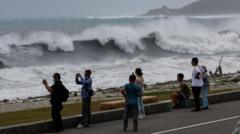
The headlines always follow the exact same script. A tropical cyclone tears through Southeast Asia, mudslides claim lives in the Philippines, and the media instantly spins up a narrative of unpredictable climate fury and passive victimization. The standard consensus is clear: nature is getting more chaotic, and developing nations are merely sitting ducks waiting for the next catastrophe.
This narrative is lazy, mathematically blind, and dangerously wrong.
When you look at the hard data behind disaster metrics, the real tragedy isn’t the weather. It is a systemic failure of infrastructure planning, coupled with a media apparatus that treats predictable engineering failures as shocking acts of God. Stop looking at the barometric pressure of the storm. Start looking at the concrete, the zoning laws, and the economic policies that practically guarantee these outcomes.
The Myth of the Unpredictable Monster Storm
Every time a typhoon enters the Philippine Area of Responsibility, the press acts like it’s an unprecedented anomaly. They focus heavily on peak wind speeds and satellite imagery, hyping up the fear factor. But meteorology has evolved. Track forecasting and intensity modeling have improved drastically over the last two decades. We know exactly where these storms are going, days before they make landfall.
The standard news cycle asks: How can we stop these destructive storms? That is the entirely wrong question. You do not stop a atmospheric thermodynamic engine. You engineer around it. When 15 people die in a landslide in rural Luzon, the root cause isn't the rainfall volume. The root cause is a lethal combination of unregulated hillside deforestation, corrupt local zoning that allows residential construction on known unstable slopes, and a complete lack of retaining infrastructure.
I have spent years analyzing regional supply chains and infrastructure resilience across East Asia. I have watched municipal governments allocate millions to cosmetic urban upgrades while completely ignoring the subterranean drainage networks that actually keep a city alive during a deluge. Calling these events "natural disasters" completely absolves the human actors who signed off on the subpar building permits.
The Math of Resilience: Why Wealth, Not Weather, Dictates Casualties
Let's look at a brutal, undeniable comparison.
In 2013, Typhoon Haiyan (Yolanda) struck the central Philippines with sustained winds of roughly 195 mph, leading to over 6,300 deaths. In 2018, Typhoon Mangkhut hit both the Philippines and Hong Kong. In the Philippines, it killed over 100 people, mostly due to landslides. In Hong Kong, which absorbed massive wave surges and similar wind intensities, the death toll was zero.
| Metric | Developing Infrastructure Region (e.g., Rural Samar/Leyte) | Highly Engineered Urban Center (e.g., Hong Kong/Tokyo) |
|---|---|---|
| Primary Building Materials | Light timber, unreinforced masonry, corrugated iron | Reinforced concrete, steel frames, deep pilings |
| Zoning Enforcement | High rates of informal settlement on marginal land | Strict geological testing and mandatory setback distances |
| Drainage Capacity | Open ditches, easily clogged by silt and debris | Massive underground storm attenuation tanks |
| Casualty Rate (Per Similar Storm Force) | High | Extremely Low to Zero |
The weather didn't discriminate; the engineering did. Hong Kong relies on strict building codes, massive underground stormwater interception tunnels, and a highly sophisticated slip-form engineering culture. The city treats typhoons as a routine operating expense, not an existential crisis.
When a competitor article focuses solely on the body count without dissecting the underlying structural deficits, they are selling disaster porn instead of journalism. They tell you what happened, but they deliberately obscure why it keeps happening in the exact same spots every single monsoon season.
Dismantling the Victimhood Narrative
The conventional view insists that developing nations simply lack the capital to build this way. This is a half-truth that masks a deeper economic reality. The issue is not a lack of capital; it is the misallocation of risk.
International aid flows into disaster zones after the fact. Billions of dollars are spent on temporary shelters, emergency food rations, and rebuilding the exact same shoddy structures in the exact same floodplains. It is a lucrative loop of reactive charity that completely disincentivizes proactive mitigation.
Imagine a scenario where global climate funds banned the use of capital for post-disaster rebuilding unless the target municipality enforced strict, verified zoning laws. Local politicians would suddenly find the political will to clear out informal settlements from dangerous hillsides. But right now, the incentives are inverted. Disasters bring foreign aid, and foreign aid fills municipal coffers with minimal accountability.
The Counter-Intuitive Truth About "Green" Infrastructure
Many modern pundits argue that the solution lies in restoring natural ecosystems—planting mangroves and reforesting hillsides. While ecologically beneficial, relying on this as a primary defense mechanism against Category 5 systems is a dangerous fantasy.
A mangrove forest cannot stop a 20-foot storm surge from obliterating a village built out of plywood. A newly planted forest cannot stabilize a sheer cliffside that has already lost its deep-rooted old-growth timber to decades of illegal logging.
We must stop romanticizing soft solutions where hard, capital-intensive civil engineering is required. You cannot combat a multi-gigawatt atmospheric event with good intentions and community-led tree planting initiatives. You combat it with:
- Deep-pile reinforced concrete foundations that tie structures directly into bedrock.
- Mandatory automated sea gates and massive pump stations driven by independent, redundant power grids.
- The forced relocation of populations out of designated low-lying alluvial plains, regardless of the political fallout.
The downside to this approach is obvious. It is incredibly expensive, it disrupts local communities, and it requires an authoritarian level of zoning enforcement that many democratic societies find unpalatable. But the alternative is the status quo: a predictable annual body count, followed by predictable media hand-wringing, followed by absolutely zero structural change.
The Next Media Cycle is Already Broken
The next time you see a headline about East Asia bracing for a destructive storm, ignore the dramatic b-roll of wind-whipped palm trees. Look past the sensationalist reporting and demand the only data point that actually matters: What is the failure point of the local infrastructure?
If the press refuses to hold local governments accountable for building death traps in the paths of predictable storms, then the media isn't just reporting on the tragedy. They are actively subsidizing the next one.
Stop blaming the sky. Demand better concrete.