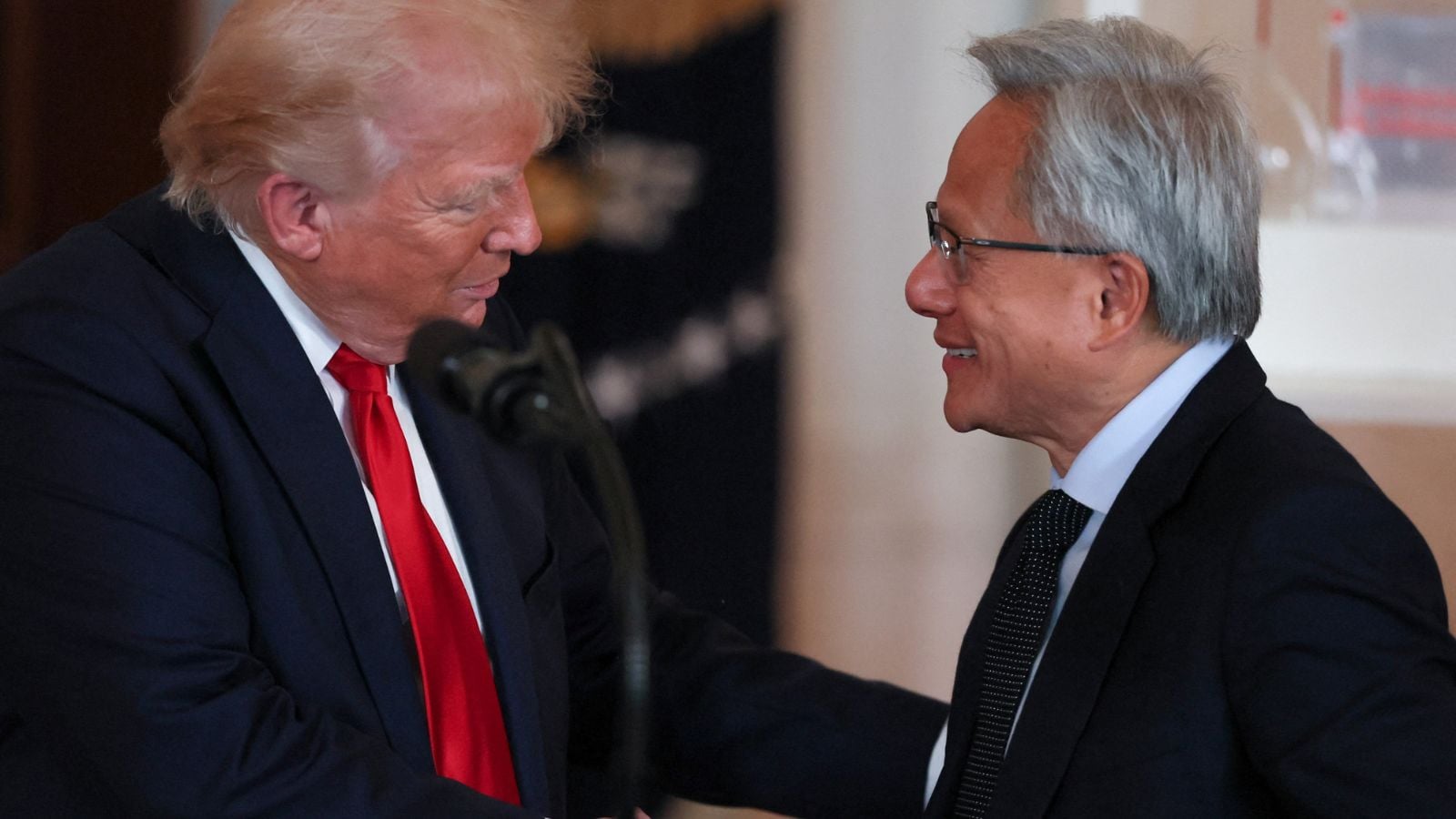
Reports that Donald Trump urged Nvidia CEO Jensen Huang to "fight for his job" strip away the polite veneer of Washington-Silicon Valley relations and expose a fundamental collision between political populism and founder-led capital allocation. On the surface, the interaction reads like standard political theater—an executive branch figure projecting strength toward a corporate titan. In reality, this dynamic highlights the structural vulnerability of dominant technology monopolies when national security policy, trade restrictions, and domestic industrial incentives intersect with extreme market concentration.
To understand why a political figure would frame a high-performing CEO's tenure as a battle for survival, analysts must separate market performance from political license to operate. Under Huang, Nvidia achieved near-total dominance in artificial intelligence compute, capturing the vast majority of data center GPU revenue and driving its market capitalization into the multi-trillion-dollar tier. By every conventional metric of shareholder return, capital efficiency, and product roadmap execution, Huang's position is unassailable. Yet in an era of techno-nationalism, boardroom metrics no longer guarantee executive autonomy.
The Dual-Mandate Paradox of Strategic Monopolies
Modern semiconductor leaders operate under a dual-mandate paradox. The first mandate is fiduciary: maximize return on invested capital by optimizing global supply chains, serving the highest-margin customers regardless of geography, and maintaining architectural lock-in. The second mandate is geopolitical: align corporate resource allocation with the strategic containment goals of the home nation.
When these two mandates diverge, political friction escalates rapidly. Nvidia's architecture—specifically its CUDA software ecosystem paired with successive generations of Hopper and Blackwell silicon—became the foundational infrastructure for global AI development. Because compute capacity directly translates to economic and military capability, the U.S. government reclassified advanced semiconductors from commercial exports to strategic assets.
This reclassification creates three structural pressures on executive leadership:
- Revenue Sterilization Through Export Controls: When the Department of Commerce restricts shipments of high-end accelerators to China, it immediately severs a historically vital revenue stream. Designing compliant, lower-performance chips to bypass thresholds invites iterative regulatory crackdowns, forcing the company into a reactive engineering cycle that consumes R&D bandwidth without expanding the technological frontier.
- Supply Chain Concentration Risk: Nvidia operates as a fabless designer, relying almost exclusively on Taiwan Semiconductor Manufacturing Company (TSMC) for leading-edge wafer fabrication and CoWoS (Chip-on-Wafer-on-Substrate) advanced packaging. From a Washington perspective, a multi-trillion-dollar American strategic asset whose physical production sits ninety miles off the coast of mainland China represents an unacceptable single point of failure.
- Antitrust and Market Power Scrutiny: Extreme gross margins—frequently exceeding seventy percent—attract regulatory hostility. When a single vendor controls the bottleneck for an entire industrial transition, both domestic regulators and foreign competition authorities look for mechanisms to force interoperability or cap pricing power.
A political directive to "fight for your job" functions as a rhetorical proxy for these pressures. It signals that past financial execution does not immunize a CEO against state-level intervention if the company's operational footprint conflicts with nationalist industrial policy.
Deconstructing the Political Leverage Mechanism
Political leaders rarely possess direct authority to remove the chief executive of a publicly traded corporation, particularly a founder who commands immense institutional loyalty and board support. Instead, state actors exercise indirect leverage by altering the external variables that govern the firm's valuation multiple.
[State Policy Lever] ---> [Operational Friction] ---> [Valuation Compression] ---> [Board Pressure]
This causal chain operates through four distinct channels:
Tariff Asymmetry and Margin Compression
The threat of broad-based tariffs on imported semiconductors or finished server racks directly attacks gross margins. Even if a fabless designer shifts final assembly outside restricted zones, the underlying silicon fabrication remains concentrated in East Asia. Absorbing tariff costs erodes free cash flow; passing them on to hyperscale customers accelerates those customers' internal custom-silicon programs (such as Google's TPUs, Amazon's Trainium, and Microsoft's Maia). Political rhetoric forces the CEO to choose between margin defense and customer retention.
The Reshoring Capital Allocation Trap
Federal subsidies, such as those structured under the CHIPS and Science Act, aim to incentivize domestic fabrication. However, building and operating leading-edge foundries in the United States carries structurally higher capital expenditure and operating costs due to labor rates, permitting timelines, and supply ecosystem gaps. Urging a CEO to aggressively back domestic manufacturing pushes the firm toward capital-intensive commitments that dilute the asset-light, high-return-on-equity model that Wall Street rewards.
Export Licensing as Discretionary Control
By shifting trade policy from static rules to discretionary licensing, the executive branch turns market access into a continuous negotiation. A CEO who fails to maintain direct, productive alignment with the administration risks watching competitors receive favorable licensing exemptions while their own products remain stalled in bureaucratic review.
Public Narrative and Institutional Investor Sentiment
Institutional investors price geopolitical risk aggressively. When a political leader publicly questions a CEO's tenacity or alignment with national interests, it introduces a governance discount into the stock. Mutual funds and pension managers do not want to hold equities caught in the crosshairs of executive branch hostility. Over time, sustained valuation compression caused by political friction is the primary mechanism that turns a secure founder into a embattled executive.
The Founder-CEO Defense Architecture
Evaluating how a leader like Huang navigates this environment requires looking at the structural defenses unique to technical founders compared to hired professional managers. A hired CEO typically responds to political pressure by hiring prominent lobbyists, issuing conciliatory press releases, and making symbolic capital commitments. Those tactics fail against populist political pressure because they signal vulnerability rather than indispensability.
Technical founders rely on a different defense architecture built on three operational realities:
- Architectural Switching Costs: As long as enterprise developers build exclusively on proprietary software layers, customers cannot migrate workloads to rival hardware without incurring massive engineering refactoring costs. Political pressure cannot instantly legislate away software ecosystem lock-in.
- Sovereign AI Diplomacy: Rather than relying solely on Washington's favor, a global compute supplier can cultivate direct infrastructure partnerships with foreign governments—building localized "sovereign AI" data centers across Europe, the Middle East, and Asia. Diversifying state-level dependencies reduces the leverage any single government holds over the company's total addressable market.
- Roadmap Velocity: In semiconductors, obsolescence is the ultimate defense against regulation. By compressing product release cycles from a two-year cadence to an annual cadence, a hardware leader ensures that regulatory frameworks and competitor benchmarks are perpetually calibrated against last year's architecture. By the time a tariff structure or export threshold is finalized, the flagship product line has already transitioned to a new node and interconnect standard.
Limitations of the Technocratic Shield
Assuming that engineering superiority alone insulates an enterprise from political disruption is a fatal strategic error. Every technocratic defense carries hard operational boundaries.
First, the physics of fabrication cannot be abstracted away by software. If geopolitical conflict disrupts shipping lanes in the Taiwan Strait or triggers acute trade embargoes, software lock-in becomes irrelevant because physical silicon delivery halts. Diversification to domestic fabs in Arizona or alternative sites in Japan and Germany requires multi-year lead times and yields lower initial margins.
Second, hyperscaler vertical integration acts as an internal ceiling on pricing power. Nvidia's largest customers—Microsoft, Meta, Alphabet, and Amazon—account for a massive concentration of its data center revenue. These organizations possess the balance sheets to fund custom ASIC development indefinitely. If political friction inflates the cost or delays the delivery of merchant GPUs, hyperscalers gain both the economic justification and the political cover to accelerate their transition away from third-party silicon.
Third, founder immunity erodes if growth decelerates. Wall Street tolerates erratic political headlines and regulatory investigations when quarterly revenue growth exceeds triple digits. The moment the law of large numbers slows top-line expansion, the same political headwinds that investors previously ignored become the primary thesis for short-sellers and activist funds.
Strategic Mandate for High-Exposure Enterprise Leaders
For chief executives and corporate boards operating at the intersection of critical technology and statecraft, treating political rhetoric as mere noise is operational negligence. When a political leader frames an executive's role as a fight for survival, the board must immediately transition from passive compliance to active geopolitical risk management.
Execute three structural adjustments immediately:
- Decouple Supply Chain Chokepoints Before Mandates Force It: Treat single-region manufacturing concentration as an existential balance-sheet liability rather than an operational efficiency. Qualify secondary fabrication and packaging partners across distinct geopolitical blocs, accepting a calculated 200-to-400 basis point gross margin compression today to prevent a 100 percent revenue halt tomorrow.
- Institutionalize Direct Principal-to-Principal Diplomacy: Eliminate reliance on third-party trade associations and traditional lobbying firms when dealing with populist administrations. Populist political actors discount institutional intermediaries and respond almost exclusively to direct, peer-level engagement from the primary decision-maker who controls capital deployment and job creation.
- Align Capital Allocation Announcements With Domestic Industrial Metrics: Frame routine R&D expansions, supply chain partnerships, and infrastructure investments in the exact metrics that political stakeholders value—domestic engineering headcount, sovereign compute capacity, and supply chain resilience—without altering the underlying unit economics of the core business.
Executive longevity in strategic industries no longer rests solely on out-executing market competitors. Survival requires treating political alignment as an explicit engineering constraint within the corporate operating model.