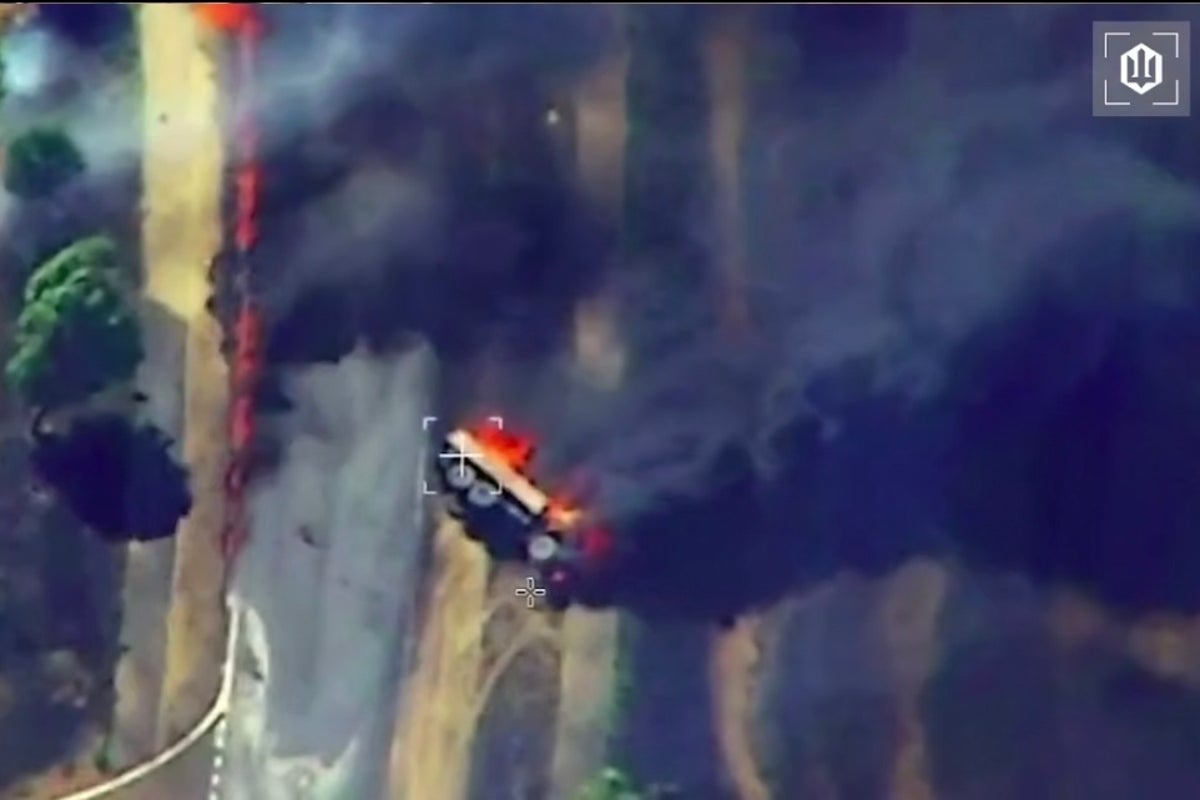
Another day, another compressed, heavily filtered clip of a fuel tanker exploding into a brilliant orange fireball. The internet treats these drone strike videos like digital dopamine hits. Social media feeds flood with applause, cheering on the fiery spectacle as definitive proof of battlefield momentum.
It is military illiteracy disguised as entertainment.
I spent years analyzing logistics chains and fuel distribution networks for state-level operations. When I watch the mainstream media salivate over a burning truck, I do not see a turning point in a conflict. I see a tactical distraction masking a profound strategic failure to understand how modern logistics actually survive.
The lazy consensus is simple: blow up the fuel truck, starve the front lines, win the war. It sounds great on a smartphone screen. It plays well to algorithms designed to reward instant destruction. But modern petroleum logistics do not operate like a localized gas station delivery route. They are redundant, decentralized, and built precisely to absorb high-attrition losses without blinking.
Let us dismantle the theater of the burning truck.
The Mirage of Tactial Destruction
Every time a drone clips a tanker, commentators rush to declare the immediate paralysis of mechanized brigades. They calculate the gallons lost, multiply it by an assumed fuel burn rate of a T-90 or a Leopard tank, and proclaim an impending operational standstill.
This is amateur hour.
Armies do not transport fuel in single, vulnerable convoys trundling down exposed highways hoping for the best, unless leadership has completely lost its mind. Real supply lines utilize a massive buffer of buried regional bladders, rail-to-truck transfer nodes, and flexible pipeline segments that can be patched in hours. A single truck going up in flames is a rounding error on a spreadsheet.
I have watched organizations spend millions on high-end munitions to destroy low-cost civilian-grade chassis carrying diesel, celebrating the secondary explosion like they just crippled an entire army group. Meanwhile, three miles away, a hardened secondary pumping station is quietly routing fuel through an alternate vector.
The media loves the footage because fire is visual. Fire makes good television. Fire generates clicks. But war is not decided by pyrotechnics. It is decided by throughput capacity and redundancy ratios.
The Logistics Fallacy Everyone Ignores
Let us address the core question driving these viral moments: Does destroying fuel supply vehicles fundamentally alter the strategic balance of a mechanized engagement?
The answer is a flat no, and the reason exposes a deep misunderstanding of attrition warfare.
When you target supply trucks, you are engaging in the logistics equivalent of trimming the lawn with nail clippers while the root system remains underground. A fuel truck is a consumable asset. It is cheap. It is easily replaced by commercial equivalents requisitioned from the civilian sector. You can blow up fifty tankers a week, and a resilient logistics apparatus will simply divert reserves from deep strategic storage hubs that you cannot reach with tactical FPV drones.
To actually choke an army of its fuel, you have to destroy the refining capacity at the source, the cracking towers, the catalytic converters, and the high-voltage electrical substations feeding the regional grids. A burning tanker on a dirt road is a localized tactical event. It alters the timeline of a single platoon for perhaps four hours. It does not stop a war.
Yet, we continue to feed the public a steady diet of tactical pornography. We confuse the destruction of a minor node with the dismantling of a network.
The Brutal Reality of Distributed Supply
Think about how modern supply chains adapted to commercial drone warfare over the past three years.
Imagine a scenario where a logistics commander relies on a linear route. Ten years ago, that worked. Today, linear logistics is suicide. Smart commands have transitioned to a mesh network of supply nodes. Fuel is cached in smaller, dispersed quantities. It moves under heavy camouflage during specific atmospheric conditions—low fog, heavy cloud cover, electronic jamming windows.
When an isolated tanker gets hit on camera, it is almost always one of two things:
- A deliberate decoy route designed to draw out counter-battery fire or waste expensive loitering munitions.
- A calculated loss from a secondary, low-priority supply tail designed to keep the primary arteries clear.
Commanders do not cry over a lost tanker. They factor attrition rates into their daily fuel requisition orders the same way a restaurant owner factors food spoilage. When you treat supply losses as a fixed operational cost, blowing up a truck ceases to be a victory. It becomes background noise.
The Danger of Visual Bias
We are suffering from a dangerous cognitive bias in modern conflict analysis: the belief that what can be filmed is what matters.
If a drone does not capture it in 4K resolution with a dramatic drone operator soundtrack, analysts pretend it did not happen. They ignore the silent, unglamorous mechanics of rail logistics, pipeline maintenance, and deep-storage inventory management because those things do not go viral on social platforms.
This visual bias warps policy decisions. It creates public pressure to supply specific tactical weapons based on how cool the compilation videos look on the internet, rather than what is required to systematically dismantle an adversary's industrial capacity.
We are optimizing for likes, retweets, and morale boosts while ignoring the grinding, unsexy math of attrition.
Stop looking at the fireball. Start looking at the balance sheet of production versus consumption. Until the supply sources are permanently choked at the refinery level, every burning fuel truck is just expensive firewood for a war machine that has already factored your ammunition waste into its budget.