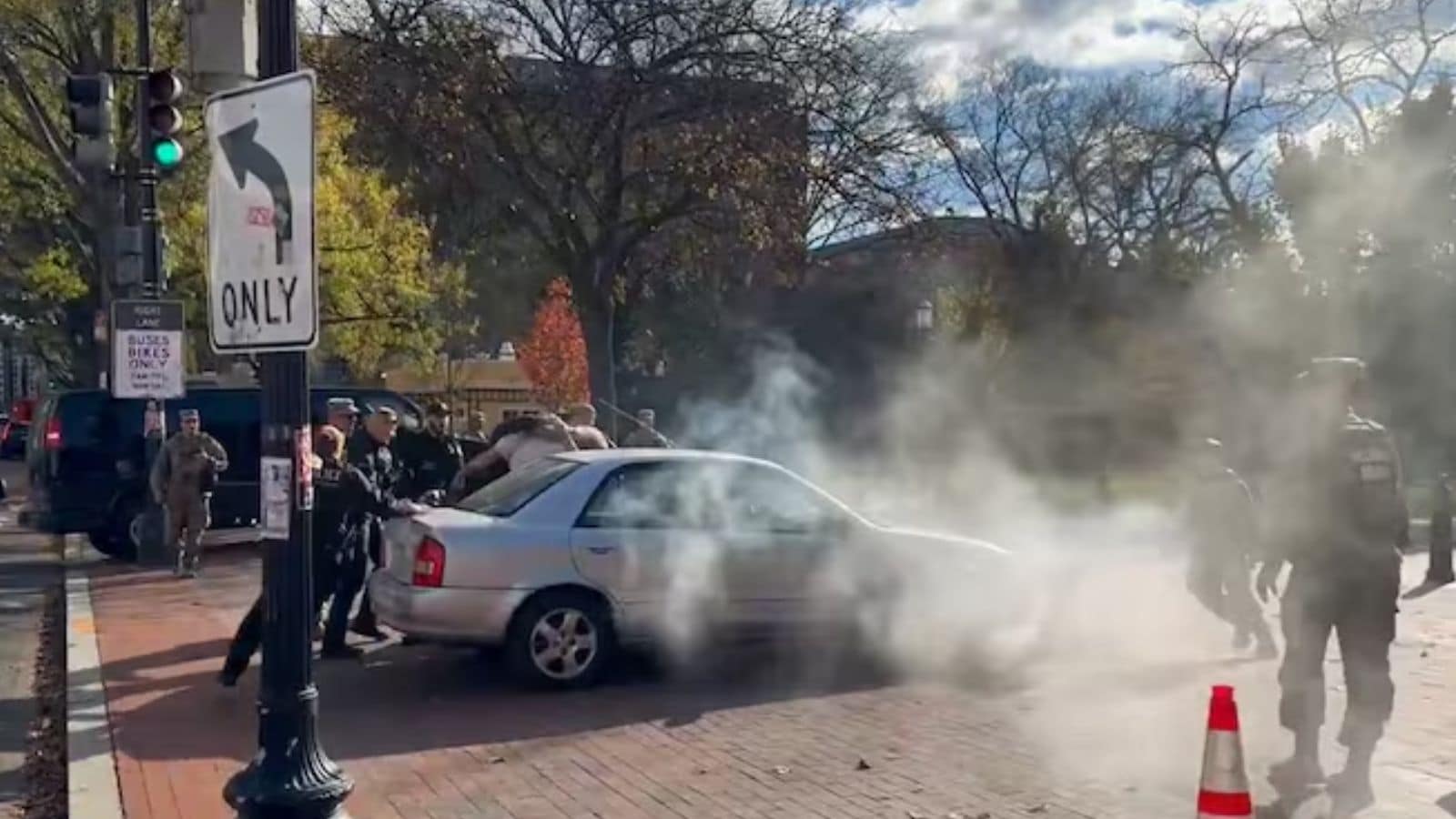
A driver loses control near Lafayette Square, clips a metal signpost, and within twenty minutes, cable news chyrons are flashing red and black SUVs are swarming the perimeter. The standard coverage treats this like a near-miss assassination attempt. Reporters stand outside the fence, breathless, reciting the boilerplate statement from the Secret Service about "tightened security protocols" and "an ongoing investigation."
It is predictable. It is dramatic. And it completely misses the point of how physical security actually works.
When the media reports that White House security has been "tightened" after a vehicle strikes a signpost on the outer perimeter, they are selling a comforting fiction: that the fortress was vulnerable, a breach occurred, and the authorities are now fixing a gap. The reality is the exact opposite. A car hitting a signpost or a bollard on the edge of Lafayette Square is not a security failure. It is proof that the multi-layered defense architecture designed decades ago is functioning precisely as intended.
Yet, every single time a fender bends near Pennsylvania Avenue, the public is fed a narrative of escalating danger and reactive fortification. If you want to understand what is actually happening around 1600 Pennsylvania Avenue, you have to strip away the sensationalism and look at the cold mechanics of perimeter engineering, threat assessment, and the dangerous trap of security theater.
The Myth of the "Tightened" Perimeter
Let us dismantle the lazy consensus first. Mainstream coverage implies that security at the White House is a static wall that gets reinforced only when someone bumps into it. When a headline reads "White House security tightened after vehicle hits Lafayette Square signpost," the average reader pictures guards suddenly realizing that cars can drive on roads, scrambling to put up extra barricades.
That is nonsense.
The physical security perimeter of the White House complex is one of the most heavily engineered, obsessively modeled environments on Earth. It is not designed by bureaucrats reacting to Tuesday’s traffic accidents; it is built by structural engineers, ballistics experts, and behavioral psychologists operating on the principles of Crime Prevention Through Environmental Design (CPTED) and Defense-in-Depth.
In physical security, a signpost, a planter, a curb, and a hydraulic bollard are not passive street furniture. They are kinetic energy absorbers and channeling mechanisms. Lafayette Square itself acts as a massive standoff zone. Following the 1995 Oklahoma City bombing and the 2020 civil unrest, the pedestrianization of Pennsylvania Avenue and the installation of anti-climb fencing turned the area north of the White House into a deliberate buffer.
When a vehicle strikes a signpost in that zone, the perimeter has not been breached. The outer ring has done its job: it detected, deflected, and arrested momentum long before a threat could reach the inner sanctum. Claiming security was "tightened" afterward is mostly public relations choreography. Putting up extra yellow tape, temporarily closing a sidewalk to tourists, and parking three more cruisers on H Street does not make the President safer. The structural steel buried four feet beneath the asphalt was already doing the heavy lifting.
Why Reactive Security Actually Creates Blind Spots
I have spent years consulting on high-risk physical infrastructure, and I have seen organizations blow millions of dollars on reactive panic. An incident happens at Gate A, so the executive team demands triple guards, concrete barriers, and invasive bag checks at Gate A. Meanwhile, they leave the loading dock at Gate C completely unmonitored because nothing happened there last week.
Security experts call this the availability heuristic, and it is the enemy of real protection.
When agencies respond to a minor perimeter collision with visible, aggressive force—closing off entire city blocks, deploying tactical teams for a fender-bender, expanding the "frozen zone" around Lafayette Square—they fall into two traps:
- Resource Misallocation: Every Uniformed Division officer pulled off a behavioral observation post to stand watch over a bent signpost is an officer who is no longer watching the crowd for actual pre-attack indicators. High-visibility posturing drains manpower from low-visibility intelligence.
- Desensitization and Friction: When you treat every traffic accident like a terrorist incursion, you desensitize both the public and the security personnel. Worse, you choke off the civic life of the capital. Lafayette Square is historically known as "the people's park." Turning it into a permanent, sterile military dead-zone every time a commuter swerves to avoid a pothole destroys the very democratic accessibility the complex is meant to symbolize.
Bruce Schneier, the renowned security technologist, famously coined the term security theater to describe countermeasures that provide the feeling of security instead of the reality of it. Deploying heavy tactical units after a minor vehicular incident at the outer edge of a multi-tiered fortress is pure theater. It reassures the television audience that "something is being done," while adding zero substantive protection against a sophisticated adversary.
What the Headlines Refuse to Ask
If you are looking at a news report about a car hitting a signpost near the White House, the standard "People Also Ask" questions—Is the President safe? How close did the car get? Will they build a bigger wall?—are entirely the wrong questions.
The President was never in danger. The car did not get close to the Executive Mansion. And building a bigger wall solves nothing.
Here are the questions an actual security analyst asks when an incident like this hits the wire:
Was it mechanical failure, medical emergency, or a probe?
Not every vehicle incident near a federal building is ideological. Washington, D.C. has notoriously chaotic traffic patterns, confused tourists, and medical emergencies behind the wheel. However, intelligence agencies look closely at probing behavior. Adversaries—whether state-sponsored actors or lone-wolf extremists—frequently test response times. They want to see how fast the Secret Service Uniformed Division deploys, which intersections get locked down first, and where the blind spots in camera coverage appear during a commotion. The real story is never the bent signpost; it is whether the driver had a burner phone and a stopwatch.
How did the bollard array perform under real-world stress?
Engineers spend lifetimes simulating crash dynamics using ASTM F2656 standards, which rate perimeter barriers based on their ability to stop a 15,000-pound truck traveling at 50 miles per hour. Every real-world impact—even a low-speed collision with a signpost or curb—provides empirical data on approach angles, sightlines, and driver reaction times. Did the street layout inadvertently funnel the vehicle toward a pedestrian cluster? Did the signpost shear cleanly as designed, or did it become a secondary projectile? Those are the metrics that actually drive engineering upgrades, not cable news panic.
Are we trading long-term resilience for short-term optics?
Every time the perimeter expands outward, it becomes harder to defend. A larger perimeter requires exponential increases in personnel, sensors, and maintenance. If the Secret Service responds to minor outer-ring incidents by permanently pushing the fence line further into downtown D.C., they stretch their own operational bandwidth thinner.
The Uncomfortable Truth About Physical Fortresses
To be completely candid, my approach—resisting reactive lockdowns and keeping public spaces open—carries an undeniable downside. It requires accepting a baseline level of visible risk.
If you keep Lafayette Square open to tourists, commuters, and protesters, cars will occasionally crash near the perimeter. People will occasionally climb the outer fence. Someone will occasionally throw a backpack over the rails. To the untrained eye, these incidents look like chaos and vulnerability. Politicians hate them because they generate terrible headlines, and agency directors hate them because they trigger congressional inquiries.
The alternative, however, is far worse. The alternative is turning the seat of the American government into a bunker—a sterile, concrete exclusion zone completely severed from the city around it.
Look at the evolution of embassy architecture following the 1998 East Africa bombings. Under the Inman Standards, the U.S. began building diplomatic compounds miles outside city centers, surrounded by 100-foot setbacks, blast walls, and concertina wire. They became virtually impenetrable to car bombs. They also became completely isolated from the local populations they were meant to engage with, turning diplomats into prisoners of their own security apparatus.
The White House cannot afford to become an Inman-style bunker. Its power relies on its visibility and its integration into the fabric of Washington, D.C. The engineers who designed its current security architecture knew this. That is why they built an invisible fortress: pressure sensors beneath the turf, infrared beams across the colonnades, sniper overwatch on the roof, and subterranean crash barriers disguised as historic streetscapes.
How Real Perimeter Defense Actually Works
If you want to understand why a signpost collision is a non-event for real professionals, you have to understand the onion model of physical security.
- Layer 1: Deterrence and Detection (The Outer Streetscape). This includes traffic calming measures, cameras with automated license plate recognition, behavioral detection officers blending into crowds, and standard municipal infrastructure like curbs and signposts. A car hitting a signpost happens here. It is miles away—metaphorically and operationally—from the target.
- Layer 2: Denial and Delay (The Hardened Perimeter). This is the anti-climb fencing, the K12-rated retractable bollards, and the guard booths. Even if a driver intentionally weaponizes a heavy vehicle, this layer is engineered to shred the engine block and stop the chassis dead in its tracks within three feet of impact.
- Layer 3: Interdiction (The Grounds). The North and South Lawns are not empty grass; they are heavily monitored kill-zones covered by overlapping fields of fire, canine units, and counter-assault teams who can deploy in seconds.
- Layer 4: The Hardened Core (The Residence). Ballistic glass, reinforced concrete, independent air filtration, and secure subterranean bunkers.
When a sedan clips a signpost on the edge of Lafayette Square, it has barely scratched the outermost skin of Layer 1. Treating that collision as a major security breach is like claiming a bank vault was compromised because someone backed into a parking meter across the street.
Stop Rewarding the Panic
The next time a breaking news alert flashes across your screen announcing that White House security has been "tightened" after a minor incident on the outer perimeter, recognize it for what it is. It is a media reflex designed to monetize anxiety, paired with an institutional reflex designed to project control.
Real security is quiet. It is proactive, mathematical, and deeply unglamorous. It lives in the metallurgical grade of a steel bollard, the turning radius of an intersection, and the quiet vigilance of an plainclothes officer watching crowd dynamics—not in the theatrical deployment of flashing lights after a fender-bender.
Don't fall for the yellow tape. Look at the steel underneath.