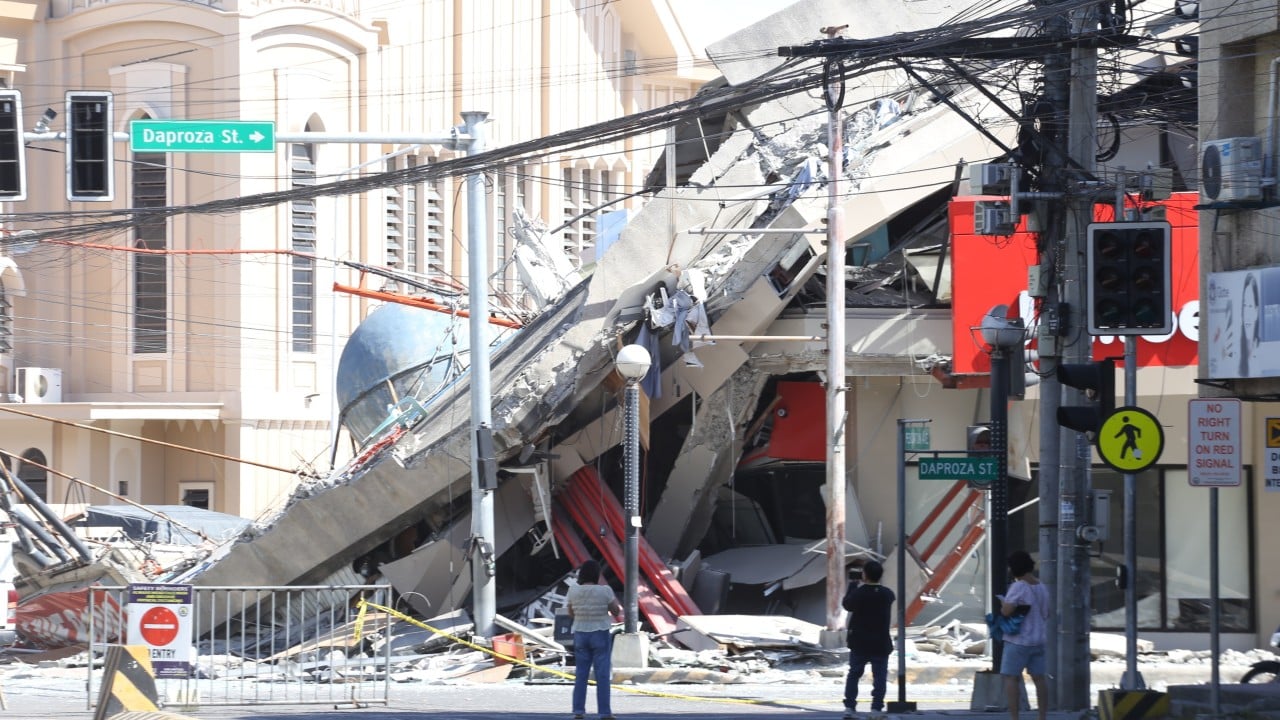
The standard disaster headline follows a script written decades ago. A magnitude 6.0 or 7.0 earthquake strikes a region like the Philippines. The body count hits 37. Immediately, newsrooms blast out generic copy focusing on "unpredictable nature," "tragic acts of God," and the heroic race to dig through the rubble.
It is lazy journalism. More importantly, it is bad science.
Earthquakes do not kill people. Bad structural engineering kills people.
When a nation sitting on the Pacific Ring of Fire suffers casualties from a moderate tectonic event, the discussion should not be about the unpredictability of the earth. We know exactly where the faults are. The discussion must be about the systemic, bureaucratic failure of infrastructure, the grift in municipal concrete procurement, and our obsession with reactive rescue operations over proactive structural reinforcement.
We need to stop treating these events as tragic surprises. They are entirely predictable engineering failures.
The Magnitude Myth
The public has been conditioned to look at the Richter scale or the Moment Magnitude Scale ($M_w$) as the ultimate metric of a disaster's severity. When the media reports a "major quake," they imply the destruction was inevitable due to the sheer kinetic energy released.
This is a fundamental misunderstanding of seismology and structural dynamics.
The energy of an earthquake propagates through seismic waves, but the destruction at the surface is governed by peak ground acceleration (PGA) and local soil conditions. A lower-magnitude event shallowly centered beneath a city built on soft alluvial soil will cause exponentially more devastation than a massive magnitude 8.0 quake deep in the crust beneath bedrock.
Consider the mechanics. Structural failure occurs when the natural frequency of a building resonates with the frequency of the seismic waves. This is a solvable math problem. Engineers use tuned mass dampers, base isolation systems, and ductile detailing to ensure buildings flex rather than snap.
When a building collapses in a seismically active zone during a moderate event, it is not an act of nature. It is a design crime. I have spent years looking at post-disaster structural failures. The story is always the same: unreinforced masonry, insufficient rebar lap lengths, or concrete mixed with too much water to cut corners on costs.
The Heroism Trap in Rescue Operations
Every camera crew rushes to capture search and rescue teams pulling survivors from the debris. It is compelling television. It makes for emotional storytelling.
It is also an incredibly inefficient allocation of crisis capital.
Urban Search and Rescue (USAR) operations are astronomically expensive, highly dangerous, and yield diminishing returns within 48 hours of the initial shock. The "Golden Hour" logic of trauma medicine applies heavily here, yet millions of dollars are poured into sending international heavy-rescue teams across borders days after the event.
| Phase | Timeframe | Primary Action | Cost-to-Benefit Ratio |
|---|---|---|---|
| Proactive | Years Before | Code Enforcement & Retrofitting | Exceptionally High |
| Immediate | 0–24 Hours | Local Community Extraction | High |
| Delayed | 48+ Hours | International USAR Deployment | Extremely Low |
We are funding the ambulance at the bottom of the cliff instead of building a fence at the top.
If governments redirected just 15% of the capital reserved for post-disaster recovery and international aid into subsidizing simple carbon-fiber wrapping for concrete columns in high-risk zones, the death toll of these events would plummet to near zero.
But prevention is invisible. You cannot stage a photo-op in front of a building that didn't collapse.
The Flawed Premise of Earthquake Prediction
Go to any online forum or comment section during a tectonic event and you will see the same questions: Why can't scientists predict these yet? Why aren't we investing more in early warning AI?
The entire premise of the question is flawed. You are asking for a weather forecast for things happening twenty miles beneath solid rock.
Earthquake prediction—specifying the exact time, location, and magnitude of an event before it happens—is a statistical impossibility due to the chaotic nature of stress accumulation along fault lines. Seismologists like those at the Philippine Institute of Volcanology and Seismology (PHIVOLCS) or the USGS focus on probabilistic hazard assessments. They tell us where quakes will happen over a 50-year window.
That is all the data we need. If you know a fault line has a 70% chance of rupturing in the next half-century, knowing the exact Tuesday it happens shouldn't matter. Your buildings should already be ready for it.
Investing billions into chasing the holy grail of short-term prediction is a distraction. Even if we had a ten-minute warning system deployed globally, it does not save a city if the housing stock consists of unreinforced brick structures that collapse in four seconds.
The Hard Truth of Strict Enforcement
The contrarian approach to seismology is simple: fire the planners and hire ruthless inspectors.
The gold standard remains Japan. In 2011, the Tohoku earthquake struck. It was a magnitude 9.0—releasing roughly 8,000 times more energy than the recent Philippines event. The seismic shaking itself killed relatively few people; the subsequent tsunami caused the vast majority of casualties. Why? Because Japan enforced its Shin-Taishin building codes enacted in 1981 without exception.
In developing economies, the issue isn't the lack of a building code. The Philippines has the National Building Code (PD 1096), which is structurally sound on paper. The breakdown occurs at the municipal level, where building permits are traded like commodities, and site inspections are bypassed via bureaucratic compliance theater.
The downside to enforcing this strictly is economic stagnation in the short term. Upgrading building stocks increases construction costs by 10% to 20%. It prices low-income residents out of informal settlements and halts rapid urbanization. It requires political will that outlasts a four-year election cycle.
It is a brutal trade-off. But the alternative is continuing to accept a body count every time the tectonic plates shift an inch.
Stop looking at the rescue dogs. Look at the building permits.