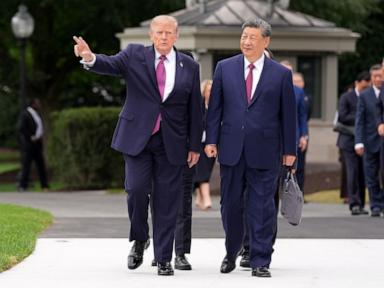
Geopolitical summits involving major economic powers rarely resolve foundational technological security dilemmas. When high-level diplomatic meetings touch upon frontier technologies, public discourse typically bifurcates into exaggerated optimism or cynical dismissal. Evaluating whether international stability regarding artificial intelligence risk improved following the high-stakes meeting between Donald Trump and Xi Jinping requires stripping away diplomatic rhetoric to analyze structural incentives, verification mechanisms, and the mechanics of technological diffusion.
The Structural Mechanics of Bilateral Artificial Intelligence Competition
To understand the impact of any diplomatic engagement on catastrophic risk, one must first isolate the core variables driving escalation. Bipolar technological competition between the United States and China differs fundamentally from historical nuclear arms races due to several distinct economic and structural properties.
Dual-use velocity represents the primary challenge. Unlike enriched uranium or ballistic missile components, high-performance computing hardware, foundational model architectures, and automated reasoning systems possess ubiquitous commercial applications. The economic penalty for supply chain restriction is immediate, whereas the realization of catastrophic model misuse or autonomous escalation scenarios remains probabilistic and temporally distant. Consequently, political leaders face a structural mismatch in incentives. Short-term economic optimization constantly pressures executives and state planners to loosen export controls, while long-term catastrophic risk management demands friction, auditing, and verification.
Commercial Demand (Velocity) ---> Economic Optimization ---> Relaxation of Controls
                                                                    vs.
Probabilistic Catastrophic Risk -> Long-Term Planning  ---> Friction and Auditing
When heads of state convene, the resulting communiques generally reflect a lowest-common-denominator compromise between these conflicting pressures. Declarations of intent to cooperate on safety standards or risk identification frameworks are politically frictionless to sign, yet operationally hollow unless tied to verifiable constraints on compute acquisition and algorithmic scaling.
Deconstructing the Diplomatic Signal Versus Operational Reality
A rigorous analysis of summit outcomes requires separating symbolic stabilization from structural risk reduction. Strategic stability in technical domains rests on three concrete pillars: transparent signaling, verification capability, and crisis communication architecture.
Symbolic commitments to manage technological development do not alter the underlying security dilemma. In game-theoretic terms, both nations operate under a dominant strategy of unilateral capability maximization. If State A decelerates its algorithmic training runs to mitigate unaligned model behavior, while State B defects and captures a decisive advantage in automated cyber offense or autonomous decision support, State A faces existential strategic subordination.
Therefore, any meaningful reduction in risk requires enforceable verification protocols. Historically, high-level summits provide the political authorization for technical working groups to begin exploring guardrails. However, the verification deficit in artificial intelligence is profound. Unlike nuclear warheads, which require physical footprints, specialized facilities, and observable supply chains, advanced models can be trained, distilled, and deployed across decentralized clusters. A bilateral agreement that lacks provisions for on-site hardware inspection, runtime monitoring of frontier compute clusters, and algorithmic auditing is structurally incapable of altering the trajectory of existential risk.
The Diffusion Problem and Multipolar Leakage
A major oversight in bilateral risk assessment is the assumption that international stability is a two-actor game. Advanced machine learning architectures, once developed, undergo rapid geographic and commercial diffusion. Even in a counterfactual scenario where Washington and Beijing establish a rigid, bilateral condominium to govern model training thresholds, the global market for open-weights models and distributed compute ensures leakage.
State actors outside the primary bilateral axis, as well as non-state entities, operate within an environment of declining marginal costs for frontier capabilities. As hardware becomes more efficient and algorithmic breakthroughs reduce training requirements for high-performance models, the leverage provided by bilateral diplomatic summits diminishes rapidly.
This introduces a severe structural limitation to summit-based risk mitigation. By focusing exclusively on the primary geopolitical rivals, negotiators often mistake bilateral détente for systemic stabilization. If the capability to deploy hazardous autonomous systems or engineer novel biological pathways diffuses to secondary actors, bilateral agreements between major powers serve primarily to manage their own competitive escalation while leaving systemic vulnerabilities unaddressed.
Incentives for Unilateral Restraint and Safety Research
In the absence of verifiable international treaties, risk reduction relies on unilateral architecture and domestic constraint. The economic dynamics of the private sector heavily influence this domain. Frontier labs operate in a high-stakes commercial race where safety expenditures compete directly with capability scaling.
When political summits yield vague statements regarding responsible innovation, they fail to alter the internal corporate cost-benefit analysis. A laboratory that unilaterally implements rigorous red-teaming, slow-roll deployment schedules, and interpretability research bears the full commercial cost of delay while capturing only a fraction of the global safety benefit.
To shift this baseline, policy interventions must alter the domestic liability and compliance structures within each nation. Diplomatic summits succeed only to the extent that they compel or provide cover for domestic regulators to enforce strict compute ceilings, mandatory reporting thresholds for large-scale training runs, and rigorous pre-deployment audits. Without domestic statutory backing, summit declarations remain diplomatic theater.
Strategic Forecast and Operational Priorities
Assessing whether the world is safer requires measuring concrete operational shifts rather than rhetorical alignments. The meeting between Trump and Xi did not alter the fundamental drivers of technological competition, nor did it establish the verification infrastructure required to prevent unconstrained algorithmic scaling or autonomous escalation.
Risk reduction requires abandoning the hope that high-level diplomatic handshakes can substitute for enforceable technical architecture. Strategic planners must focus on three immediate operational priorities:
- Establishing domestic liability regimes that internalize the tail risks of frontier model deployment, forcing commercial entities to price safety into their scaling decisions.
- Developing hardware-level tracking and cryptographic attestation standards for high-end accelerator chips to monitor aggregate compute accumulation.
- Building robust, independent technical evaluation protocols that function independently of diplomatic cycles or commercial pressures.
Until these structural mechanisms replace rhetorical commitments, fluctuations in high-level political tone will have negligible impact on the baseline trajectory of systemic artificial intelligence risk.