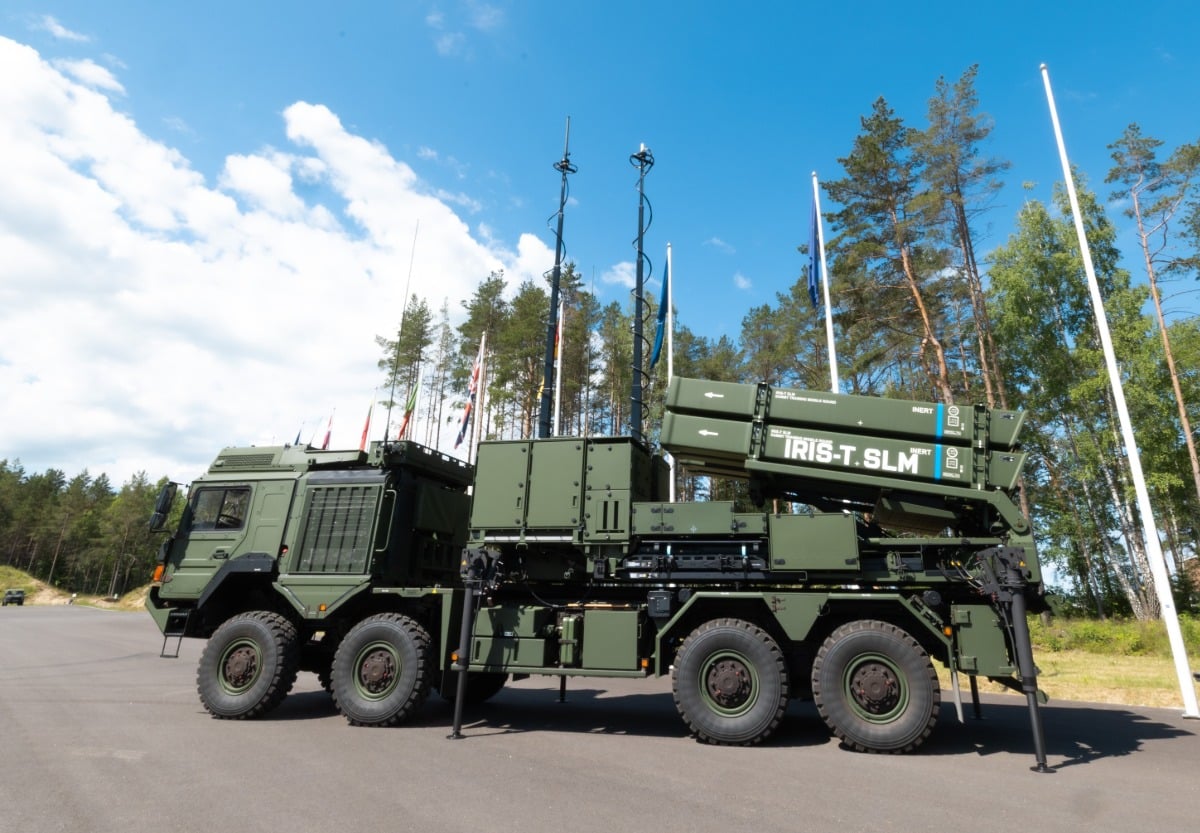
Estonia just bought the IRIS-T SLM air defense system, and the defense media is celebrating like Tallinn just built an impenetrable dome. The narrative is comforting: Ukraine used it, it shot down Russian cruise missiles with near-perfect interception rates, so Estonia is now safe.
That narrative is dangerously naive.
Buying an air defense battery is not the same as buying security. The defense establishment is suffering from a severe case of hardware fetishism, treating single weapon systems as magic wands. In reality, transplanting a system that succeeded in the vast, deep battlespace of Ukraine into the narrow bottleneck of the Baltics changes the strategic math entirely. Estonia hasn't solved its airspace problem; it has just given its adversary a high-value target to destroy in the first ten minutes of a conflict.
The Myth of the Ukraine Copy-Paste
The lazy consensus relies entirely on the combat record of the IRIS-T in Ukraine. Diehl Defence built a phenomenal piece of engineering—nobody denies that the active radar-guided missile is highly capable. But weapon systems do not fight in a vacuum. They fight within geographies and systems of scale.
Ukraine is the second-largest country in Europe by area. When Russia launches a Kh-101 cruise missile from a bomber over the Caspian Sea, Ukrainian air defenders have hours of early warning. They have deep territory to track, predict, and position assets.
Estonia has no such luxury.
The distance from the Russian border to Tallinn is roughly 200 kilometers. A supersonic missile crossing that border gives operators minutes, sometimes seconds, to react. More importantly, the lack of strategic depth means an IRIS-T battery in Estonia cannot hide. In Ukraine, batteries move across thousands of square kilometers of varied terrain. In Estonia, the deployment options are geographically choked. You cannot copy and paste a defensive strategy when your entire country is smaller than many Ukrainian oblasts.
The Logistics Trap Nobody Wants to Calculate
Let’s look at the brutal math of missile attrition.
An IRIS-T SLM launcher holds eight missiles. A standard fire unit typically comprises three mobile launchers, a radar, and a command post. That is 24 ready-to-fire missiles.
What happens when an adversary launches a saturation attack? During major strikes on Ukrainian infrastructure, Russia routinely deployed waves of cheap Shahed-136 kamikaze drones specifically designed to draw fire, followed immediately by ballistic and cruise missiles.
If Estonia fires its ready-to-use missiles to intercept a wave of cheap drones, the battery is dry. Reloading a tactical air defense system isn't like changing a magazine in a rifle. It requires heavy logistics vehicles, cranes, and time—all while operating under a compromised radar signature. I have seen defense planners run simulations where multi-million-dollar batteries are rendered completely useless within the first twenty minutes of an engagement simply because their reload logistics were targeted or delayed.
Furthermore, Europe’s defense industrial base cannot produce these missiles fast enough. If Estonia burns through its initial inventory in week one, there is no magical warehouse in Germany waiting to top them off overnight.
The False Security of Medium-Range Systems
The IRIS-T SLM is a medium-range system, effective up to about 40 kilometers horizontally and 20 kilometers vertically. It is designed to intercept cruise missiles, aircraft, and drones.
It does not intercept heavy ballistic missiles like the Iskander-M.
By investing heavily in medium-range coverage, Estonia leaves a glaring vulnerability at the top of the envelope. An adversary facing an IRIS-T setup will simply bypass it by utilizing high-altitude ballistic trajectories or hypersonic assets. Without a multi-layered architecture—combining short-range systems like Mistral or Piorun with long-range, ballistic-capable systems like Patriot or Israel's Arrow 3—a medium-range system acts as a fence with a wide-open gate next to it.
Worse, an isolated radar asset is a magnet for anti-radiation missiles like the Kh-31P. Once the main radar of the IRIS-T system is knocked out by a high-speed, radiation-homing missile, the entire multi-million-euro battery becomes an expensive collection of trucks.
The Real Alternative: Asymmetric Air Denial
If buying standard Western air defense systems isn't the silver bullet, what is? The answer lies in shifting the paradigm from air defense to asymmetric air denial.
Instead of buying a few highly centralized, extraordinarily expensive targets like the IRIS-T, smaller nations should focus on mass distribution of low-signature assets.
- Radical decentralization: Hundreds of MANPADS (Man-Portable Air-Defense Systems) embedded within highly mobile infantry units create an unpredictable, distributed network that cannot be wiped out in a single preemptive strike.
- Passive sensor networks: Relying less on active radars that scream "here I am" to enemy electronic intelligence, and more on acoustic, optical, and passive radio-frequency tracking networks.
- Offensive counter-air capabilities: The best air defense is often a long-range drone or loitering munition striking the enemy aircraft or missile launchers while they are still on the ground inside enemy territory.
Admitting this requires admitting a hard truth: a small nation near a major military power cannot realistically protect every square meter of its airspace using conventional methods.
The Actionable Pivot for Baltic Security
Estonia’s acquisition is done, and the hardware will arrive. The task now is to mitigate the inherent flaws of the purchase.
First, integration into the wider NATO Integrated Air and Missile Defense (IAMD) must be absolute, not theoretical. The Estonian IRIS-T units must be fed data from airborne AWACS and regional naval assets continuously so they can operate in "radar silent" modes until the absolute moment of firing.
Second, the state must aggressively fund decoy operations. For every real IRIS-T launcher on the field, there should be five high-fidelity inflatable or wooden decoys with thermal and electromagnetic signatures designed to waste the enemy's expensive suppression-of-enemy-air-defense (SEAD) munitions.
Stop celebrating the purchase of hardware as if it is the achievement of safety. Security is measured by your capacity to sustain a beating and keep fighting, not by the price tag of the target you just painted on your own back. Treat the IRIS-T as a fragile, high-maintenance component of a much larger, uglier survival strategy—or watch it burn early in the opening act of a crisis.


